

The Places That Hold Us
On losing a gym, losing third places, and building containers the system can’t monetize

There is a kind of grief most of us do not have language for.
It is not the grief of losing a person. It is the grief of losing a place that helped you stay a person.
A room you returned to when the world was too much. A set of faces that became familiar enough to be safe. A ritual of showing up that taught your nervous system, slowly, that you did not have to carry everything alone.
We live in a culture that treats places like products. If the product stops performing, it gets rebranded or erased. But humans do not experience places as products. We experience them as containers, as anchors, as the kind of ordinary holy ground where life can move again.
This is a story about my gym closing. It is also a story about the quiet demolition of third places, and the stubborn work of resistance, which is building new containers when the old ones get taken.
Watch or Listen
The Whole Story
Last Friday, I heard the rumor. The kind of rumor that arrives like a hairline fracture. Nothing breaks yet, but you feel the structure shift.
Then Tuesday it became official. The Gravity Haus Denver Clubhouse is closing. The last day is April 30th. Six weeks from now.
At one level, this is a story about my gym closing. At a deeper level, it’s a story about what happens when the spaces that hold our humanity get taken, and what it looks like to build something the system cannot monetize.
A place becomes an anchor
As a bit of background, I’ve trained at Gravity Haus for more than four years. But even saying that does not capture the way a place can become a nervous system anchor. It does not name what happens when a room becomes a refuge, not because it is beautiful, but because it is true.
And that last line reveals why the response now is more than going to find a new gym.
The basement that became holy
With Gravity Haus, it was never the physical space that grabbed me.
At first, it was a small black room with turf and odd windows. Light came in at horrible angles at different times of day. Nothing about it felt curated for transcendence.
Then, last May, it moved into the basement of an office building. Yes, they added coworking to go along with the gym, but to get there, you go down concrete stairs into a decorated basement. And as much as they tried to make the basement space look and feel good, the lack of natural light makes it abundantly clear, you’re in a basement.
So if you are trying to picture the sacredness of this place, you need to understand something. It was not an aesthetic holy. It was not the kind of holy that comes from stained glass or mountain views. It was the kind of holy that happens when humans keep showing up.
That means what I’m trying to name here is bigger than a gym. I’m trying to name what it costs us when the spaces where we can be human get erased, and what it looks like to resist that erasure.
Because while it’s about people, people need a places to gather. Bodies need coordinates. Belonging needs a room. A community without a container eventually dissolves into text threads and good intentions. You can love people deeply and still drift if you do not share time and space.
So yes, it was the people. But the basement mattered too. Not because it was impressive. Because it became a shared altar. We made it holy.
We made it holy by returning. By sweating there. By suffering there. By laughing there. By talking about the things that matter most there. By letting the hardest seasons of our lives move through our bodies instead of staying trapped behind our ribs.
Holy is not always what a place is. Sometimes holy is what a place has held. And so that basement became one of the most important places in my life.
Lesson one: covenant, not just coordinates
That is the first lesson. Place is not only geography, and it is not only people. Place is what happens when people and space make a covenant with each other.
And that covenant is not abstract. It is made out of very ordinary materials. It is made out of the concrete stairwell you walk down when you are tired. It is made out of the smell of sweat that is not glamorous, but honest. It is made out of the half-second pause at the bottom of the stairs where you decide, again, to enter. It is made out of a room full of bodies that are not trying to impress anyone, just trying to stay alive.
A snapshot of what this place actually was
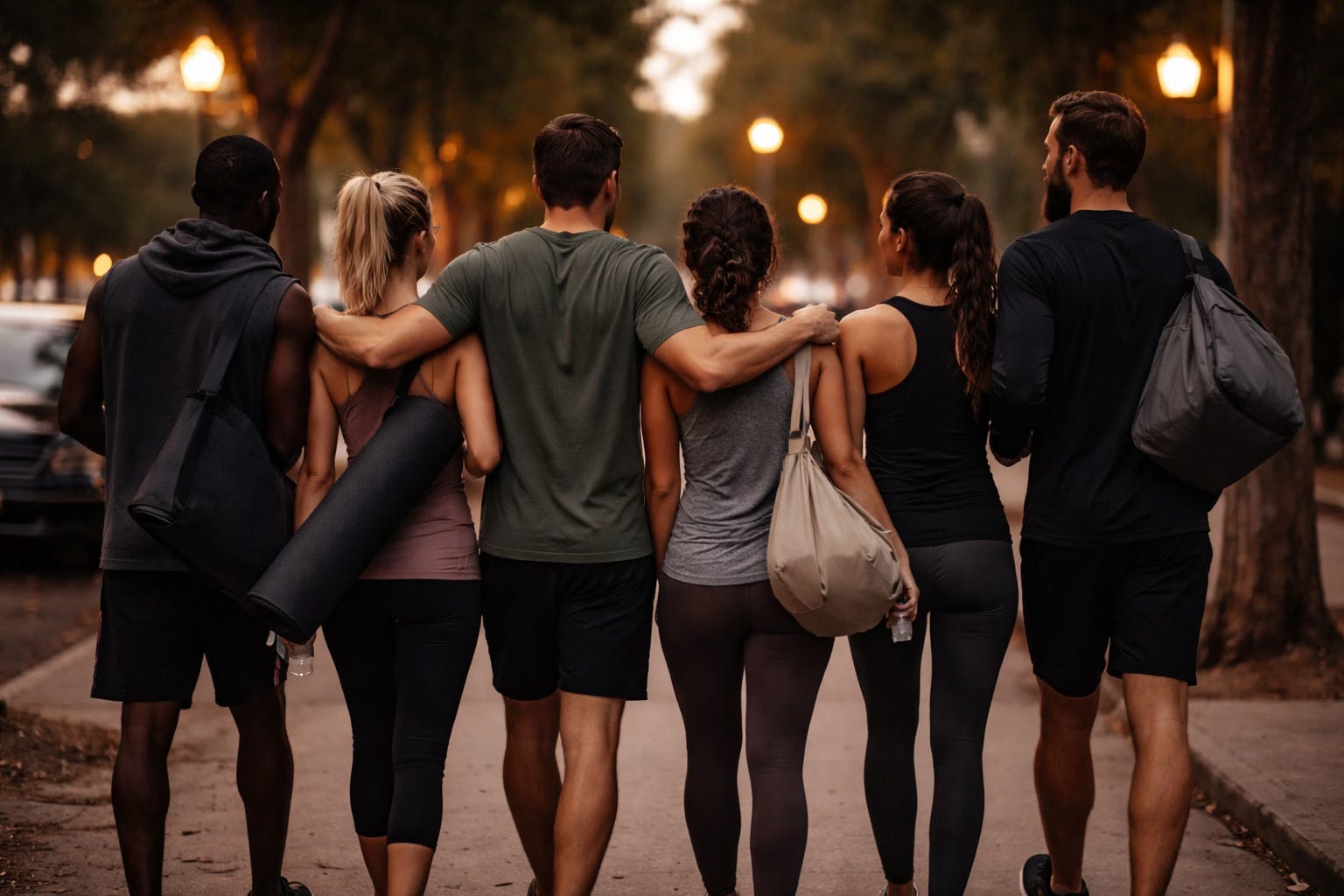
Most days, if you came a few minutes early, you would see the same small scene. People trickling in with the look that says, “I do not know if I have this today.” Water bottles thudding on the floor. Someone rolling out a tight calf. Someone laughing too loud because the laughter is a pressure valve.
And then, inevitably, some small act of recognition. A nod across the room. A “hey, you made it.” A coach looking at you, not like a number, but like a human.
It is hard to describe how much those tiny moments matter when life is heavy. Because even when life is hard, the world does not stop. It keeps demanding productivity. It keeps demanding composure. It keeps demanding that you be fine.
But a third place like this does something different. It does not ask you to be fine. It asks you to show up. And then it gives you a rare gift. It lets your body tell the truth.
The nervous system learns through return
This is why I keep using the language of container. Because what you receive in a place like this is not only fitness. It is capacity.
The nervous system learns safety through repetition, not through slogans. Through return. You walk into the same room. You see the same faces. You do the same warm-up. You suffer the same honest suffering.
And slowly, without you having to force it, your body starts to unclench. Not because your problems are gone, but because for one hour you are not alone inside them.
And when the class ends, something subtle has shifted. Breath is deeper. Jaw is softer. The mind is less frantic. It is not that everything is healed. It is that the grief has moved.
This is the kind of healing that does not come from ideas. It comes from place.
How the place held me
The workouts I did there were class-based. Which means what I really did, five to six days a week, was show up to a shared rhythm. A set time. A familiar suffering. A handful of faces that became steady over the years. People at different times, different days, and somehow it braided into an extended family.
Gravity Haus held me through an abusive relationship, the kind that ends with a permanent restraining order. It held me through my dad’s cancer journey. It held me through my dad’s death. It held me through losing a job.
But it did not hold me by giving me answers. It held me by giving me a container. A place where I could metabolize stress with my body. A place where encouragement came not as a motivational poster, but as a glance, a joke, a simple “good to see you,” a trainer who believed you could do one more rep. A place where grief could move, instead of calcify.
The day I came back
I was never a real gym guy. The first day I showed up, I was completely out of my element. I got my ass kicked. It took three days before I could walk again. And then I came back.
That first week, I went on Monday. Then I came back on Friday, the day before Christmas. It was a tiny class. Just two of us and a trainer. There was some kind of workout pyramid, the Twelve Days of Fitmas. The other person finished in about twenty minutes. At an hour, I was halfway through and dying.
Afterwards, the trainer, the woman who ripped through the workout in no time, and I talked about divorce. I began to think that I’d found my place.
I came three days the next week. Then five days a week after that. It was the first time in my life I made a serious attempt to lift weights.
So a place that initially felt very not-home became the place that felt the most home in my life. And losing a place like that is a real kind of grief. Not because you worship the building. Because what you lose is the container for being human.
The assault on third places
In a disconnected society, we keep losing our third places. Not home. Not work. The in-between spaces where belonging has room to grow. And our nervous systems are paying the price. Because the human animal is not built for floating. We are built for rhythms, relationships, and return.
And the resistance starts here. Not with a grand theory, but with the stubborn insistence on building containers where people can keep showing up.
The email that refused to honor a community
And here is where the righteous fury shows up for me. Not in the fact that a business closes. They can make that choice. It is theirs. But in the way it was handled.
The closure was announced via email. It was positioned like a personal note, like, “you matter, we want you to hear it from us.” Except the email came with the wrong name for some people. Mine came with no name. And it did nothing to acknowledge what those of us who gathered there day after day have built together.
It was basically: We’re shifting the coworker space over to this hotel, we’re closing the gym, and here are other services you can use with your membership.
In other words, we’re rearranging the product offering. But we are not grieving with you. We are not honoring what this place has been. We are not even willing to speak the words: people built a life here.
Capitalism’s spiritual poverty
This is capitalism’s spiritual poverty. Not only extraction of money, but extraction of meaning. A world where the bottom line becomes a god, and humans become collateral. And I want to slow down here, because this is not just a gym story. This is a parable.
We are living through the steady demolition of place, and most of us are not calling it what it is. We call it convenience. We call it modernization. We call it market forces. We call it “they had to make a business decision.” But in the body it lands as exile.
If you have been paying attention, you have seen this script everywhere. Places that held people get shut down, consolidated, optimized, or repositioned. And the human cost is treated like a rounding error.
The system has a particular kind of genius. It learns how to turn everything into a commodity, even belonging. It will sell you community as a subscription. It will sell you wellness as a brand. It will sell you connection as content. But the moment the spreadsheet says the belonging is not profitable enough, it disappears.
You are not failing at being human
This is where I want to name something that feels obvious, and still has to be said out loud. Humans are not built to live placeless. We are not just minds floating through the internet. We are bodies. We are creatures. We are local.
Your nervous system does not bond with concepts. It bonds with rhythms, with faces, with doors you have walked through a thousand times, with the sound of a room you know, with the ordinary miracle of being expected.
This is why a third place matters. Not home. Not work. The in-between place where your life is allowed to be more than survival. Where you are not performing for a paycheck. Where you are not managing the chaos of a household. Where you can simply be a person among people.
And the tragedy is that we are losing these places while being told we are gaining freedom. We are told that being untethered is the dream. Remote work, digital nomadism, constant mobility, frictionless delivery, endless options.
But options are not the same thing as belonging. Endless choice can be a form of starvation. If you can go anywhere, and you belong nowhere, you end up eating connection like junk food. You scroll. You consume. You binge other people’s lives. You let algorithms simulate intimacy.
Then you turn the phone off and the room is quiet, and your body panics, because it is not meant to live without a village.
If you have ever wondered why anxiety is everywhere, why depression is everywhere, why loneliness is everywhere, why so many people feel like they are barely holding it together, I want to offer one answer. We are trying to survive in a world that keeps dissolving the containers that make life survivable.
A cruel god
And here is the more prophetic layer. It is not accidental. The system benefits when you are isolated, because isolated people are easier to manage.
When you do not have community, you have fewer mirrors. Fewer people who can tell you the truth. Fewer people who can interrupt the story that you are alone, that you are the problem, that you should be ashamed.
When you do not have community, you have fewer hands. Fewer people to help you carry the weight. Fewer people to say, “come over, eat, sit, breathe, let’s figure it out.”
When you do not have community, the system becomes your default provider. Your therapist. Your friend. Your distraction. Your god.
And it is a cruel god. Because the system does not love you. It does not know your name. It does not care that you survived an abusive relationship. It does not care that you buried your father. It does not care that you lost a job.
It will take your money, your attention, your energy, your body. And then it will tell you to buy a little more self-care if you are still tired.
This is where I want to speak directly to the part of you that feels that exhaustion. You are not failing at being human. You are trying to be human in a world that is actively hostile to the conditions that make humanness possible.
Holy ground
And that is why a gym can become holy ground. Not because barbells are sacred. Because place is sacred. Because bodies are sacred. Because a community that keeps showing up, week after week, can become a kind of liturgy. A repeated ritual of suffering and laughter and encouragement. A small rebellion against the story that you are on your own.
So yes, I am angry about the email. Not because I want a better customer service experience. Because the email is a window into a deeper contempt.
The contempt says: Your relationships are not real. Your belonging is not real. What you built here is not real. Only the transaction is real.
And I have had enough of that contempt. Because I have watched what place does. Gravity Haus held me through grief and rebuilding. It held me through the unraveling of a life. It held me while I rebuilt a body I did not know I could have. And I know I am not the only one.
Which means this closure is not just an inconvenience. It is a rupture. A rupture in rhythm. A rupture in connection. A rupture in the nervous system’s sense of safety.
So if you are grieving the loss of a place, don’t try to minimize it. You are not being dramatic. You are having an appropriate human response to the loss of a container that held your life.
The counter-story
Now, the next layer. Here is the counter-story I am refusing to let die. Even if a place closes, the people do not have to disappear.
In my own little circle, there are four of us especially close, two guys and two women. We hang out regularly. We are part of each other’s social circles. We are constantly texting, talking, encouraging each other through life.
And the trainers have been fantastic. The programming has changed my body. I put on about twenty pounds of muscle in four years. I am the strongest I have ever been. I feel fantastic at 51.
But beyond that, they are good humans. I consider them friends. Which means the question now is not only, “where will I work out?”
The deeper question is this. How do we practice solidarity when the system shrugs? How do we refuse to let a community get dissolved just because it is not profitable enough for someone’s spreadsheet? How do we keep choosing each other?
Re-creation as rebellion
Because solidarity is not a vibe. It is not a hashtag. It is not a political identity. Solidarity is the slow, stubborn commitment to shared life. It is the decision that my life is bound up with yours. It is the refusal to let the system turn us into consumers of one another instead of kin.
And here is the deeper claim. I do not actually think the opposite of capitalism is simply different policies. Policies matter. But the deeper problem is formation. Capitalism forms us into a particular kind of human, a human who believes they are alone, a human who believes their worth is productivity, a human who believes relationship is optional as long as they can purchase services, a human who believes everything is replaceable, even people.
This is why losing third places is not just sad. It is strategic. Because third places are where solidarity is trained. Third places are where you learn how to be with people outside your family system, outside your workplace, outside your ideological bubble. Third places are where you practice small repair, small kindness, small resilience. Third places are where you remember you are not a machine.
So when those places disappear, we become easier to exploit. And that is why I want to speak prophetically. If we want to stay human, we have to fight for place. Not only for our own comfort, for our collective survival.
We have to grieve what is being taken. And we have to build what the system refuses to build.
This is where I keep thinking about re-creation. Not as escapism. As rebellion. Re-creation means making again, rebuilding, restoring, creating containers where life can take root. It is what happens when the system says, “everything is a transaction,” and we answer, “no, some things are covenant.” It is what happens when the system says, “you are on your own,” and we answer, “no, we are going to make a village.”
Bless what was true
This is what I was getting at in a previous post where I argued that the future grows in cracks.
When a corporate email fails to honor what was sacred, we can still honor it. We can grieve what is ending. And we can bless what was true.
Because one of the system’s quieter violences is this. It tries to convince you that if something ends, it did not matter. But that is a lie.
A place can be real, and still be temporary. A community can be sacred, and still be fragile.
The diaspora
So what does that mean for the Gravity Haus diaspora? It means we grieve, not only the inconvenience, but the rupture. It means we tell the truth about how it landed, not to stew in it, but to refuse the gaslighting.
It means we gather. We’re gathering on WhatsApp. We are planning social gatherings. We are talking about future gym possibilities. We are sorting out how we can keep choosing each other.
Because if the place is going away, we will have to build a new container. Not alone. Together.
In other words, we are insisting that we stay human.
One invitation before the paywall
Before I draw the paywall line, one clear invitation. If this stirred something in you, I’m creating a course on loss. More importantly, it’s about life after loss. It is not a productivity hack. It is tools for staying human when the places and people that held you start to disappear.
Join the waitlist here, and when it’s ready, I’ll send you a discount code: Course waitlist link.
Three Embodiment Practices To Help You Stay Rooted
Whether your day only allows for a 60-second reclamation, your week a one-hour resistance ritual, or you find yourself ready for a full on rebellion against a world that assaults your humanity, behind the paywall I offer you three practices that will help you bring this post to life in your everyday.