


This isn’t a reaction. It’s a reckoning.
A reflection shaped by soil and silence, disappointment and persistence. A thread that began with a stranger’s comment, but unraveled into something deeper. A story about systems, shame, and the sacred possibility of becoming human again.
If you’ve felt the weight of performance. If you’ve sensed that the world is asking more of you than it’s willing to return. If you’ve tried to speak up or build something better, only to feel dismissed or disillusioned…
This is for you.
What follows is not a manifesto or master plan. It’s a testimony. A lived meditation on what it means to stay human in the shadow of systems that feed on our numbness.
Read it as story. As soil. As slow rebellion.
And if a key appears, take it.
Watch or Listen
The Whole Story
I saw the comment at the gym, right after I finished a workout.
That moment when your body is still humming, sweat drying, breath settling. The rare pocket of clarity you get when you have done something real with your muscles and your breath, and you are not trying to be a brand or a product for five minutes.
I opened Instagram, and there it was. A stranger under a clip I had posted about how the system is screwed up.
“It’s cute that you think systems, structures, and powers actually care what you think.”
My heart sank. Not in a dramatic way, more like the air got let out of a balloon. A quick collapse inside my chest. Confusion first. That kind of confusion that is not intellectual, it is bodily. Like, Why would you come here and do that?
Now, to be honest, cynicism is not how I operate. I am honest about what is. I am not pretending the machine has a conscience. But I am also relentlessly optimistic that there is possibility for more.
So my first instinct was not to clap back. It was to try to understand. To hope there was something underneath it. A real question. A real wound. A real perspective. Something with substance. I found myself wanting to invite that forward.
Because if you are going to challenge me, fine. I can take a challenge. But this was not a challenge. It was a door slam. And maybe that is the point. Cynicism rarely arrives with curiosity. It arrives with a verdict. It shows up to say, “You do not matter.” It’s the very lifeblood of a shit post.
And it does not even say it in a cruel way, most of the time. It says it in a cool way. A detached way. A world-weary way. A way that lets the cynic feel like they are simply reporting reality. But cynicism is not neutral. Cynicism is one of the system’s most dependable defense mechanisms.
The system does not just govern us. It trains us.
In my posts here over the past few months I have spent a lot of time lately trying to help people see the system more clearly. Not because awareness is a magic wand, but because naming the bars matters. You cannot walk out of a prison you refuse to admit you are in.
In my own language, I have been trying to rattle cages. Not to shame prisoners. To help people recognize the sound of the lock. Because the system is not only “out there,” in politics and policy and power. It is also “in here,” in the way we are shaped. In the reflexes we develop to survive. In what we learn to normalize. In the kind of human being we are being trained to become.
Here is what I mean when I say the world around us is crafted to assault our humanity.
1) Shame: the inner whip
The system runs on shame. Shame turns humans into compliant labor. Shame turns living beings into performance machines. Shame tells you:
You are behind.
You are not enough.
You are failing at being human.
And once you believe that story, you will do almost anything to stop feeling it. You will overwork. You will under-rest. You will keep the peace by swallowing the truth. You will apologize for needs that are simply human needs. You will stay in relationships, organizations, jobs, and identities that keep you small because the cost of leaving feels like death.
Shame does not only hurt. Shame governs. Shame is how the system gets inside your nervous system and starts making decisions for you.
2) Cog-making: the flattening of soul
But shame is not the only tool. The system also tries to turn us into cogs. Not unique creatures with a soul-call and a strange, holy particularity. Not people meant to embody a specific kind of beauty in the world. Just interchangeable units. Replaceable. Optimized. Quantified.
This is why so many people feel like their life is a series of tasks rather than a story. This is why the question “What do you want?” can feel offensive, like someone is asking you to speak a language you never learned. This is why we have to relearn how to feel desire without immediately turning it into a performance plan.
That is not just economic. It is spiritual violence.
3) Exploitation: extraction dressed up as normal
And the system does not only ask for effort. It extracts. It trains you to give your life away to something that will never love you back. It asks for your best hours, your clearest attention, your creative fire. And then it offers you crumbs of status and a thin, anxious kind of security.
It calls this “success.” It calls this “being responsible.” It calls this “adulting.”
But if you pay attention, you can feel the trade. Your body knows when it is being used. Your soul knows when it is being harvested.
4) Numbing-by-consumption: sedation disguised as self-care
So when shame hurts too much, and exploitation leaves you empty, the system offers anesthesia.
Consume. Scroll. Buy. Binge. Dissociate. Do whatever it takes to not feel the ache.
I do not say that with contempt. I say it with recognition. Because numbness is not a moral failure. Numbness is often a survival response. Sometimes it is the last mercy your body can offer you when life has been too much for too long.
But numbness is also a kind of captivity. It keeps you alive, and it keeps you asleep. And most people I know are there right now. Not raging. Not organizing. Not “changing the system.” Just trying to make it to the end of the day without falling apart.
My detour through “the movement” and what it taught me
Part of what made that Instagram comment hit so hard is this. I have tried to do the big systemic thing. I have tried to join a political organization. I have devoted countless hours in collective spaces that were supposed to be aimed at liberation. And what I found there was sobering.
Not because the dream of democracy is stupid. Not because collective action is impossible. But because human formation does not magically appear just because we put a justice word on the banner.
In one particular movement I poured myself into, I found myself as the Co-Coordinator of the Regenerative Culture Circle. A group created within the organization to help it embody values around respect and partnership. Functionally that meant conflict resolution. Dispute handling. The attempt to keep the body intact.
And then the moment came that clarified the whole thing for me.
Two dynamics were happening at the same time.
The first: the vote that was never allowed to become real
First, a key person on the team overseeing political outreach resigned.
The people actually doing that work wanted to hold a vote to decide who the new coordinator or coordinators would be. The founder wanted to appoint someone.
There were long discussions. An interim coordinator was appointed. And then there was an agreement that mattered. There would be a vote within a set time frame. I was integral in helping bring about the conditions where that vote could actually happen.
The vote came. The committee elected co-coordinators who would work together to run that committee and take a seat on the steering committee. And then, before that vote could take effect, it got neutralized. Not with an honest “no.” With timing. With procedure. With the kind of maneuver that keeps the illusion of democracy alive while making the people’s will irrelevant.
The second: the national organizing committee that kept getting postponed
How? Even before the head of political outreach resigned, there had been a strong push for months to begin moving toward the formation of a national organizing committee.
If you want to become a real political body, this is not optional. It means forming state parties that then come together to form a national party. The infrastructure of democracy.
Month after month, there was pushback. Delay. Deflection. A quiet resistance to letting that become real. And then, right after the vote on the political outreach committee, the founder announced the formation of an interim national committee.
And inside that announcement was a move that froze the central leadership group exactly where it was. The interim coordinator stayed locked in as the ongoing coordinator. The vote that had happened by the people had not been “affirmed” yet, which meant it could be treated as irrelevant.
And then, after demanding immediate action on forming state committees, the national organizing project was put back on hold again. Another stretch of time. More stalling. Not because the work was impossible. Because the work needed to be controlled. Because there was a desire to rig the formation of the national organizing body and ensure that any elections aligned with what the founder wanted.
When organizing meetings began, a proposal would be read and someone from the inner circle would immediately “call the question.” A vote would happen. They had just enough people to ensure every vote they wanted passed.
And they had one more agreement that made the whole thing feel like gaslighting. If a vote passed, it would be listed in the minutes in a way that made it look like everyone was in agreement. No debate. No discussion. Forced agreement, at least for the public record. And this was what was sold as democracy.
Ultimately, no amount of conflict resolution can heal a system where people are continuously dishonored. You can teach communication skills all day. But if one person has the power to silence the body, then the conflict is not a misunderstanding. It is structural.
What followed was the predictable spiral. People got exhausted. People got suspicious. People started reading one another through purity tests. Someone disagreed on an issue, and suddenly they could not be trusted on any issue. One group splintered into three. Then three into five. Then five into a hundred tiny factions, each convinced their own nuance was the only faithful path.
This is not a critique of passion. It is a critique of what happens when our nervous systems are still living in scarcity and threat, but we are trying to build liberation on top of that. It is what happens when we have not yet learned how to stay human with one another.
A poem about cages, and the quiet work of keys
Disheartened, I walked away. Not because I don’t believe change is possible, but because change has to happen a different way.
There is a poem from the Sufi mystic Hafiz that lives in the rhythm of my life. It was first spoken over me by a soul guide four years ago, and images from the poem captured my imagination:
The small man builds cages for everyone he knows.
While the sage, who has to duck his head when the moon is low,
keeps dropping keys all night long
for the beautiful rowdy prisoners.
I do not claim to be a sage. But I do know what it is to live in a cage, and then to find a key.
I have gone from a life that felt imprisoned to a life with far more freedom. Not because the system suddenly got kind. Not because I cracked the code. But because I started rebuilding my humanity in the shadow. And now, when I speak, that is what I am trying to do.
Rattle cages. Then drop keys. Not a master plan. Not a new ideology. Keys. Small, real, usable ways out.
We do not overthrow the system by yelling at it
So I want to be careful here. Sometimes naming the system sounds like yelling, but it is not the same thing. I am not interested in performative outrage. I am not interested in outrage as a substitute for love. And I am not interested in the fantasy that if we just say the perfect sentence, the whole machine collapses. I am interested in something slower, and in the long run, stronger.
We do not overthrow the system by yelling at it. We outgrow it. We outgrow it by building pockets of shalom.
The system is not only held together by law. It is held together by imagination. By habit. By a million daily acts of compliance that we have been trained to call “normal.”
Which means the system does not only break through confrontation. It also breaks through replacement. Through building something more beautiful, more nourishing, more human.
Shalom: not calm, but wholeness
There’s a word I dropped there: shalom. It’s a Hebrew word that gets translated as “peace,” but it is deeper than calm.
It is wholeness. Health. Human thriving.
It is the kind of well-being where your nervous system can unclench. Where your dignity is not up for debate. Where you can tell the truth. Where you can belong. Where you can rest. Where your life is not a commodity.
I am not offering shalom as a religious brand. I am offering it as a human possibility. A way of being in the world that can be rooted in spiritual soil without being trapped in religious gatekeeping.
And here is what matters. Shalom is not a theory. Shalom is a lived environment. It is what it feels like when you are with people who are not trying to use you. It is what it feels like when someone makes room for your “no.” It is what it feels like when conflict can happen without contempt. It is what it feels like when people can disagree and still choose one another. It is what it feels like when the goal is not winning. The goal is thriving.
Beauty grows in the shadow
Here is the vision that is holding me right now:
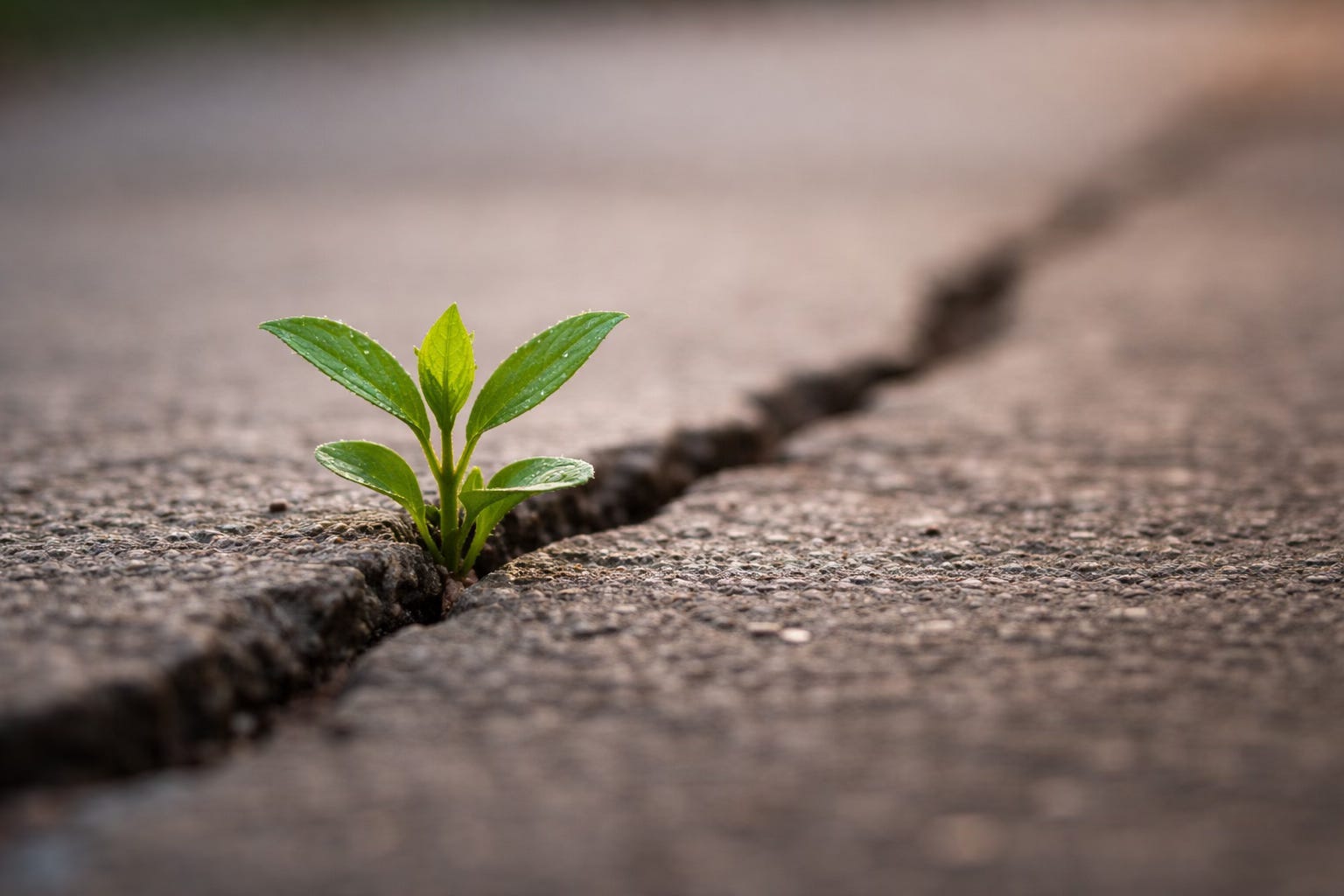
In the shadow of the system, something beautiful is growing. Like a plant finding life in the least hospitable place. A shoot pushing up through a crack in rock.
The rock is hard. The conditions are brutal. The system is indifferent. And still, life insists.
At first it looks insignificant. One green thing. One person doing one small human thing. One pocket of shalom. One friend group telling the truth. One garden bed. One shared meal. One neighborly act.
But roots do something shouting cannot. Roots go deep. Roots keep growing when no one is watching. Roots find water. And over time, when enough roots do their quiet work, the rock begins to split.
That is how the future arrives. Not as a sudden clean reset. As life rising. As commons returning. As communities of shalom growing in the shadow until the old stone cannot hold.
A word about “reset” and “transition”
I was listening to a podcast recently where two people were arguing about systems change. One was naming all the ways material conditions shape what we call “public safety,” and how investing in care can reduce harm. The other kept returning to a different point: we cannot just flick a switch and jump from the world we have to the world we want. We need a real transition. I found myself nodding at both.
Yes, we need transformation. And yes, we cannot pretend the way there is instant.
Which is exactly why the work of shalom matters. It is transition work. It is seed work. It is building what we wish existed, in the places we actually live.
This is one of the system’s great traps. It whispers: “If you cannot fix it all, do nothing.” And then it calls that “realism.”
But real life does not happen through switch-flipping. Real life happens through seasons. Through compost. Through time. Through fidelity.
Re-creation is rebellion
Here is the key I am trying to drop, as plainly as I can: The system trained you to consume. Re-creation is rebellion. Not re-creation as escapism. Re-creation as cultivation. Re-creation as choosing aliveness. Re-creation as building a life you do not need to numb yourself to survive.
This is where the word “re-creation” matters. Not entertainment. Not distraction. Not retail therapy.
Re-creation as making again. Re-creating a human life. Re-creating a nervous system. Re-creating friendships that can hold truth. Re-creating shared space. Re-creating beauty. Re-creating rest. Re-creating community.
That is not small. That is not apolitical. That is not selfish. It is the beginning of a new commons. It is the return of the human.
Always be ready to name the hope
There’s a line in 1 Peter that has been following me around for years. “Always be prepared to give an answer to everyone who asks you to give the reason for the hope that you have.” And then it adds, “Do this with gentleness and respect.”
I love that pairing. Hope is not a vibe. Hope is not denial. Hope is a practiced posture. And it has to be speakable. Not in a defensive, debate-me way. More like, “If you are curious why I refuse to give myself to cynicism, here’s the soil I’m rooted in.”
Because we have seen world-changing transformation happen before.
Long before Christianity became an institution, it was a way. A way of living. A way of being in community. A way of being in the world.
It sprang up in the wake of the life, death, and resurrection of Jesus. Not as an organization you joined, but as a new kind of human life you practiced. And in a Roman world built on hierarchy, division, and domination, it was shocking.
There are hints in the historical record of communities where old separations started to lose their power. Where people refused the usual sorting mechanisms, race, gender, class. Where the poor were not treated as disposable. Where resources were shared. Where care was not a charity project, but a communal responsibility.
In other words, it looked like shalom in public. Not perfect. Not painless. Not free of conflict. But real enough that the world noticed.
And when something like that becomes visible, empires do what empires do. They move to contain it. They absorb it.
It was both appropriation and co-optation. A distortion, and a redirection. A strategic domestication that took something living and powerful and folded it into structure.
A movement becomes an institution. A way becomes a membership system. A table becomes an org chart.
I’m not saying that story with contempt. I’m saying it with grief and clarity. Because it means two things can be true at once.
First, this kind of transformation is possible. It has happened.
Second, if we build pockets of shalom now, we should expect the system to try to tame them. Not necessarily with violence at first. Sometimes with respectability. Sometimes with funding. Sometimes with “partnership.” Sometimes with a seat at the table that comes with a muzzle.
So when I talk about hope, I am not talking about a clean revolution that never gets compromised. I am talking about something more resilient.
I am talking about a way of life that keeps reappearing, like shoots through cracks in stone. A way that makes the world ask, “Where did you get that kind of hope?”
The system is not only held together by law. It is held together by imagination. By habit. By a million daily acts of compliance that we have been trained to call “normal.”
Which means the system does not only break through confrontation. It also breaks through replacement. Through building something more beautiful, more nourishing, more human.
Where I am practicing this right now
My own “crack in the rock” is not glamorous. It is land. It is friendships. It is the slow work of turning 1.1 acres into something more like an urban homestead, and also something more like a gathering place.
One of the first projects that really got me started was almost laughably ordinary. There is a strip between the street and the front fence at my house. In that space was a mix of rocks, dying juniper, and weeds. It looked like neglect. And it felt like neglect.
But I wanted it to become something that worked well for the neighbors. Something pleasant to walk by. Something that communicated, in the quiet language of landscaping and care: “I am with you. I live here too. I want this place to be beautiful.”
So I started clearing. Getting rid of the rock. Pulling the dying juniper. Working with the stubbornness of the soil instead of fighting it.
And then, in a way that felt like a tiny parable, the rock I removed did not become trash. I gave it to another neighbor who needed rock for mud mitigation. What could have been waste became support.
Then I started composting what I was removing. Mulching the juniper down. Feeding it into compost bins. Letting what was dying become the beginning of soil that will feed garden beds later.
And it kept expanding.
Fallen branches from around my house. Fallen branches from neighbors. I started taking what was already here, mulching it, and using it to fill in the dirt where the juniper and rocks had been.
In the spring, I will plant and xeriscape that whole strip. But even now, it feels like a different story is being told. Not because it is finished. Because it is moving. Because it is becoming.
And then there is compost in the more communal sense. I am on the MakeSoil app, which means I keep a trash can at the end of my driveway. People can drop off compostable scraps which feed my compost bins today and will nurture my fruits and vegetables tomorrow.
There is something small and holy about that. Neighbors feeding the soil of a place we all share. And it has made me notice how the earth does what the system refuses to do.
The system tells us: Extract. Consume. Discard.
But the earth composts. It takes what was and turns it into what will be. Even the pine needles that fall and start suffocating the ground beneath the trees, I have been gathering and spreading out in an area where I have rabbits.
Then I spread clover seed. So they have a place that feels safe and vibrant and alive.
This is the practice that keeps returning to me. How do I take what is here and feed it back into what is here? How do I take what was and use it to give life to what will be?
And in the midst of it, how do I partner with neighbors? Receiving from them. Helping clear out their debris. Participating in life cycles instead of feeding the machine.
And alongside the land, it is friendships. Not networking. Not clout. Not transactional community. A friend group that can tell the truth, hold tenderness, and stay human together. A friend group that can laugh. A friend group that can disagree without turning disagreement into exile. A friend group that can name the system without becoming a replica of it.
This is not me opting out of care for the larger world. This is me refusing to let the system dictate the only way change is allowed to happen.
Because the system loves two kinds of people. The numb. And the addicted-to-outrage. Both are predictable. Both are controllable.
But a person who is quietly becoming free is dangerous.
Numb to tenderness to agency
So if you are numb, I want to say this gently: Your numbness makes sense. It is not laziness. It is not failure. It is often the last mercy your body can offer you when life has been too much for too long.
But numbness is not the end of the story. There is a path. Not a perfect path. A human one. A path that moves from numbness to tenderness. And from tenderness to agency.
Not the agency of “fix the whole world.” The agency of “build something living in the shadow.” The agency of “practice shalom where you actually are.” The agency of “choose re-creation over consumption, one small key at a time.”
Agency, in this frame, is not heroic. It is not performative. It is not one more thing you have to do to prove you are good. Agency is what happens when your life stops being dictated entirely by the machine.
It is what happens when you can say:
I can make soup.
I can plant something.
I can host one person.
I can walk outside without headphones.
I can put my phone down.
I can tell the truth to someone safe.
Small things. But small things, repeated, are how a different world grows.
Below the paywall
Below the paywall, I am sharing a simple set of practices in three layers.
A micro practice you can do in a minute.
A deeper rhythm that takes more time.
A longer reorientation toward a pocket-of-shalom life.
Not because you have to do it my way. Because I want you to have something you can use. Because I want more keys in more hands. Because the beautiful rowdy prisoners deserve a way out. Because we all deserve the opportunity to stay human.
Embodiment Practices
Whether your day only allows for a 60-second reclamation, your week a one-hour resistance ritual, or you find yourself ready for a full on rebellion against a world that assaults your humanity. While these practices are usually behind the paywall, this week they are my gift to you.