


This is a piece about violence. Not the kind that happens in a moment, but the kind that builds over decades. The kind that gets into the groundwater of a nation. The kind that shows up when people have been abandoned long enough that they stop believing repair is possible.
It is also a piece about grief. About what happens when a society refuses to metabolize its losses. About the gap between the world we were promised and the world we are living in. About the dangerous things people reach for when that gap becomes unbearable.
And it is a piece about a choice. Not a political choice, though politics will be part of it. A deeper choice. The choice between becoming monstrous or staying human when everything around us is breaking.
I am writing this because I watched the killing of Alex Pretti in Minneapolis and felt something shift. Not just anger. Not just grief. Something older. The recognition that we are living through a collapse, and that what we do in the next few years will determine whether we fracture completely or find our way back to each other.
If you are exhausted, I understand. If you are angry, I am with you. If you are scared, you are not alone. And if you are wondering whether there is a way through this that does not require us to become the very thing we are fighting against, this piece is for you.
What follows is long. It is heavy. But it is also honest. And at the end, I will offer you something you can actually do. Not a think piece. Not a sermon. A practice. Because the path forward is not a new opinion. It is a new way of being with each other.
Let’s begin.
Watch or Listen
The Whole Story
I stepped out of the portable wood-burning sauna drenched in sweat, directly into the ten-degree morning air. That shock of cold after intense heat, that’s the kind of contrast therapy that makes you feel impossibly alive. Vibrant. Energized. Like every cell in your body just remembered what it was built for.
The morning had already been good. I’d gotten up early, gone to the gym, and taken part in a really intense workout. Afterwards, my gym was doing something special: they had this portable wood-burning sauna on site, and we could use it for as long as we wanted. So I did. I sat in that heat until my muscles went soft and my mind went quiet.
I was still in that clean, animal relief when I got in the car. Blood moving. Breath deep. That rare feeling of being completely at home in your own body.
That’s when I looked at my phone and saw the kind of sentence that does not belong in a society that wants to call itself sane.
A federal agent shot and killed Alex Pretti in Minneapolis.
And the whiplash is immediate. Not metaphorical. Nervous system whiplash.
Because for a few hours you were inside something coherent. Inside heat and effort and restoration. Inside the simple truth that your body can still come home to itself. Then, with one notification, you are back in the other world. The world where the ground feels less like ground, and more like a trap door.
I wrestled with it all afternoon. I could not put it down. I kept turning it over, like a broken tooth in my mouth. I spent hours that night awake, staring into the dark, trying to understand what the hell is going on.
Not just the shooting itself, but the story around it. The immediate, prepackaged narrative. The reflex to justify. The speed with which people decide whose death counts as tragedy and whose death counts as inconvenience.
And I felt something else underneath the rage and the disbelief.
I felt grief.
Not the sentimental kind. Not the tearjerker kind. The older kind. The kind grief workers recognize in the body before it ever becomes language.
The kind that shows up when the social contract breaks.
What we are watching is not just chaos
It is easy to find a simple story to explain what we see.
A man killed on the streets of Minneapolis trying to protect a woman being pepper sprayed by federal agents. A woman shot dead as she tried to drive away from the chaos caused by immigration enforcement. Both killings prompted outrage from those who code left, with the political right aimed to justify the killings.
It’s a simple right vs. left, us vs. them.
But if you step back 13 months it was a healthcare executive killed on a Manhattan sidewalk. An equally horrifying act, one the prompted political elites and the ultra-wealthy to respond with outrage, but also one that much of the public responded to with a with a shrug, or a cheer, or a grim, exhausted “yeah, that makes sense.”
And it’s because of that last killing, the one that seemed sensical even in the midst of tragedy, that makes me think that what we are watching in Minnesota is coherent, but perhaps in a way we don’t realize.
We are living in a time when the systems that are supposed to make life livable feel like they are crumbling. Not in some abstract, policy-wonk way. In a bones way.
Economic stability. Healthcare. Basic trust in institutions. Shared reality. When those systems crumble, something predictable happens. People become unstable.
And when people become unstable, they start reaching for anything that promises relief. Anything that promises clarity. Anything that promises power.
Some people reach for violence. Some people reach for violent leaders. Some people reach for stories that make violence feel like justice.
And when the ground fails us long enough, even decent people start to develop a taste for the idea of vengeance. Not always in action, but in imagination. In the quiet part of the soul that whispers, “Good. Let them feel it too.”
That whisper is not proof that we are evil. It is proof that we are ungrieved.
The social contract is failing, and we can feel it
Let me say this plainly. Humans are not designed to live in a society where survival is a private project. We are not designed to live in a world where healthcare is a profit extraction machine. We are not designed to live in a world where full-time work does not guarantee a dignified life. We are not designed to live in a world where you can do everything “right” and still get one diagnosis, one layoff, one accident, one rent increase, one family emergency away from collapse. Even the idea of needing to earn a living, something most of us take for granted, is a relatively modern concept.
In your body, you can feel what this kind of instability does.
It does not just create “stress.” It creates a constant background hum of threat. It turns people into cornered animals. It makes every disagreement feel existential. It makes scapegoating feel soothing. It makes domination look like leadership.
And we can talk about this like it is new. But part of what is so important to name is that the United States has never been especially good at building systems that care for people. The closest we got, structurally, was the New Deal era. A partial reweaving. A moment where, under pressure, the country admitted that the market is not a god and that the state has responsibilities.
Then we spent decades dismantling it. We hollowed out unions. We financialized housing. We privatized care. We turned healthcare into an industry that profits when people stay sick and stay afraid. We offshored jobs, stripped towns of their economic foundation, and then acted confused when resentment became a dominant emotion in whole regions of the country.
Let me be specific about what that looked like on the ground.
Whole towns built around manufacturing, around making things, around the dignity of skilled labor, were gutted. Not because the work was not valuable. Not because the workers were not skilled. But because profit could be extracted more efficiently elsewhere.
When a factory closes in a small town, it is not just one business shutting down. It is the entire ecosystem collapsing. The diner that fed the workers. The auto shop that fixed their trucks. The schools that were funded by the tax base. The sense of purpose that came from building something with your hands and bringing it home as a paycheck.
When those jobs left, they took more than wages. They took identity. They took community coherence. They took the basic promise that if you work hard, you will be okay.
And then, in the wreckage of that abandonment, something else arrived: pills.
The opioid epidemic did not happen by accident. It was created. Pharmaceutical companies lied about the addictive nature of their products. They paid doctors to prescribe. They flooded communities, particularly communities that were already reeling from economic collapse, with a substance that promised relief from unbearable pain.
And people took them. Not because they were weak. But because the pain was real. Physical pain from decades of hard labor in jobs that broke bodies. Emotional pain from watching your town die. Spiritual pain from losing the sense that your life has meaning.
The pills worked, for a while. And then they stopped working. And then people needed more. And then the prescriptions ran out. And then people turned to heroin. And then fentanyl flooded the streets because it was cheaper to manufacture and more profitable to sell.
And people started dying. Not in ones and twos. In waves. Entire generations were lost. Parents buried children. Children were raised by grandparents because both parents were gone. Foster systems were overwhelmed. Schools were trauma centers. Employers could not find workers who could pass a drug test, not because people were lazy, but because addiction had become the atmospheric condition.
And the rest of the country barely noticed. Or worse, they noticed with contempt. They called it a character problem. They called it poor choices. They used the language of personal responsibility to avoid the language of systemic betrayal.
What happened in these towns was not a series of individual failures. It was structural violence. It was the decision to prioritize shareholder value over human life. It was the decision to let entire regions collapse rather than invest in a just transition. It was the decision to flood traumatized populations with addictive substances and then criminalize them for becoming addicted. It was the decision to look at suffering people and see profit potential instead of human beings.
And all of that, every single piece of it, created what we might call systemic grief. Grief that does not just live in individuals, but in the soil of a place. Grief that gets into the water. Grief that shapes the nervous system of everyone who grows up there.
Children in these towns did not just inherit poverty. They inherited loss that was never named, never honored, never given space to be anything other than rage or numbness or despair.
And then we, as a country, turned to those same people and said, “Why are you so angry? Why are you voting for extremists? Why are you not okay?” As if we did not do this to them. As if we did not abandon them. As if we did not profit from their pain and then blame them for breaking under it.
And here is where the racial grievance becomes fuel for something dangerous.
Because part of the story that took root in these predominantly white communities was this: when these same harms happened to Black and Brown communities, the government cared. When crack ravaged Black neighborhoods in the 1980s and 90s, there was a response.
Now, it was a brutal, carceral response. It was mass incarceration, militarized policing, the destruction of families, the criminalization of entire populations. It was not care. It was punishment.
But in the minds of people watching their own communities collapse, it looked like attention. It looked like the state showing up. And when opioids tore through predominantly white rural and suburban areas, the response felt different. It felt like neglect. It felt like silence. It felt like no one cared enough to even punish them.
This perception, whether fully accurate or not, became a grievance. And that grievance was weaponized.
Because the truth that should have been obvious is this: the government did not care about Black communities when crack arrived. The government enacted policies that destroyed Black families and communities under the guise of “law and order.” And the government did not care about white communities when opioids arrived. The government allowed pharmaceutical companies to profit from mass death and then walked away.
The common thread is not race. The common thread is disposability. The common thread is a system that sees poor and working people, regardless of race, as expendable. But when you are in pain, it is hard to see systems. It is easier to see people. It is easier to see other struggling communities and think they got something you did not.
And so the rage that should have been directed at the pharmaceutical executives, the policymakers, the economic architects who orchestrated this suffering, got redirected. It got turned into racial resentment. It got turned into the belief that the real problem is not capitalism or extraction or systemic abandonment, but that “those people” got help and “we” did not.
That lie is one of the most effective tools of authoritarianism. Because once you convince people that their suffering is someone else’s fault, once you convince them that solidarity is a betrayal, once you convince them that the enemy is the family next to them and not the system above them, you can get them to do almost anything.
You can get them to vote against their own interests. You can get them to accept cruelty as strength. You can get them to hand power to people who will make their lives worse, as long as those people promise to make someone else’s life even worse.
And then, when those same people asked, “What are we supposed to do now,” too many institutions responded with contempt disguised as advice: Learn to code.
This is not a debate about whether coding is useful. It is a symbol. “Learn to code” is what you say when you do not actually intend to build a just transition. It is what you say when you want displaced people to take responsibility for a decision they did not make. It is what you say when you want a human being to solve a systemic betrayal with personal hustle.
It is the language of abandonment. And abandoned people do not just disappear. They become combustible.
This is not an excuse. This is an explanation. And if we want to interrupt this cycle, we have to tell a better story. A truer story. A story that names the real enemy and builds real solidarity across all the lines that power wants us to fight along.
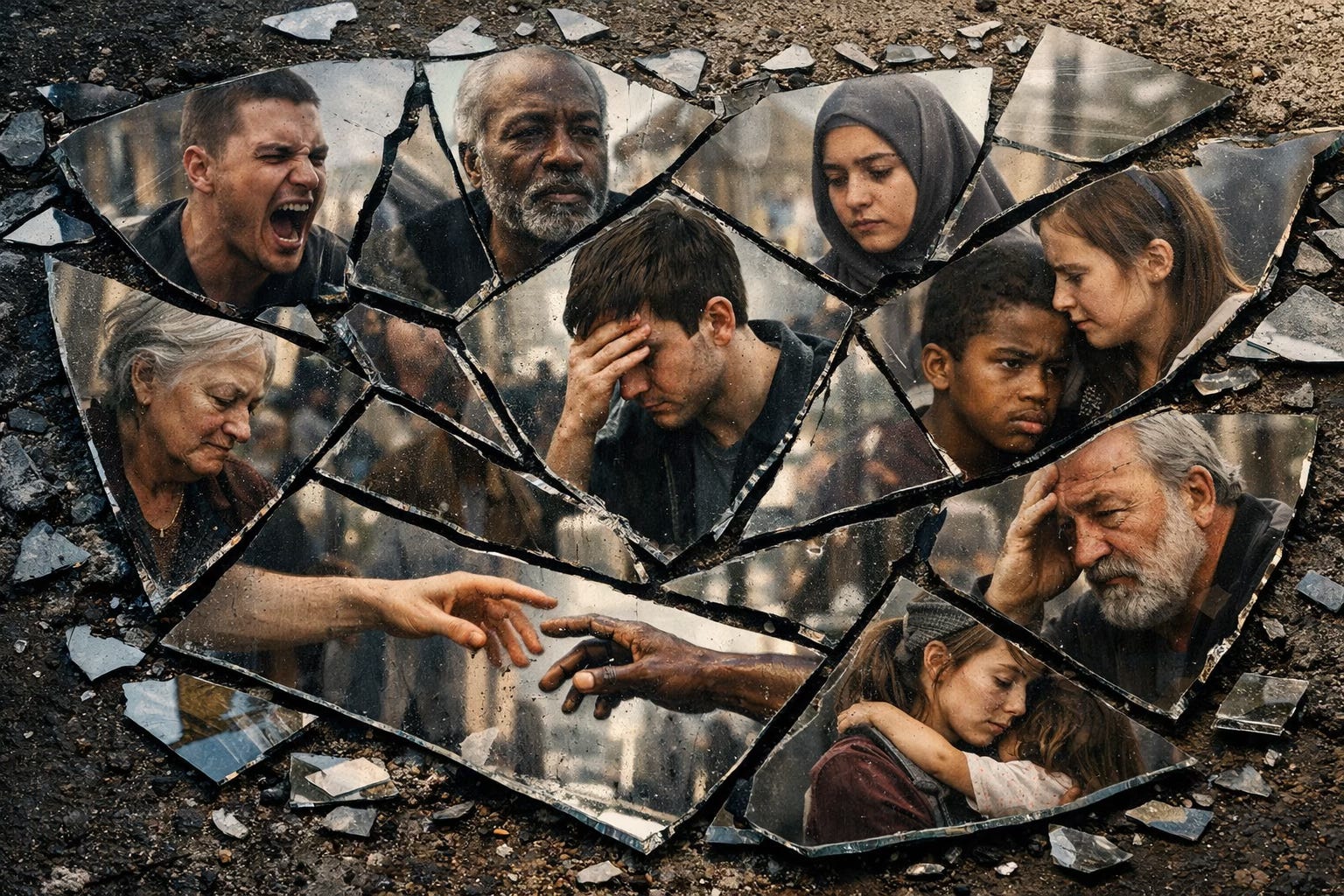
The pattern: when the ground collapses, people reach for monsters
When you strip away economic security, when you humiliate people, when you collapse the ground beneath their feet, something predictable happens. They reach for anyone who promises order. They overlook brutality because it feels like strength. They tolerate scapegoating because it feels like an explanation.
You can say, “I would never.” But when the nervous system is flooded, the human animal becomes persuadable in ways it is not proud of. That is not an excuse. It is a warning.
This is why fascism is always waiting. Not because people are stupid. Because people are desperate.
Three deaths, and what they reveal about the battle for our souls
I opened this piece highlighting three deaths. Alex Pretti and Renee Good this month in Minneapolis, and Brian Thompson thirteen months ago. Three deaths. And the way we responded to them reveals something about where we are as a people. Because here is what I watched happen.
When Alex Pretti and Renee Good were killed by federal agents, one segment of the population responded with outrage while another either justified it, dismissed it, or simply moved on. This is the culture war at work.
This is how we are kept fighting sideways instead of looking up. Immigration enforcement divides us along the oldest fault lines: who belongs, who deserves protection, who is “really American.” It keeps us arguing about the people standing next to us in the rubble instead of the people who orchestrated the collapse. It keeps us focused on borders and belonging while the systems extracting from all of us continue untouched.
And when Brian Thompson was killed, something different happened. Something that should have terrified the people in power. For a brief, uncomfortable moment, the 99% found something like unity. Not celebration, exactly. But a grim recognition. A shared understanding that this man had presided over a system that killed people with spreadsheets instead of bullets, and that his death felt like a kind of cosmic accounting.
The reaction was not universal. But it was widespread enough to be undeniable. People across the political spectrum, people who agree on almost nothing else, looked at that death and said, “I understand why someone did that.”
This is the class war we are not supposed to name. This is what happens when people stop fighting each other long enough to look up and see the real architecture of their suffering. Thompson’s death revealed that the real enemy is not the immigrant next to you or the person who speaks a different language or practices a different faith. The real enemy is the system that treats all of us as disposable in the name of profit.
Now, I want to be clear about something. I am opposed to violence. All of it. But I also want to reveal what these three deaths reveal about the game being played on us.
The people in power know this. They know that if we ever stop fighting each other long enough to look up, the whole house of cards collapses. So they keep us focused on the culture war, on things like immigration and border security and who is a true American versus a threat. They keep us pointing our rage sideways instead of up.
This is the spiritual crisis we are facing. This is the moral injury.
In a twisted, terrible way, Brian Thompson’s death united people. It gave us a glimpse of what could happen if we stopped accepting the lie that our enemies are each other. But it did so through violence. It did so through bloodshed. It did so in a way that rots the soul even as it reveals the truth.
And that is not the path forward. We do not heal harm by multiplying harm. We do not build a just world by becoming executioners. We do not reclaim our humanity by dehumanizing anyone, even the people who have caused enormous suffering.
So here is what I want to offer. Not as a naive fantasy. Not as a way to avoid hard truths. But as a North Star. As the only way I know how to stay human in a world that is trying to make us monstrous.
The two stories about the same wound
In 2016, both Donald Trump and Bernie Sanders broke through because they did something the establishment refused to do: they looked at towns where the factories had gone silent, at communities where the pill bottles outnumbered the paychecks, at people who had been left to drown while both parties argued about the temperature of the water. And they said, “Your pain is real. The system is failing you. You are not crazy for feeling like the ground is collapsing.”
That refusal to gaslight people was powerful. It was like finally being seen after years of being invisible. But what they did next was everything. Because they both identified the same wound, but they pointed to completely different sources of the infection.
Bernie pointed to the top of the tower. He said the super-wealthy and corporate power have rigged the system. Wall Street crashed the economy and got bailed out while working people lost everything. Healthcare, education, and housing have been turned into profit machines. The solution is solidarity. The solution is weaving ourselves back together across every line that power uses to divide us. The solution is building an economy that serves the living, not the dead weight of shareholder value.
Bernie offered the class war. The hard work of it. The long labor of building power together.
Trump pointed to the people standing next to you in the rubble. He said immigrants, globalists, and corrupt political elites have stolen what is yours. The factories left because of bad trade deals and treasonous politicians. The country has been invaded. The solution is a strongman who will fight for “us” against “them.” The solution is domination, exclusion, and the restoration of a hierarchical order where you are no longer at the bottom.
Trump offered the culture war. The quick hit of scapegoating. The immediate relief of having someone to blame who you can see and touch.
And here is what matters: when people are destabilized, when their nervous systems have been flooded for decades, when the ground beneath them feels more like quicksand than bedrock, they do not automatically choose the most accurate story. They choose the story that feels like it will stop the bleeding fastest.
Trump’s story was simpler. It did not require the patient work of building coalition. It did not require transforming systems. It just required a villain you could see and a strongman who promised to crush that villain on your behalf.
That is the seduction of authoritarianism. It is not about ideology. It is about nervous system relief. It offers the fantasy of an easy answer when the real answer requires a root system that takes years to grow.
But here is where the story gets darker, and where you start to see who really benefits from keeping us fractured.
When the elites closed ranks
Bernie built a movement. He won state after state in the primary. He filled arenas with people who had written off politics as a scam. He activated young people and working-class voters who had nothing left to lose. He offered a grief-capable path. A solidarity path. A path that could have interrupted the cycle. And the party machinery closed ranks.
Superdelegates. Coordinated media narratives. Institutional gatekeeping that looked less like democracy and more like damage control. The message was clear: we will not allow you to disrupt the system, even if the system is killing people.
This was not an accident. This was the elites protecting the status quo. Because the people who benefit from the current system, the people who profit from our fragmentation, the people who extract wealth while we fight each other, they do not want solidarity. They do not want us looking up. They do not want us naming the real enemy.
So they crushed the solidarity candidate. Not with violence. With institutional power. With the quiet, bureaucratic brutality of gatekeeping. And people watched it happen in real time. And when they watched the party protect itself instead of responding to the pain of its base, it fertilized the very story Trump was selling: the elites are corrupt, the game is rigged, and no one inside the system will ever fight for you.
Meanwhile, Trump bulldozed through offering permission to stop pretending the old story still worked. And people who were desperate, people who were exhausted, people who had been abandoned, said yes. Not because they were stupid. But because when you are drowning, you will grab onto anything that looks like it floats, even if it is made of bones.
This is the pattern we are still living inside.
When the ground collapses and people are not offered a grief-capable, solidarity-based way to rebuild it, they will reach for the authoritarian one. When the institutions that claim to protect people choose instead to protect the systems that are breaking people, they do not stop the authoritarian. They create the conditions for the authoritarian to thrive.
And this is where we have to zoom out. Because if we only see this as a story about two men or one election, we will miss the deeper architecture. We will keep treating symptoms. We will keep hoping the removal of one person will solve what is, at root, a sick story and a sick structure.
Who benefits when we fracture
When communities collapse, private equity buys the wreckage. When people lose healthcare, insurers profit. When wages stagnate, shareholders gain. When the public fights itself, the powerful remain protected.
Exploitation is not just greed. It is a system that tells the poor, the sick, the working class, the immigrant, and the desperate to blame each other while the extraction continues untouched.
Solidarity is the refusal to play that game. It is remembering that the people next to you are not your enemy. It is seeing that the real divide is vertical, not horizontal.
And solidarity is impossible without grief, because grief is how we tell the truth about what has been done to us and what we have done to each other.
We need an ancient architecture for social healing
Francis Weller writes about grief work as something larger than private catharsis. As something communal. As something that belongs to villages, not just individuals. As something that helps a society metabolize what it has lived through, so it does not keep reenacting it.
There is the phrase I cannot stop thinking about right now: an ancient architecture for social healing.
Because what we are doing right now is not social healing. It is social acting out. It is the cycling of outrage without integration. It is the constant re-traumatization without ritual. It is the performance of certainty in the absence of groundedness.
And when we do not have an architecture for grief, we will build one out of whatever materials are available.
In America, our default materials are:
consumption
distraction
domination
scapegoating
violence
nationalism
denial
None of those heal. They numb. They harden. They fracture.
Grief work is different. Grief work is a declaration that we refuse to become less human in response to a world that is trying to make us less human. Grief work is the refusal to let the wound define the story. Grief work is the alchemy that turns pain into wisdom instead of pain into poison.
And yes, grief has to move. It cannot just be lament on repeat. If grief is only endless expression with no integration, it becomes a loop. And when people are stuck in loops, they seek release. If the culture does not offer a healthy release, people will find a dysfunctional one. That is what we are watching.
The path forward is not a new opinion. It is a new practice.
If you are trying to make sense of what you are seeing, I want to offer this as a grounded claim: The opposite of violence is not passivity. The opposite of violence is not “being nice.” The opposite of violence is not pretending everything is fine. The opposite of violence is a grief-capable community.
A grief-capable community tells the truth without turning it into cruelty. A grief-capable community holds anger without worshiping it. A grief-capable community can face what is breaking without needing to make a god out of a strongman. A grief-capable community can feel loss without needing to make someone else pay for it.
And if that sounds too idealistic, I want to make it concrete. Grief-capable community looks like:
people who can sit with sorrow without rushing to fix it
people who can name harm without dehumanizing
people who can practice repair instead of revenge
people who can build real mutual support networks for survival, not just vibes
people who know how to slow their nervous system down enough to stay accountable to love
That is not theoretical. That is training. That is practice. That is spiritual work and political work and nervous system work all at the same time, because in a world like this, they cannot be separated.
Call to action
If you’re not sure how to embody this in your own life and want support that is personal and structured, my grief coaching is the clearest next step. You can book a discovery call from this page.
If coaching is not a fit right now, the paid version of We Can Stay Human is the low-barrier on-ramp: $5/month or $50/year. The practices to help embody each post lives beyond the paywall.
But because I don’t want to leave you completely hanging, here’s a bonus one:
Do this today (practice preview, 30–60 seconds)
Before you scroll, do this with me.
Put one hand on your chest and one hand on your belly. Feel the contact. Feel the weight.
Inhale through your nose for a slow count of 4.
Exhale for a slow count of 6. Longer exhale than inhale.
Do that three times.
Now name what is true, out loud if you can:
“My body is responding to a world that does not feel safe.”
“Rage is here.”
“Grief is under it.”
“I do not have to turn my pain into violence to prove it matters.”
That’s it. That is a beginning. Not a solution. A beginning. A moment of honesty in a world of deception. Because learning to be honest is the first step in how we stay human.
Embodiment practices
If you want more than analysis, and you want something you can actually do with your hands and your breath, I put three practices on the other side of the paywall: one that takes a minute, one that takes an hour, and one that changes your life by changing your community.