


What if the capitalism we argue about today is not the same thing Adam Smith described?
A recent comment from Abdul El-Sayed sent me into a deeper exploration of Adam Smith, Karl Marx, and David Graeber. Reading them in succession unsettled many of the economic stories I had inherited. Smith was not the cartoon prophet of unregulated shareholder capitalism. Marx exposed dimensions of labor and capital that Smith could not fully see. Graeber challenged the foundational story that money began with isolated people bartering in the first place.
Beneath all three conversations is a deeper question about relationship. Why are we taught to fear one another, fight over political labels, and blame our neighbors while concentrated wealth and power remain largely untouched? What happens when an economy forgets that every transaction rests on labor, trust, dependence, shared infrastructure, and a living earth?
This is an exploration of political fear, oligarchic power, economic mythology, and the possibility of building an economy that serves human thriving rather than treating profit as sacred.
Watch or Listen
The Whole Story
A recent comment from Abdul El-Sayed sent me back into a question I have been circling for years. El-Sayed was explaining why he does not identify as a socialist. He considers himself a capitalist, he said, while also believing capitalism must be regulated. Then he pointed back to Adam Smith and The Wealth of Nations.
That move matters because it exposes how little precision we often bring to our political language. “Capitalism” and “socialism” have become less like descriptions of economic arrangements and more like weapons we use to sort people into friends and enemies. One word is supposed to mean freedom, prosperity, and common sense. The other is supposed to mean tyranny, scarcity, and the end of everything familiar. The categories are not allowed to become complicated, because complicated categories make fear less useful.
So I want to ask a different question. What if the capitalism we argue about today is not the same thing Adam Smith described? What if the political fear surrounding these words is part of a larger story, one that keeps us looking sideways at one another while concentrated wealth and power continue to organize the terms of our lives?
I am not talking about a secret room where every powerful person sits around smoking cigars and cackling. I am talking about an oligarchic class, people with extraordinary wealth, access, institutional influence, social networks, and shared interests. They attend the same schools, move through the same financial and political circles, sit on the same boards, and understand which arrangements protect their position. They do not need to coordinate every detail in order to recognize what works for them and organize around it.
This is not new. The robber barons understood that labor was easier to control when workers could be divided by race, ethnicity, religion, and national origin. Black workers, Mexican workers, Irish workers, Italian workers, and other immigrant groups were not naturally enemies. They were made into competing categories, then invited into or excluded from whiteness in shifting ways, often according to what would best preserve the existing order. The point was not merely prejudice, though prejudice was real and devastating. The point was power. A divided workforce is a cheaper and more manageable workforce.
The same political technology keeps returning in new clothing. The Red Scare taught Americans to fear communists and socialists. Today, the right often mobilizes fear around immigrants, racial justice, trans people, public assistance, crime, or the imagined threat of cultural replacement. The Democratic establishment often mobilizes fear around electoral catastrophe, political chaos, extremism, or the return of authoritarianism. These fears are not identical in content or consequence. Some of the harms they name are real, and some are manufactured. But fear can function similarly in both parties when it keeps people from asking who owns the systems, who writes the rules, who receives the wealth, and who is being asked to bear the cost.
The parties are not identical. They differ on policy, rhetoric, and the kinds of harm they produce. But both operate within a political economy where concentrated wealth has disproportionate access, influence, and protection. They may disagree about which neighbor we should fear while leaving the deeper architecture of oligarchic power remarkably untouched.
This is where Adam Smith became important for me. I read The Wealth of Nations and felt a persistent dissonance. The Adam Smith I encountered was not the cartoon prophet of unregulated shareholder capitalism that so many people seem to invoke. He was suspicious of monopoly. He understood that employers had structural advantages over workers in disputes about wages. He recognized that merchants and manufacturers could conspire against the public. He supported limits on interest rates because he worried that unrestricted lending would channel money toward reckless borrowers and speculative projects. He even worried that extreme division of labor could reduce workers to something less than fully developed human beings, and he supported public education partly as a response.
None of this makes Smith a Marxist. It does not turn him into a democratic socialist or a modern progressive. Smith believed that competition and self-interest, under certain conditions, could contribute to the common good. He believed capital could receive a legitimate return. He did not think the existence of markets was itself a moral failure.
But the Smith we have inherited in contemporary political conversation is selective. We remember the invisible hand and forget the warnings about monopoly. We remember self-interest and forget the employer’s power over labor. We remember markets and forget the moral, civic, and institutional conditions that make markets something other than organized predation. We use Smith to defend a system he would likely have recognized as deeply distorted by concentrated wealth, political favoritism, and the power of large firms to shape the rules in their own interest.
Marx on the other hand saw some of this more clearly and pushed the critique further, especially in the book Capital, Volume 1: Critique of Political Economy. Where Smith could describe the unequal relationship between employers and workers, Marx asked what was built into the relationship itself. Who owns the productive resources? Who must sell their labor in order to live? Who receives the value produced by that labor? What happens when capital is not simply a tool for human flourishing, but a system whose central purpose is to reproduce and enlarge itself?
Smith and Marx share a vocabulary around labor and value, but they do not share the same final vision. Smith believed a properly functioning market could produce general prosperity. Marx argued that the wage relationship itself contained a structural form of exploitation, because workers create more value than they receive in wages and the difference becomes the basis of profit. Smith worried about the abuses of capital. Marx questioned the social relationship that made capital accumulation possible in the first place.
I do not need either thinker to be completely right in order to learn from both. In fact, the need to choose one thinker as the final authority is part of the problem. We have been trained to treat economic traditions like teams. If you criticize capitalism, you must be a socialist. If you defend markets, you must accept whatever powerful people call capitalism. But serious thinkers are more difficult than the labels used to contain them.
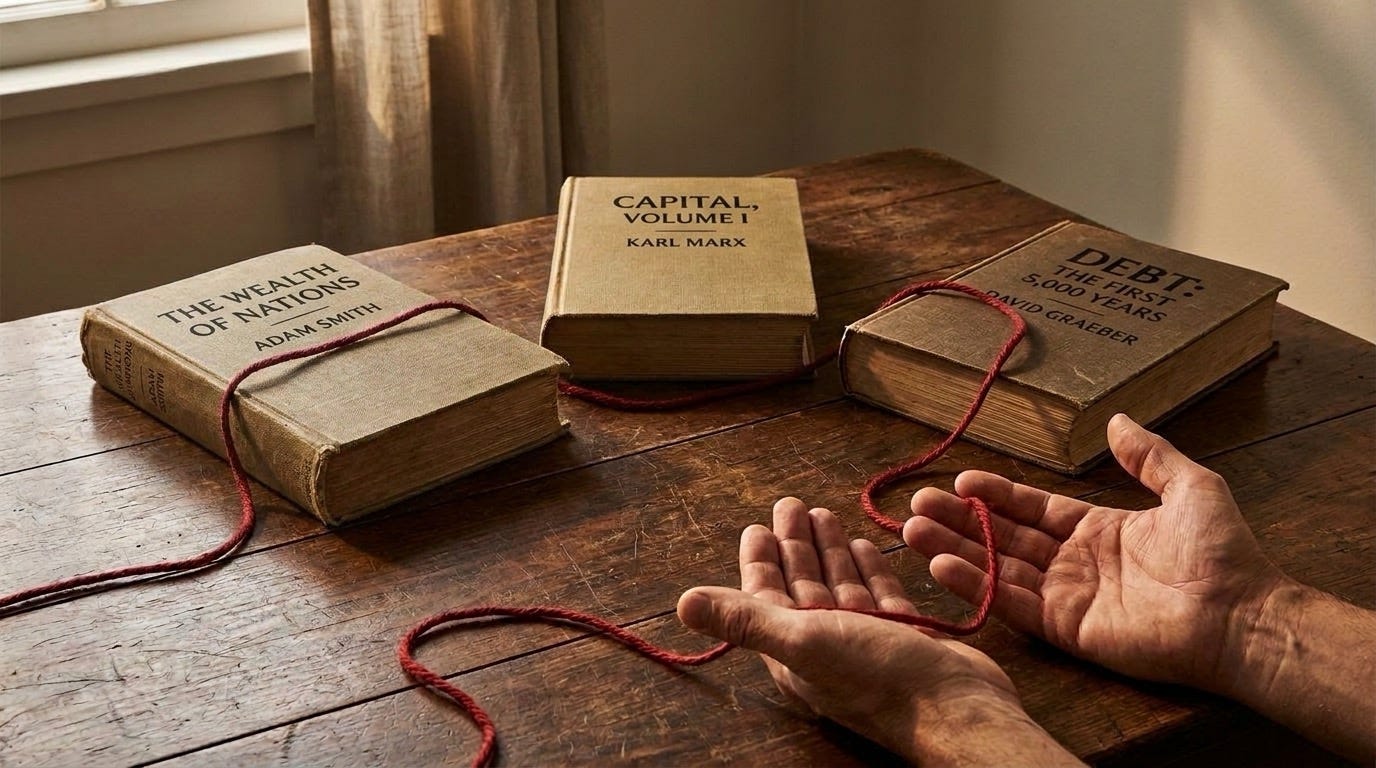
Then I read David Graeber’s Debt: The First 5,000 Years, and the floor shifted again. Graeber challenged the foundational story that money emerged because isolated people were trading goods through barter and eventually needed a more efficient medium of exchange. Barter certainly exists, but Graeber argued that the historical and anthropological record does not support it as the universal starting point of economic life. What appears much more often is credit, obligation, trust, memory, and ongoing relationship.
That matters because the barter story gives us a particular picture of the human person. It imagines us as isolated individuals with possessions, looking for the most efficient way to exchange them. Relationship comes later, after the transaction. Graeber’s account reverses the order. We begin in relationship. We keep accounts because we live with one another. We borrow, give, owe, forgive, remember, and trust before money becomes an abstract instrument moving through an impersonal market.
Before debt was a number, it was an obligation between people. That obligation could express care and mutual dependence. It could also become a tool of domination. Once the relationship is stripped away, repayment can be treated as a moral absolute, even when the original arrangement was coercive, unjust, or impossible to fulfill. “You must repay” can become a way of hiding the question, “Who had the power to set the terms?”
Graeber’s critique also reveals something about the stories economics tells about itself. Foundational stories are never merely academic. They shape what we consider natural. If we believe human beings are fundamentally isolated barterers, then competition feels inevitable and mutual obligation feels secondary. If we believe debt is simply a neutral number, then debt forgiveness appears irresponsible rather than sometimes necessary for restoring life. If we believe markets are sacred, then any limit on profit appears to be an attack on freedom.
But every transaction rests on relationship, labor, trust, and shared life. The person buying a house did not build the roads, write the laws, educate the workforce, maintain the electrical grid, or create the land. The corporation earning a profit did not invent the human capacities, public infrastructure, ecological systems, and inherited knowledge that make its activity possible. The worker selling labor is not merely a cost. The patient receiving care is not merely revenue. The tenant paying rent is not merely a monthly return.
An economy becomes dehumanizing when it forgets these relationships. Human beings become labor costs, risk profiles, consumers, debtors, voters, units of productivity, or obstacles to growth. The language becomes efficient, and the lives inside it disappear.
This is why fear is so useful to oligarchic power. Fear teaches us to see one another as isolated threats rather than participants in a shared life. It convinces workers that the problem is another worker. It convinces struggling people that the person receiving assistance is the reason they cannot afford housing. It convinces people that a migrant, a queer person, a protester, a bureaucrat, or a political opponent is the main obstacle between them and security. It asks us to fight over scraps while treating the people who control the table as inevitable.
The alternative is not a world without markets. Markets can be useful tools. But markets are not sacred, and profit is not the highest measure of human good. A human economy would begin with a different question: What supports human thriving?
That would mean fair compensation for labor, meaningful limits on monopoly and concentrated power, humane lending, and debt forgiveness where debt has become a mechanism of permanent domination. It would mean democratic ownership in places where shared control produces greater dignity and accountability. It would mean removing the profit motive from survival necessities such as healthcare, housing, and electricity. Those systems might be publicly owned, cooperatively owned, or organized through nonprofits. The essential point is that no one’s access to the conditions of life should depend on whether someone else can maximize a return.
It would also mean protecting rest, creativity, care, community, and ecological limits. Human beings are not machines whose value can be calculated by output. The earth is not a warehouse of raw materials. Economic security is not a luxury added after freedom. It is one of the conditions that makes genuine freedom possible.
This is where the conversation becomes theological for me. Empire is always trying to hide behind neutral language. Extraction becomes efficiency. Domination becomes leadership. Scarcity becomes discipline. Debt becomes morality. Profit becomes freedom. The bodies carrying the cost are pushed out of the frame.
Liberating truth begins by bringing those bodies back into view. It asks who is working, who is waiting, who is sick, who is displaced, who is indebted, who is exhausted, and who has the power to decide what counts as an acceptable sacrifice. Love is not merely a feeling we have toward one another. Love is the refusal to organize shared life around the expendability of other people.
I think that is also where grief belongs in this conversation. We grieve not only people who have died. We grieve communities hollowed out by extraction. We grieve the years consumed by debt. We grieve the healthcare that was denied, the housing that became unreachable, the creativity sacrificed to survival, the relationships strained by economic fear. Sometimes we grieve the life that should have been possible.
That grief is not a reason to surrender. It may be evidence that something in us still knows the difference between what is normal and what is humane. The fact that we can mourn a more just world means we have not completely accepted the lie that this is the only world available to us.
So I want to return to the question that began this reflection. What do we mean when we say capitalism? Whose version are we defending? Which parts of Adam Smith have been forgotten? What did Marx see that Smith could not? What does Graeber reveal when he tells us that money itself began not with isolated exchange, but with relationship and obligation?
I do not think these thinkers give us a finished system. They give us interruptions. They interrupt the stories that have become too convenient. They remind us that economic arrangements are made by human beings, that they can be changed by human beings, and that the economy is never separate from our moral vision of what people are for.
The practice, then, is not simply to choose the correct label. It is to examine the stories we have accepted as natural and ask whether they make more human life possible. It is to read beyond the caricatures. It is to notice when fear is being used to turn neighbors into enemies. It is to ask who benefits when we stop looking at the structure and start blaming one another.
We were told that the market is impersonal, that debt is merely contractual, that profit is the measure of value, that scarcity is inevitable, and that our neighbors are the threat. Perhaps staying human means learning to tell a different story. Perhaps it means remembering that beneath every economic abstraction is a body, a household, a community, a living earth, and a web of relationships that none of us created alone.
If you are carrying grief about a person, a community, or a future that has been lost, my Life After Loss work is a place to explore that grief without turning away from the possibility of new life. You can find out more about this work here.
Practices for Staying Human
Whether your day only allows for a 60-second reclamation, your week a one-hour resistance ritual, or you find yourself ready for a full on rebellion against a world that assaults your humanity, behind the paywall I offer you three practices that will help you bring this post to life in your everyday.
60-second Reclamation: One Economic Story
Notice one economic story you have been taught to treat as natural. It might be “people are poor because they do not work hard enough,” “debt must always be repaid,” “healthcare is a product,” or “there is not enough for everyone.” Write the story down. Then ask: Who benefits when I believe this? Who becomes invisible?
60-minute Ritual: A Deeper Look
Choose one relationship in your economic life and look at it without abstraction. This might be your work, your rent, a loan, a medical bill, a purchase, or a recurring subscription. Who made the thing possible? Who does the arrangement serve? Where is there mutuality, and where is there coercion? What would a more humane version of this relationship require?
Whole-life Rebellion: A Deep Dive
Read Smith, Marx, and Graeber with enough patience to let each one disrupt you. You do not need to become a disciple of any of them. Read Smith for the critique of monopoly and concentrated power. Read Marx for the analysis of labor and capital. Read Graeber for the social and moral history of debt.
As you read, keep asking three questions: What view of the human person is operating here? What relationships are visible, and which ones have been erased? Does this way of organizing life make greater freedom, dignity, care, creativity, and shared flourishing possible?
The goal is not to win an argument about economic labels. The goal is to recover an imagination large enough to see people again.
As usual, I love your perspective. As I’m reading this, the phrase “it’s not personal…it’s business “ keeps going through my head. It’s always personal. Always.