


There was a time when a diagnosis felt like mercy. A name for the chaos. A reason for the restlessness. A sentence that said, “This makes sense.” And sometimes it is mercy. Sometimes it is the first breath after years of shame.
But lately I’ve been wondering if we’ve asked diagnosis to do more than it can carry.
What happens when the language meant to help us understand ourselves quietly becomes the walls of our lives? When explanation replaces transformation. When relief becomes the highest good. When the ache that might be calling us back to ourselves is met first with management.
This isn’t a rejection of therapy, medication, or mental health care. Some of them have saved my life. This is a question about formation. About what kind of humans we are becoming in a culture that names pain quickly and listens slowly.
Because beneath all our labels, there is a more ancient truth waiting to be remembered.
You are not a problem to solve. You are a human to restore. And restoration, unlike consumption, asks for participation.
Watch or Listen
The Whole Story
On New Year’s Day I sat in a Harkins theater, waiting to watch the newest Avatar movie. The lights were down, the room was filling up, and I was doing what people do before a film: settling in, letting myself get quiet, letting my body shift into rest.
And then a pharma ad started playing. Not on a TV in a living room where commercials are already a kind of background noise. Not in a doctor’s office where you can at least pretend it belongs. In a theater.
It hit me like a violation. A disgust. A shock. It was not only the content. It was the expansion. Like, really? We cannot even have this space? We cannot even watch a movie without being invited to see ourselves as a problem?
The ad was structured like an invitation. Do you struggle with this? Do you ever feel that? Do you find yourself doing this? And the tone was almost tender. Almost communal. Almost like it was letting me in on something. Are you one of us?
That is what struck me, more than the product. It was selling belonging. It was saying: you are not alone. There is a name for what you feel. There is a community for this. There is a category that can hold you. And there is a pill that can make you normal.
But the “normal” it promised was not aliveness. It was not thriving. It was not re-creation. It was relief. It was management. It was, at best, symptom abatement.
And part of me wanted to scream, not because relief is evil, but because I could feel how the invitation works. It takes the ache that makes you human and offers you a product as the first response.
It trains you out of curiosity. It trains you out of the body. It trains you into consumption. This is not just medicine. This is catechism. This is formation. This is a world teaching us, again and again, that the answer to pain is to buy something that mutes it.
That night in the theater, I realized again how deep this goes. Our culture does not just diagnose, it disciples.
Consuming Solutions
We were taught to manage pain by consuming solutions. Healing asks us to participate in our own re-creation.
That sentence is not a metaphor. It is a diagnosis of the culture we live in. A culture where the default response to discomfort is consumption.
You feel off. You feel heavy. You feel restless. You cannot focus. You cannot sleep. You are too much, or not enough. You have an ache you cannot name, a loneliness that won’t loosen its grip, a nervous system stuck in the on position. And almost immediately, the world around you offers the same kind of answer:
Name it. Label it. Pathologize it. Treat it. And “treat it” usually means: shut it down.
I want to say clearly, right up front, what this is and is not. I am not anti-medication. I am not anti-therapy. I am not anti-diagnosis.
There are situations where medication is necessary and lifesaving. There are people with real chemical imbalances, real conditions, real crises, and medication can be a bridge back to stability. Therapy can be a place where shame unknots itself for the first time in years. Diagnosis can be a tool. A map. A flashlight.
But a flashlight is not a home.
My critique is not diagnosis as a tool. It’s diagnosis as an identity. It’s the moment a label stops being a helpful description and starts becoming a definition of who you are. It’s the moment we start confusing explanation with transformation, and symptom suppression with healing.
Because here’s the thing I’m willing to say plainly: A diagnosis can be accurate and still be spiritually and biologically incomplete.
Accurate and incomplete. Because you are more than your symptoms. You are more than your past. You are more than your story. You are more than the worst things that happened to you, and more than the ways you learned to survive them. And if we stop at diagnosis, if we stop at the label, we might relieve shame, but we will not necessarily restore life.
And I am increasingly convinced that we live in a society that is not just overly diagnosed, but overly pathologized.
We’ve been trained to talk about everything in the language of disorder. We take ordinary human struggles and turn them into clinical identities. We take nervous systems that learned to protect us and call them broken. We take pain that may be calling us toward reorientation and call it a problem to manage.
We are obsessed with diagnosing people. And then we are shocked that people feel less human.
Diagnosis as identity, and the comfort of being named
I know why diagnosis is appealing. I have felt its comfort. Not theoretically. In my own skin.
There was a season when I sat in a therapist’s office and went through what felt like an exhaustive diagnostic process. He was mapping my life like it was a series of inputs and outputs. Concussions. History. Patterns. Family stuff. Nervous system stuff. He moved through it all with a kind of authority that felt like wisdom.
At one point he looked at me and asked, “You were a C-section, right?”
Then he started talking about birth canal hormones. Cortisol. Sympathetic activation from the very beginning. As if my nervous system had been set to overdrive before I even had a chance to choose anything.
And then he said a line that landed like absolution. Based on your history, I totally get right where you are. I totally get why you are the way you are.
In that moment, I felt something lift. I had been living inside deep shame, convinced I was broken. Convinced I was fundamentally defective. So to have someone look at me and say, “This makes sense,” felt like being released from prison.
I felt seen. I felt relief. I felt shame loosen its grip. And if I am honest, I also felt let off the hook.
Because if this is just where life brought me, if this is the natural extension of what happened to me, then what more can be asked of me? I am simply the product of my story.
This is where diagnosis becomes seductive. It gives you an explanation for who you are. It names the chaos. It gives you a reason. It can reduce the shame that says, “You are bad.” It can replace it with a story that says, “You are understandable.”
That is not nothing. Shame is not a tool of transformation. Shame fractures relationship with self, with others, and with the Beloved. If a diagnosis helps someone breathe for the first time in years, I am not here to take that from them. But what I did not realize in that season is that explanation can become a hiding place.
Because after that appointment, I started calling my therapist “my Yoda.” He had the wisdom. He had the map. He had the language. And I slipped into a posture of victimhood.
Not victimhood as in, “What happened to me was not real.” It was real. It shaped me. It mattered. It left grooves in my nervous system. But victimhood as in: agency moved outside of me. It became, “This is what happened. This explains me. This is why I am this way.” And I lived like that explanation was the end of the story.
Here is how I know it was a trap. It did not resolve the dysfunctional behavior. It did not heal my relationships. It did not stop me from doing things that harmed other people. It gave me a story that felt good, but it did not give me a new way of being.
The comfort of diagnosis can be real, and it can also become a cage. Diagnosis can be a tool, but when it becomes identity, transformation often stalls. You get a name. You get a narrative. You get a community. And sometimes you stop moving.
When treatment becomes suppression, and suppression becomes a way of life
I have also felt the comfort of diagnosis in a more direct way. I was once diagnosed as type II bipolar. And I remember, in the beginning, it felt good. There was a strange relief in the idea: “Oh. This is why. There is an explanation.”
Before that, my days were often marked by stagnation, then sudden bursts of hyper productivity. I would struggle to do anything, then cram everything into a short window with frantic intensity. There were compulsions, including a deep and restless craving for human connection; physical connection. It was chaotic. It was exhausting. It felt like I was being dragged by something I could not name.
So when the label came, it gave me a sense of orientation. It offered me a coherent story. And then came the solution. Lithium.
Now, I want to be careful. I know medication can be a bridge for people. I know it can be necessary. I know it can save lives. But in my experience, lithium also felt like a numbing of myself. It did not feel like re-creation. It felt like shutdown. And the shutdown had a shape. It looked like playing solitaire games all day. It looked like sleeping and taking naps. It looked like drifting through life in a fog. It looked like disconnection.
It also carried shame. Because when you are numb, you do not just lose pain. You lose desire. You lose presence. You lose the signal that tells you what is true. And then you feel guilty for being numb, which adds another layer of heaviness. It affected relationships. It made intimacy harder. It made aliveness harder. It made my inner world quieter, but not necessarily more whole.
I only took lithium for about eight months. Eventually I hit a point where I knew, deep down, I could not live this way. I did not want a life that was simply the absence of symptoms. I wanted a life that was full. I wanted thriving. And that is where I started to see the deeper problem.
Sometimes our solutions are also part of the assault. Sometimes we respond to a nervous system screaming for care by giving it something that mutes the scream, but never attends to what caused it. Sometimes we treat the symptom as the enemy, instead of treating the symptom as a messenger. Sometimes, what we call “treatment” is simply the management of a human being back into functioning. Back into productivity. Back into compliance. Back into performance.
I am not saying medication is always that. I am saying it can be used that way in a culture that is addicted to consumption. In a culture that wants relief fast, and wants discomfort quiet, and wants people to keep moving.
This is why I keep coming back to the same line. We were taught to manage pain by consuming solutions. Healing asks us to participate in our own re-creation.
The hidden theology of “consumption as healing”
This is bigger than medicine. This is a story we live inside. Consumption as healing is a cultural religion.
It tells you: If you are hurting, buy relief. If you are anxious, buy calm. If you are lonely, buy distraction. If you are restless, buy stimulation. If you are overwhelmed, buy escape. If you are empty, buy a product that promises fullness.
It is a system that trains us to outsource our inner life. It keeps us from developing the muscles of presence. It keeps us from practicing discernment. It keeps us from the slow work of re-creation, the work that cannot be packaged or sold because it requires participation.
And yes, there is an exploitation element to this. Because if I am defined by my diagnosis, then I become predictable. I become marketable. I become a demographic. I become a recurring revenue stream. Diagnosis as identity can be the hook. Consumption as healing can be the business model.
And if I never move toward re-creation, if I never learn how to return to my body, if I never reclaim agency, then the system gets to keep me as a customer. Not as a human. Not as a neighbor. Not as a beloved. As a consumer.
This is where I want to name something with righteous fury and deep compassion at the same time. I am angry at any system that profits from people staying stuck. I am also tender toward anyone who has taken the only path that was offered.
Because it makes sense. We grew up in this. We were trained in this. We learned, early, that discomfort is dangerous, and that relief is the goal.
So if you have pursued medication, if you have pursued labels, if you have pursued the language of pathology as a way to make sense of your life, I am not here to shame you. I was you. You are not weak for wanting relief. You are not wrong for following the path that was laid in front of you.
But you may be ready for a different invitation. Not relief as the end. Relief as a bridge. A bridge back to re-creation.
The turn I did not expect, and what it taught me about healing
This past summer I had a moment that surprised me. I felt chaotic in my mind in a way I had not felt since back in the days when I was diagnosed bipolar. It was unsettling. It was familiar in the worst way.
It happened after I hurt my elbow and could not work out. I had been less active. Less in motion. Less in my body. And then suddenly my brain felt like it was spinning. I could not focus. I felt anxious and compulsive. There was a kind of panicked lust, a restless hunger for something, anything, to discharge the energy.
Years ago, I would have panicked. I would have assumed I was sliding backward. I would have treated it as proof that I was broken. This time, something different happened. I got curious. I paused. I listened. And I asked a question that does not fit well inside a culture of pathology. What is this trying to tell me?
That question prompted reflection. I went back through “Eastern Body, Western Mind,” and I noticed something about the energy in my head. Sometimes that pattern points to a longing to reconnect to the root. A longing to return to the body. A longing to come back to earth.
Most of my anxiety was about physicality. About embodiment. And the truth was, without working out, I had become more disembodied than I realized. I had drifted into my head. And my nervous system was trying to find its way home.
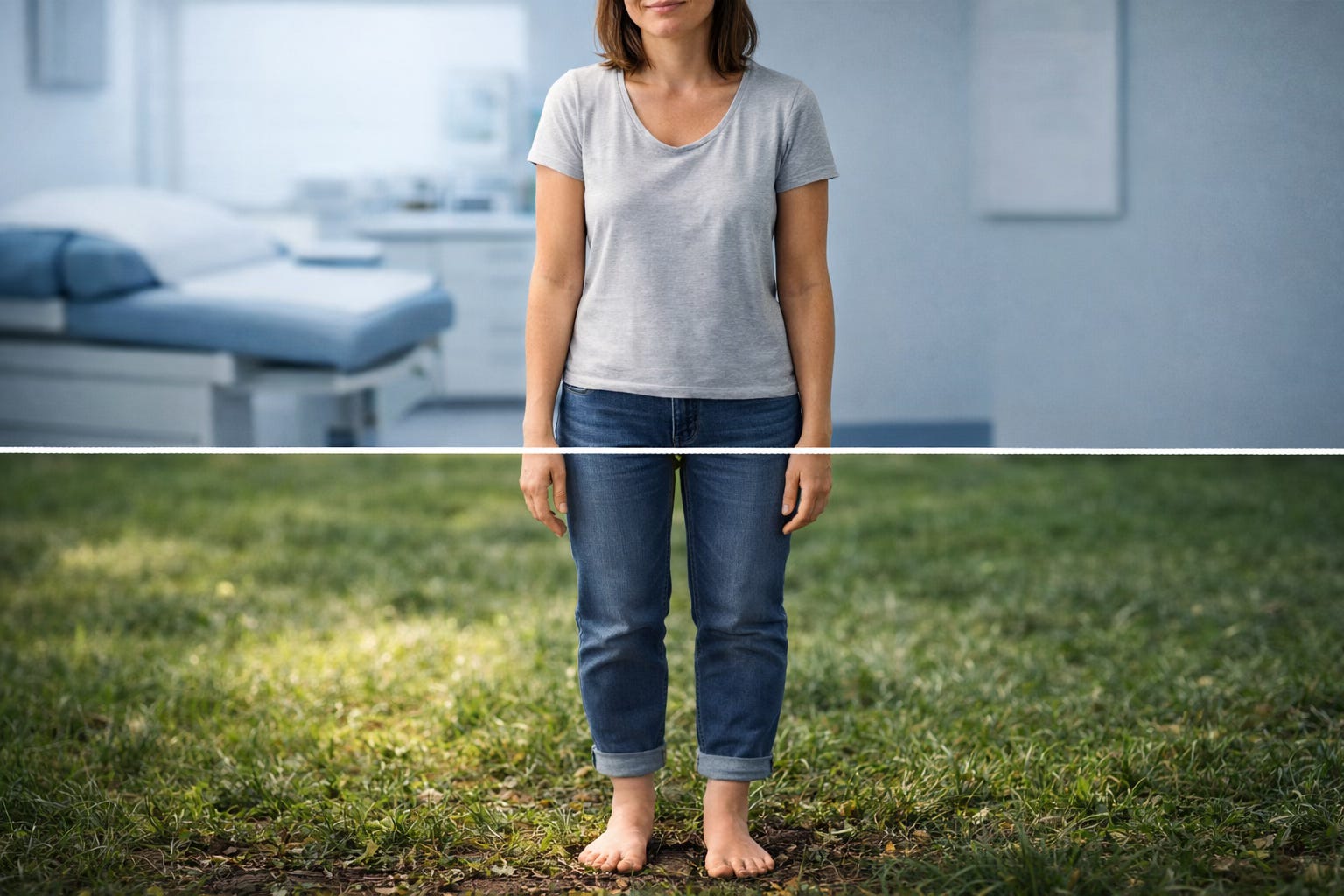
So I did something that felt almost too simple. I went outside and walked on grass. I made coffee slowly. I sipped it slowly. I engaged my senses. I returned to my body. And it changed everything.
That moment taught me something I wish our culture understood. System suppression is not the same as system regulation. Suppression says: make it stop. Regulation says: come back. Come back to breath. Come back to sensation. Come back to the body as the sacred interface, the place where life meets you, the place where the Beloved meets you.
Healing is not numbing. Healing is not shutting down. Healing is not plugging a volcano. Healing is learning how to feel what is true without being destroyed by it. It is letting anger move through you without becoming violence. It is letting grief soften you without collapsing you. It is letting anxiety become a signal, not a sentence.
For me, healing has meant learning to regulate my nervous system. Not by suppressing emotion, but by resourcing my capacity to feel it. It has meant practices over products. It has meant return over escape. It has meant re-creation.
Trauma culture, and the way identity can get anchored in injury
Now, in the midst of all this, we need to talk about trauma, because trauma language is everywhere now.
On one hand, I am grateful. There are people who lived for decades believing they were broken, when what they were actually carrying was a nervous system shaped by pain. Naming trauma can be the first crack in the shame story. It can be the first moment someone realizes: “This response makes sense.” That is a gift.
But trauma language can also become another identity trap. Trauma culture, as I am using the phrase, is the obsession with trauma as a defining feature of the self. It is the way “I am traumatized” can become both a core identity and a social shield.
It can turn into: You cannot challenge me because I have this trauma. You cannot call me toward growth because you might trigger me. You cannot tell me the truth because my story is the trump card.
And again, I want to be tender here. Sometimes those boundaries are necessary. Sometimes a person is genuinely not resourced for certain conversations. Sometimes safety is the first step. But I have also seen trauma language become a defense mechanism against growth.
This is the distinction that matters. Trauma as explanation says: this is why the pattern formed. Trauma as destiny says: this is who I am forever.
The first can be liberating. The second becomes a prison.
Trauma is not only what happened to you. Trauma is your response to what happened. And here is the hopeful part. Responses can change.
That does not mean you can rewrite history. It means you can rewrite the way your body holds it. You can change the groove. You can build new pathways. Neuroplasticity is real. The nervous system can learn safety. The body can repair.
In other words, you can move from “this explains me” to “this shaped me.” “This explains me” often keeps you in victimhood. “This shaped me” becomes a compost story. It becomes, “This happened, and it was real, and it left a mark. And I am still here. And I am still becoming. And I can metabolize this into wisdom and tenderness and strength.” That is re-creation.
The alternative vision, becoming human again
If consumption as healing is the villain, then re-creation is the alternative.
Re-creation is not self improvement. It is not hustle. It is not another performance project dressed up as spirituality. Re-creation is participation in the slow restoration of wholeness. It is the ongoing healing of fragmentation within self, with others, with earth, with God, with the Beloved. It is embodiment, not evacuation. It is presence, not perfection. It is learning to live from belovedness instead of fear.
And it has a doorway. Returning to the body. Because the body is not an obstacle to transcend. The body is the sacred interface. It is where we encounter the world, and where we encounter Spirit.
This is why the most human thing you can do in a dehumanizing culture is often painfully simple. Breathe. Feel your feet. Taste your coffee. Walk on the earth. Notice the tension in your jaw. Let your nervous system know it is safe. Let the story move through you. Come back.
Returning to the body is not a cute wellness trend. It is resistance. It is solidarity with your own humanity. It is the refusal to be reduced to a diagnosis, or a consumer profile, or a set of symptoms to manage. It is the practice of becoming human again.
What I want you to hear, if you are holding a diagnosis right now
If you have a diagnosis, I am not here to rip it away. If the label gave you language, I honor that. If it helped you feel less alone, I honor that. If medication has helped you survive, I honor that.
But I want to offer an invitation.
Do not confuse the name of the wound with the path of healing. Do not confuse relief with re-creation. Do not confuse management with aliveness.
Let diagnosis be a flashlight. Use it to see. Use it to orient. Use it to find support. But do not let it become the walls of your life.
Because you are not a problem to solve. You are a human to restore. And restoration is possible. It’s how we stay human.
Embodiment Practices
Whether your day only allows for a 60-second reclamation, your week a one-hour resistance ritual, or you find yourself ready for a full on rebellion against a world that assaults your humanity. While these practices are usually behind the paywall, this week they are my gift to you.