


Every winter, the funerals come in waves. Overdoses. Suicides. Lonely deaths in motel rooms and tragic crashes on icy roads. We grieve and adapt. We tell ourselves it’s just how things are.
But what if it’s not? What if these tragedies aren’t unfortunate flukes, but symptoms of a society that’s been structured for extraction instead of care? This post is a refusal to normalize the abnormal. It’s an invitation to remember what we were made for, and to reimagine what else is possible. Not through politics or protest, but through a grassroots resurrection of presence, community, and love.
Because this is not how life works. This is how empire works, and empire only wins if we forget we are human.
Watch or Listen
The Whole Story
I sat in my car for a moment after pulling up in front of the house. I popped open my iPad, made sure I was online, pulled Notion up to the right page, and double checked the names of family members, saying each one and hoping they would lock into my short-term memory. Then I took a deep breath, walked up to the door, and knocked.
As a funeral officiant, I’ve done this more times than I can count. You walk in. Shake hands. Offer hugs. Nod when they say they’re doing okay, even when you both know they’re not.
Normalizing the Abnormal
This time, it was a 38-year-old. Dead from an overdose. Found alone in a hotel room. Grandson. Son. Brother. Father. Uncle. Gone.
And what struck me, what arrested me in a strange kind of horror, was how not shocked I was. I didn’t feel surprised. Not at the way he died. Not at the age. Not at the grief spread like ash across the faces in the room. This has become normal. And that realization wrecked me.
I sat with the family. We sifted through photos. We talked about his smile, his humor, his struggles. The child he once was. The man he wanted to be. The ways he showed up. The ways he didn’t. And under it all was this hum. This background static of resignation. Another young man. Another overdose. Another story that ends in a funeral home instead of a full, messy, mid-life unraveling.
Just a few weeks earlier, it was a 16-year old murdered in the street as a party took a violent turn. A few weeks after, I presided over the burial of a 24-year-old. We’ll never know if she was murdered or committed suicide in that Vegas hotel. A few weeks later, it was another 38-year-old, lost in a car crash, one her four-year-old daughter survived. The stories keep coming.
A few days after the first 38-year-old’s service, I was talking with someone about the funeral business. They asked how things were going, and I said what I always say when this time of year rolls around. “It’s going to be a busy winter.” I don’t say that to inspire shock. It’s just the rhythm of things. Winter is always heavier. Like trees that shed their leaves, winter strips away pretense. The cold reveals what the warmth allowed us to hide.
Natural Rhythm vs. Abnormal Rupture
There’s a softness to this season, if you know what to look for. Older people sometimes hold on just long enough to see their family gathered one more time at Thanksgiving or Christmas. They catch that last flicker of connection, and then they let go. There’s something holy in that. The body knowing its time. The soul easing into release.
But winter also brings loneliness. And depression. And suicide. Which is not holy. It’s hell. It’s not normal that the holidays increase suicide rates. It’s not normal that the pressure of joy makes people feel more isolated than ever. It’s not normal that economic stress pushes people to the brink.
And here I am. The one who walks into living rooms and chapels and churches and gravesides, finding words that don’t dismiss the emotion, but walk people into the grief and guilt and shame and loss, not so those feelings can be amplified, but so they can be honored, witnessed, and moved through.
I’ve come to realize, again and again, that the problem is not the grief. The grief is sacred. The grief tells us we loved. The grief, in many ways, is what keeps us human.
The problem is that this untimely grief has become so routine. It is no longer a disruption. It is a fixture. In the society we’ve chosen to create, it is normal. And as much as it stirs discomfort, as much as we might live in denial of it, we’ve normalized death in youth. We’ve normalized isolation in winter. We’ve normalized despair in the season of joy. And sadly, for me, stepping into it now feels frighteningly normal.
The Sickness of Normal Abnormality
There’s a quote I come back to often. It’s attributed to the Indian philosopher Krishnamurti: “It is no measure of health to be well adjusted to a profoundly sick society.”
I’ve never seen that quote stitched on a pillow or printed on an office wall, but it belongs there. Tattooed on our collective conscience. Branded into the bones of anyone trying to survive modern life with their humanity intact. Because we are adjusting. All the time. Adapting to absurdity.
We tell ourselves it’s just how things are. That funerals come in waves. That holidays are hard. That suicide, overdose, loneliness, and economic collapse are all just part of the landscape. We shrug and adjust. We learn to carry the weight. To silence the ache. To fold our grief into a socially acceptable size. And then we call it normal.
But what we’re grieving isn’t just death. It’s the architecture of a world built on false assumptions. We are suffering not because this is human nature, but because this is the nature of the systems we’ve constructed.
The death and despair we’re experiencing isn’t inevitable. It’s not biology. It’s not fate. It’s not the will of the divine. It’s a system we built. A society we’ve chosen, whether actively or by inertia. And like any system, it can be unbuilt. Remade. Reimagined.
Because these tragedies aren’t just individual misfortunes. They are collective symptoms. Symptoms of a society where we’ve mistaken productivity for worth and profit for value. Where connection is rare, but performance is required. Where we medicate instead of support, consume instead of care, isolate instead of gather. Where grief is privatized. Health is monetized. Love is conditional. Where the most vulnerable are always the most expendable.
The grief we experience when loss comes home is sacred. But the systems that cause it? They are not. And the greatest danger isn’t the violence or the loneliness or the injustice. It’s how easily we accept them. How we stop being disturbed. How we start calling this normal.
This isn’t a sermon. This is a rupture. A plea to feel again. To name what’s wrong. To stop numbing ourselves with acceptance. Because when we stop grieving, we stop longing. And when we stop longing, we forget what we were made for. We forget what it means to be human.
Why We Normalize the Abnormal
And I get it. I really do. I understand why we numb ourselves with acceptance. So when we see these abnormal outcomes from what we’ve settled for as normal, we reach for the familiar lines. “God wanted them more.” “Everything happens for a reason.” “They were spared some future pain.” I’ve sat with parents who’ve clung to those phrases like life rafts. Not because they’re true. But because having to admit the society we’ve created is profoundly sick is too much to bear.
Yet that is exactly what we need in those moments. It isn’t explanations or justifications, it’s the lifejacket of presence that allows us to sit with the silence and feel all the emotions, and as we feel, to allow the questions that form from the ache to rise from beneath the surface:
What if the grief isn’t just personal?
What if it’s pointing to something deeper?
What if the suffering isn’t a test, or a lesson, or a punishment?
What if it’s a symptom, a symptom of a profoundly sick society?
Because when our stories of normal stop working, the soul starts searching. And it’s there, right there, that theology in the truest sense begins. Not as certainty. Not as doctrine. But as the ache to remember who we are and why we’re here.
We Have a Choice
And that ache opens a choice. Not just what we believe, but how we live. Not just what we worship, but what form we take in the world.
As humans, we are meaning-makers. Whether we name it as faith or not, we all live liturgically. We practice beliefs we never choose. We inherit rituals we never named. We are formed, shaped, discipled. Not just in churches or temples or mosques, but in checkout lines, corporate trainings, scroll loops, and policy decisions. And what we worship, what we allow to have ultimate say, shapes what we call normal.
James K.A. Smith writes about “cultural liturgies.” He names how our hearts are shaped not by the ideas we believe, but by the practices we repeat. And while churches may teach belief, malls teach desire. Markets teach allegiance. Social feeds teach identity.
The mall has an altar. The brand is a god. The scroll is a prayer wheel. You become what you repeat. And what you repeat becomes normal.
We’ve baptized the marketplace. We’ve theologized capitalism. We’ve traded the living God for a curated algorithm of self-justifying wants. And we wonder why it’s so hard to stay human.
The Taking Form
The world we’ve inherited, the world we keep recreating, has a form. A shape. A posture it trains us into. Catholic priest and educator Henri Nouwen called it the “taking form.” It doesn’t always take with violence. Sometimes it takes with a smile. With a headline. With a price tag. Sometimes it doesn’t even feel like taking at all. It feels like being seen, being liked, being safe. But it is still taking.
The taking form is always about control. It wants power over how others see you. It crafts the image. Projects the self. Performs certainty. Hides the wound. It seduces with stability but deals in shame. It uses performance to cover fear. It builds systems that look like care but are structured for profit. Healthcare that calls itself compassionate while extracting billions. Food systems that promise nourishment while engineering addiction. Religions that speak of love while policing bodies and branding belief.
The taking form is not just a spiritual metaphor. It’s an economic model. A political logic. The shape of empire. And it works because it has taught us to value appearance over essence. Image over integrity. Performance over presence. You can see it in every ad that sells salvation. In every influencer post designed for envy. In every policy that rewards the efficient over the honest. We live under a regime of managed perception.
And so we adapt. We curate ourselves to be acceptable. We normalize the spectacle. We call it branding. We call it professionalism. We call it spiritual maturity. But what it really is, is hiding. What it really is, is fear. And the more we shape ourselves according to fear, the more our world begins to reflect that shape.
The (For)Giving Form
But there is another form. Nouwen called it the “forgiving form.” We might also call it the vulnerable form. The human form. The Christ form.
This is not a form that grasps or hides. This is the form that kneels. That bleeds. That forgives. That shows up unguarded and says, “Here I am.” The forgiving form is the posture of sacred presence. It is not efficient. It is not profitable. It is not polished. But it is real. And it is life. It is the way a seed breaks open in dark soil, surrendering its shell to become something new.
Where the taking form builds walls, the forgiving form builds tables. Where the taking form says, “I must be seen as powerful,” the forgiving form says, “You can see me as I am.” Where the taking form demands payment, the forgiving form gives itself away.
It’s not that one form is religious and the other secular. It’s that one is human and the other is not.
(For)Giving Across Traditions
All of the great faith traditions echo this contrast.
In Buddhist practice, there’s the renunciation of illusion. Not just illusion in the mind, but illusion projected by culture, consumption, and control. To see clearly is to let go of what is not real, it is to abandon taking so you can embrace giving.
In Jewish theology, the prophets speak again and again of teshuva, which is often translated as repentance. While repentance has connotations of guilt or potential punishment, teshuva translated more literally connects to the idea of return. Return to justice. Return to truth. Return to the human we have hidden beneath our idols. Again it is the movement from taking to giving.
A Sufi proverb declares, “I searched for God and found only myself. I searched for myself and found only God.” This is the paradox at the heart of all true religion. The more we let go of managing how we are seen, the more we are truly seen. The more we relinquish control, the more we experience connection. The more we surrender our illusions of power, the more we discover the sacred in the center of our being.
And in Indigenous spiritualities, especially those rooted in relationship with land, the human is never isolated. The human belongs in a web of reciprocity. To dominate, to hoard, to manipulate the image, these are symptoms of disconnection, not strength.
So much of what we call normal is simply what we’ve practiced long enough to stop noticing. But if we stop noticing, we stop resisting. And if we stop resisting, we stop transforming. And if we stop transforming, we settle for survival instead of love.
Life vs. Empire
This is not how life works. This is how empire works. And empire is very good at hiding in plain sight. It doesn’t march in with banners and boots anymore. It shows up with buzzwords and branding. It speaks in metrics and margins. It hides in what we call normal. In the expected. In what we’ve come to believe we can’t change.
Empire tells stories too. But not the kind that makes you more human. Empire tells the kind that makes you compliant. Empire says: This is just the way things are. Markets are natural. Poverty is deserved. Success is proof of virtue. Wealth is wisdom. God helps those who help themselves.
But every one of these lines is a lie. A beautifully marketed, algorithmically reinforced, industrial-grade lie.
Empire and Markets
I heard the “This is just the way things are” argument in my TikTok comments a couple weeks ago. Based on the 79 in the username and the tone of the replies, I’m guessing this forty-something man, proud of his passport stamps and degrees, was certain of his point. He insisted that markets are the only natural way for humans to live together, so whatever outcomes they produce are unavoidable. He insisted it’s been that way since the first caveman offered his wheel for a slab of mammoth meat. We exchanging goods and call it society. It was Adam Smith, simplified and sanctified.
Never mind that David Graeber’s Debt: The First 5,000 Years blows that myth to pieces. Graeber shows that for most of human history, economies were not driven by markets or money, but by trust, obligation, reciprocity, and relationship. Not transaction, but connection. Not profit, but presence. We have not always lived this way. We do not have to keep living this way.
Empire and Poverty
The same is true of poverty. Poverty is rarely about laziness or moral failure. It’s about policy. It’s about who has access and who is excluded. It’s about systemic disinvestment, racialize exploitation, inherited trauma, and the fact that the harder some work, the less they have. Poverty is not the absence of character. It is the result of extraction.
Empire and Success
The opposite is true at the other end of the spectrum. Success is often not a result of hard work, but proof of proximity to power. Take Elon Musk. He’s celebrated as a self-made genius, an icon of innovation. But the rise of Tesla and SpaceX is not a story of pure entrepreneurial brilliance; it’s a story of billions in government subsidies. From Department of Energy loans to lucrative federal contracts and tax breaks, Musk’s empire is built with public money. His success isn’t just innovation. It’s access. It’s being in the room where decisions are made and dollars are allocated. It’s empire rewarding its own.
Others achieve success by finding ways to maximize monetization of what others generously laid the groundwork for. Consider the mRNA vaccines. The foundational technology was nurtured by decades of publicly‑funded research at the National Institutes of Health and other agencies, with hundreds of research grants and inventions that directly contributed. When the pandemic struck, private firms built on that base, secured patents, and earned billions in revenue. Citizens and taxpayers paid first for the research and then again through the market for access. The result: a preventive medical breakthrough, for some of the population yes, but also a sharply illustrated case of how the dance between public investment and private profit plays out in our world.
In Pharma, this kind of grift is institutionalized. What corporations too often call ‘research and development’ is, in significant cases, not a fresh discovery but a carefully‑scripted lifecycle play. Minor tweaks to existing drugs (a reformulated dosage, new delivery mechanism, or repackaged indication) become new patents, delayed generics, extended monopolies. The goal shifts from better medicine to longer exclusivity. It becomes profit rather than healing. Innovation gets the marketing spotlight while the real engine runs on extraction and enforcement.
And it’s not just the drug companies. It’s the same with your smartphone. GPS, touchscreen tech, the internet itself. These weren’t corporate inventions. They were government-funded advances, birthed in labs and universities, freely shared with the world. Apple simply wrapped them in sleek design, claimed the rights, and locked them behind a brand.
The Lessons of Empire
Because all of that is how empire works. Empire is not just a nation. It’s not just a government. Empire is a way of organizing life where power concentrates, where worth is measured in production, and where those with the most resources shape reality for everyone else. Then it tells you lies to justify itself.
It hides in corporate language. In religious platitudes. In policy decisions that feel like destiny. And when empire becomes the air we breathe, it starts shaping the world in its own image. Not out of malice. But out of efficiency. Control. Fear.
Empire teaches us to take. To hoard. To dominate. To hide. To perform. And then it tells us this is just being responsible. Just being safe. Just being smart. And what does empire breed? Overdoses. Murders. Car crashes that shouldn’t happen. Funerals that should have been birthday parties. Grief that isn’t tragic anymore. It’s just expected.
This isn’t empire in decay. This is what empire produces.
The End of Empire
But yes. Empires do decay. They always do.
Sometimes they collapse under their own weight: bloated, overextended, disconnected from the people they claim to serve. Sometimes they are torn down in revolution, when the people finally decide survival is not enough. Sometimes they’re conquered from the outside. Sometimes, they cannibalize themselves from within.
But something new is happening now.
For the first time in history, empire may no longer need people. At least, not the masses. AI replaces workers. Automation replaces community. The ultra-wealthy retreat to enclaves, no longer dependent on the labor or loyalty of the many. They don’t need human batteries anymore. They’ve built machines to mine our attention, mimic our empathy, and monetize our emotions.
So what do we do? Violent revolt will not save us. It just becomes another story empire will sell back to us later. Another brand of patriotism. Another myth of blood-earned freedom.
Creating Something New
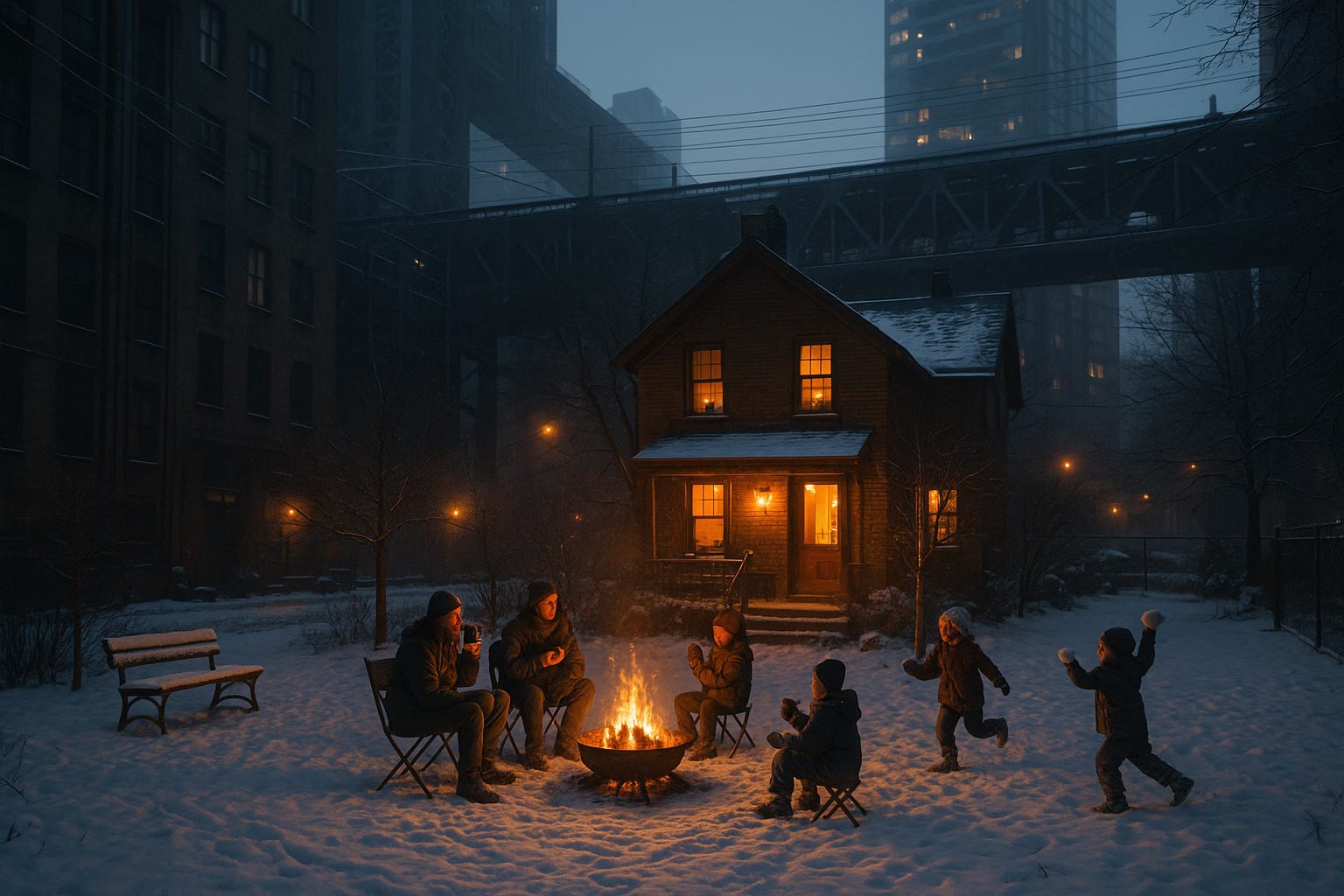
We need something slower. Something quieter. Something deeper. A grassroots resurrection. A return to the forgiving form. Not a storming of the gates. A lighting of fires in every home. Not a toppling of structures. A nurturing of lives in the shadow of what no longer serves us. Mutual aid instead of market exchange. Community instead of consumerism. Sufficiency instead of scarcity.
And this does not have to happen via some grand political turnaround. It can, sure. It may include ballots, civic reform, policy shifts. But it doesn’t depend on them. This isn’t about showing up every four years and hoping for something better. It’s about showing up now. In neighborhood kitchens. In lending a hand across the driveway. In sharing a table, not waiting for permission. It’s the quiet revolution of people who choose each other over the system. Who build the structures of care beneath the radar of empire. Together. Not waiting. Because the world we were made for is not on loan. It’s being built here. By us.
This is the true beginning of empire’s undoing. Not with swords. But with presence. With shared meals. With shelter offered. With needs met. With stories told. With the courage to name that this, this world we’ve made, is not the only one possible. And not the one we were made for.
So what might the world we were made for look like?
Life Beyond Empire
Let’s imagine a world beyond the lies of empire. A world where intelligence isn’t measured by how well it can manipulate or extract, but by how deeply it can connect and uplift. Where we no longer entrust our future to machines built to mimic humans, but to communities committed to becoming more fully human. Machine learning, not as artificial but enhanced intelligence, supporting what is humane, not out to replace humans.
Let’s imagine a world where wealth is no longer accumulated through proximity to power or by manipulating what the public paid to discover. mRNA technology, GPS, touchscreen tech would not be privatized behind corporate patents. They would be shared as a common good. Because what was birthed from our collective effort should benefit our collective life.
Let’s imagine we structured our economy not around scarcity and extraction, but around sufficiency and well-being. We would no longer measure economic strength by profits during global crises or soaring stock prices while the shelves of food banks are depleated. We would measure it by how few go to bed hungry. By how many are lifted into wholeness.
We would no longer believe the lie that everything must be market-driven. That the only value worth naming is the one with a dollar sign. We would dare to believe in systems that serve people, not profits. In solutions rooted in care, not competition.
And when we begin to undo those lies, when we start to unlearn what empire taught us, we create space for something new. Or rather, something ancient and eternal to return.
Children would be raised not with pressure to perform, but with permission to play. Education would center joy, curiosity, and wonder. The question wouldn’t be, “How will you contribute to the economy?” but, “Who are you becoming?”
Safety would no longer be a luxury afforded to the gated few. It would be a right woven into every neighborhood, every policy, every streetlight and sidewalk and school hallway. We would stop building cages and start building trust.
Food would not be a commodity engineered for addiction. It would be communion: nourishment for body and soul, grown in reciprocity with the earth and shared with gratitude at the table.
Innovation would be a shared blessing, not a corporate goldmine. It would arise not from urgency to dominate but from the desire to heal, to restore, to tend to the world with reverence.
Work would be restored to dignity, not reduced to exploitation. No longer the endless hustle to survive, it would become a means of contribution, creativity, and care. We would measure success not by promotions but by presence. Not by revenue but by restoration.
Healthcare would no longer be a privilege wrapped in bureaucracy. It would be a sacrament: a sacred expression of our shared humanity. Not something earned by employment or luck, but something offered as a basic act of love.
And if we built such a world, if we structured life around presence instead of performance, around care instead of control, then winter and the holidays would no longer be the season of despair. It would become what it was always meant to be: a time of reflection, of gathering close, of connection in the quiet.
Death would still come. It always does. But it would arrive with gentleness, in its time. Not as the shock of overdose or suicide, not as the violence of despair or the silence of isolation. The early death, the tragic death, the funeral before the mid-life unraveling, these would become rare again. An aberration, not an expectation. Because in a world where we honor our humanity, where we care for one another, where presence is prioritized over performance, untimely death no longer needs to be normal.
And that is not fantasy. That’s what it’s like when we collectively rise up, reject what’s not normal, and come together so that we can stay human.
Embodiment Practices
Whether your day only allows for a 60-second reclamation, your week a one-hour resistance ritual, or you find yourself ready for a full on rebellion against a world that assaults your humanity, behind the paywall I offer you three practices that will help you bring this post to life in your everyday.