


What if your feet have been trying to tell you something your whole life?
Not just about your gait, your pain, or your shoes. But about your story. Your culture. Your god.
This isn’t just about footwear. This is about the scaffolding we’ve been sold in place of strength. About how our bodies have been medicalized, managed, and mistrusted. About the way modern life keeps us numb, disembodied, and dependent. Then it convinces us it’s for our own good.
In this piece, I explore how orthotics and lawns, high heels and heel drops, fashion and faith all trace the same arc: from embodied wisdom to artificial support. From sacred design to dependency. And I ask what might happen if we stopped compensating and started cultivating the capacity we were born with.
Feet first.
Because how we walk tells the story of how we live. And maybe, just maybe, that story’s ready to change.
Watch or Listen
The Whole Story
I was standing in the middle of the LA Convention Center, surrounded by thousands of bodies moving through The Fit Expo. Behind me, a banner highlighting the brand I represented. The Foot Collective, a group that believes “the key to better movement, less pain, and greater freedom starts with our feet.” Their goal, to provide the tools and training needed to, “empower people along the journey of restoring natural foot function and balance.” And they want to have as much fun as they can along the way.
So the question I keep asking those passing by was, “How are your feet doing?” and the follow up, “How will they be in a couple hours.” For those who were or would be suffering, I’d introduce them to a Soulmate.
While I did this hundreds of times over two days, there are a few people who really stood out in their responses. One was a woman in her sixties. When I asked that opening question she pointed down at her feet, encased in what looked like small orthopedic fortresses, and said with genuine pride, “I finally found the right orthotics and the right cushioned shoes. My feet have never felt better.”
She wasn’t the only one who had that response. Person after person would share their relief at finding the right insert, the right arch support, the right amount of cushion. And each time, I felt the quiet ache of watching people celebrate a scaffolding they’d been taught to mistake for strength.
So what did I do? I smiled. I nodded. And then I told her what I knew.
“It sounds like you’ve found a manufactured, outside-of-your-body solution to address the problems you were experiencing,” I said gently. “What we offer here are tools and resources that will help restore your body so it’s in a place where it can do what it’s designed to do without that support.”
She looked confused at first. Then curious. But also a bit traumatized at the idea that those she trusted to provide a solution might have actually just sold her a band-aid.
And in a world where we’ve been told to obsess over high arches and flat feet, along with the notion that healthy feet need support, the simple suggestion that feet, if we take time to strengthens and mobilize them, are designed to endure anything we can throw at them, sounds radical.
Some people weren’t ready to hear it. Some were defensive. But others leaned in. They sensed something true in what I was saying, even if it challenged everything they’d been told about how bodies work.
The Body as Sacred Interface
Here’s what I’ve come to understand, both through my work with The Foot Collective, my years at Xero Shoes, and through my own stumbling journey back into my body: your body is not a problem to be solved. It is a sacred interface with the world.
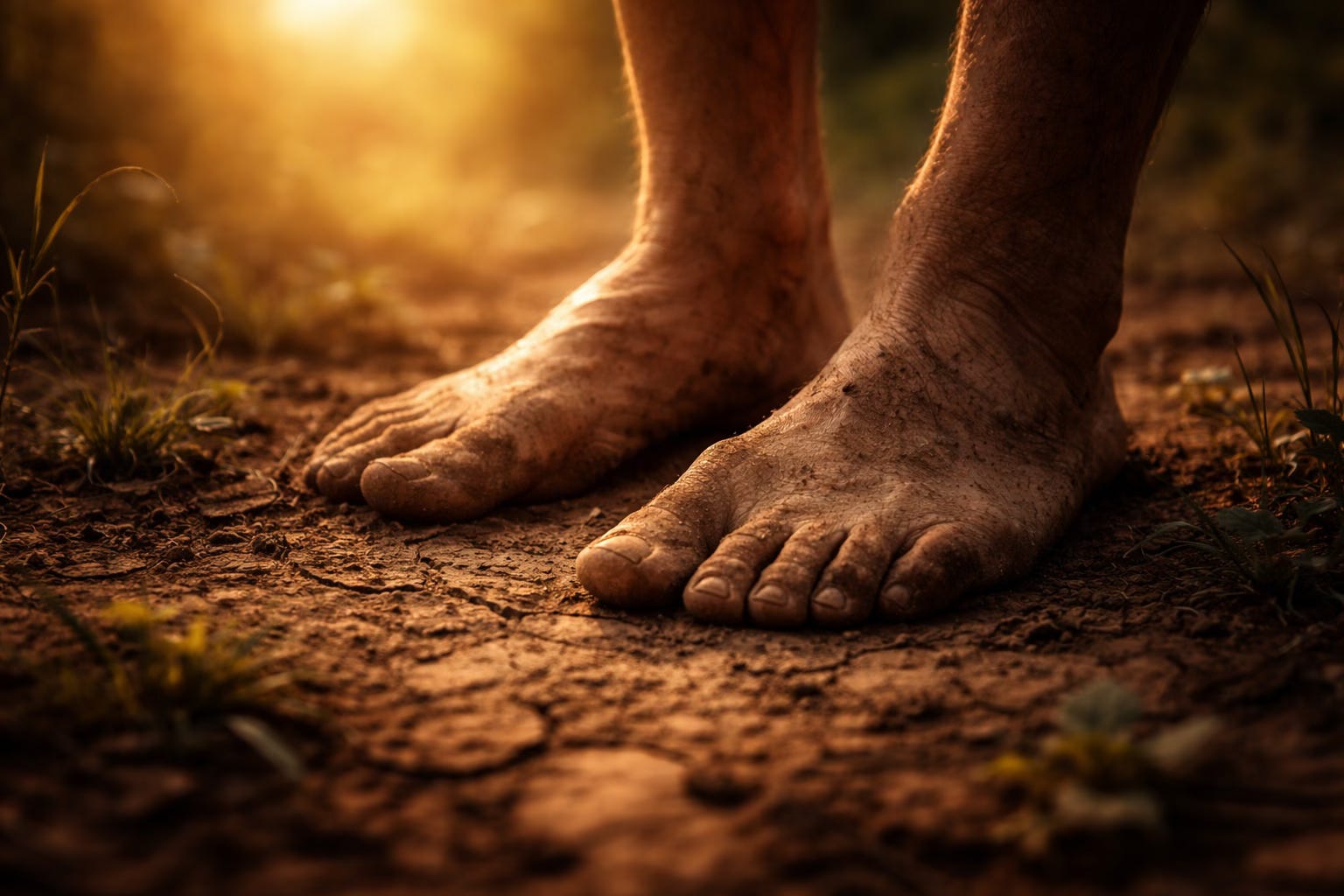
When the Christian tradition talks about being made in the image of God, the Imago Dei, it’s not just talking about some abstract spiritual quality floating above our meat and bones. It’s saying that this body, with its thirty-three joints per foot, its ten thousand nerve endings, its ability to feel stone and soil and temperature and texture, is the very means by which we encounter the divine.
The body is not an obstacle to transcend. It is the canvas of our becoming.
And what we’ve done, in our modern brilliance, is build an entire industry around the assumption that this sacred interface is fundamentally broken. That it needs constant intervention, perpetual correction, endless compensation.
But here’s what I need you to hear: this isn’t just about feet. This is about the body as sacred interface, about what it means to be fully human in a world that profits from our fragmentation. The story of the foot is the story of everything. It’s how we’ve been taught to mistrust our own design, to outsource our strength, to believe that the scaffolding is the structure. And once you see this pattern in your feet, you start seeing it everywhere: in how we eat, how we move, how we rest, how we relate, how we think about ourselves and our place in the world.
The question isn’t just “How do we restore our feet?” It’s “How do we restore our humanity?” Because every time we choose compensation over cultivation, every time we reach for the external fix instead of tending the internal capacity, we’re participating in a larger story. A story that says we’re fundamentally broken. That our bodies can’t be trusted. That we need constant intervention just to function. And that story, friends, is a lie that keeps us dependent, disembodied, and disconnected from the very ground beneath us.
So what is the story of feet? How did we get here and what might it reveal about a larger story of staying human?
How We Got Here
For thousands of years, human feet moved across varied terrain: rock, sand, mud, root, snow, grass. Our feet learned to grip, to adjust, to respond to the earth beneath them. Every step was a conversation between body and ground, a tiny negotiation that kept joints mobile, muscles engaged, balance sharp.
Then we invented the modern shoe. It’s appearance isn’t an accident of progress. It’s a two part story, with the first one involving fashion born from function, then frozen into form long after the function faded.
So what are the characteristics of the modern shoe and where did they come from?
Medieval Function Becoming Fashion
Have you ever noticed how modern shoes taper into points at the toe, never mind that feet, especially healthy ones, are widest at the toes? Who decided that, rather than shoes being foot shaped, shoes should reshape our feet?
When we go back in history, it becomes clear that the narrow toe and elevated heel weren’t originally designed for walking. They were designed for riding. In medieval Europe, those wealthy enough to own horses needed footwear that would slip easily into stirrups and lock securely in place. A pointed toe made insertion smooth. An elevated heel caught the stirrup’s edge, anchoring the rider’s foot so they could maintain control of a thousand-pound animal beneath them.
This made perfect sense if you spent your days on horseback. But here’s where the story turns: because the people who rode horses were the people with wealth and power, they were also the people who set the standard for what looked dignified, respectable, fashionable. The riding shoe became the status symbol. And status symbols, once established, rarely stay tethered to their original function.
By the 15th century, narrow-toed shoes had become wildly fashionable across Europe. The wealthy weren’t just wearing them for riding anymore. They were wearing them everywhere, each generation making the toe boxes narrower, the points more exaggerated, the heels more pronounced. It was a way of announcing, without words, that you belonged to the class that didn’t walk far, didn’t labor with their hands, didn’t need their feet to be practical.
And the bodies paid the price.
Skeletal remains from 15th-century England tell a story the fashion historians missed. Among the wealthier segments of the population, there’s a sudden explosion of bunions, deformed toe joints, and broken arms. The bunions came from years of squeezing feet into shapes they were never meant to hold. The broken arms came from falls: people losing their balance because their feet, trapped and weakened in rigid, narrow shoes, could no longer do the subtle work of keeping them upright. They were literally breaking their bodies to signal their status.
One of the women I encountered at The Fit Expo, a woman who spent the day walking around in high heeled boots, summed up their lives in a single sentence, “Beauty is pain.” she told me. And the terrifying part, she meant it and embraced it.
The Lawn as Status Symbol
There’s another perfect parallel here, and it’s literally right under our feet: the American lawn.
The manicured grass lawn isn’t native to most of America. It’s a European import, specifically from the English and French aristocracy, where vast stretches of perfectly maintained grass signaled that you had so much land and so much wealth that you could afford to dedicate acres to something purely ornamental. You didn’t need that land to grow food. You didn’t need it for livestock. You had enough resources that you could pay people to maintain grass for the sole purpose of looking at it.
It was the ultimate status symbol: perfectly useless land.
And we imported that symbol wholesale, but here’s the problem: most of America doesn’t have the climate for it. England is cool and rainy. Grass grows there with minimal intervention. But we’ve taken this European status marker and tried to force it onto desert climates, arid regions, places where grass has no business growing naturally.
So what do we do? We pump massive amounts of water, a precious and increasingly scarce resource, into keeping these lawns alive. We dump fertilizers and pesticides to maintain that perfect green color. We mow obsessively, often with gas-powered equipment that pollutes the air. We’ve created an entire industry around maintaining something that doesn’t belong in most of the environments where we’ve planted it.
And for what? So we can signal the same thing those European aristocrats were signaling centuries ago: that we have resources to waste. That we can afford to maintain something purely decorative. That we belong to a certain class, a certain vision of suburban respectability.
The lawn isn’t just environmentally destructive. It’s a perfect example of how we’ve mistaken the scaffolding for the structure. We’re not creating actual wealth or actual beauty or actual connection to the land we live on. We’re maintaining an imported symbol of wealth that made sense for the greedy and opulent in a completely different context, and we’re destroying our local ecosystems and depleting our water resources to do it.
Just like the narrow-toed riding boot that became fashionable footwear centuries after anyone needed it for riding, the manicured lawn persists as a status symbol long after the conditions that made it sensible have disappeared. We’re breaking our environment the same way medieval Europeans broke their feet: sacrificing function for the appearance of status.
And just like with our feet, the solution isn’t more intervention, more products, more chemicals to force the lawn to thrive where it doesn’t belong. The solution is to ask: What actually belongs here? What could grow naturally in this climate, in this soil, with the water that actually falls from the sky?
That’s cultivation. That’s working with the capacity of the land instead of constantly compensating for what it lacks. That’s letting go of the imported symbol and discovering what’s actually sustainable, what’s actually beautiful, what actually makes sense for where we are.
The Running Revolution
But as I implied before, there’s another shoe that needs to drop, the rest of the modern shoe story to tell. This one tells the story of the modern athletic shoe and the 20th century’s athletic shoe revolution. Finally, we thought, footwear designed for movement. Shoes built for function, not fashion. Except we made the same mistake all over again, just with different materials. Rigid soles that eliminate ground feel. Arch supports that do the work our foot muscles were designed to do. And cushioning, so much cushioning, that we lost all feedback from the ground. We traded the narrow constraints of the riding boot for the numbing comfort of the modern running shoe, and called it progress.
The turning point came in 1972. Frank Shorter won the Olympic marathon in Munich, and something unprecedented happened in American culture: people who had been largely sedentary suddenly wanted to run. It was beautiful. A collective impulse toward embodied movement, toward reclaiming something primal and human. But bodies that had been sitting in cars and offices for decades weren’t ready for the sudden demand. And predictably, injuries spiked.
Now, back in 1972, athletic shoes were the old school Puma and Adidas. Completely flat with minimal cushioning. Since that’s what was available, that’s what people wore. So that’s what people got hurt wearing. And here’s where the athletic shoe industry saw an opportunity. Instead of teaching people how to train well, how to gradually build capacity, how to let their bodies adapt the way human bodies have adapted for millennia, researchers came to Phil Knight and others in the early days of what would become Nike with a proposal: elevate the heel. The logic was seductive in its simplicity. Calf pain came from the eccentric lengthening of the calf muscle during running. If you elevate the heel, you shorten the range of motion, reduce the strain, eliminate the pain.
And it worked. Sort of. The immediate calf pain decreased. People felt relief. The shoes sold. The industry exploded. But here’s what they didn’t tell anyone, or perhaps didn’t yet understand: when you change the heel height, you change everything.
The elevated heel shifts your center of gravity forward. It invites overstriding: that reaching-out-in-front-of-you gait that looks fast but is actually a braking motion with every step. It encourages heel striking, slamming your heel into the ground first instead of landing on your midfoot or forefoot the way barefoot runners naturally do. And both of those changes send shockwaves of impact up the kinetic chain. The very problems the elevated heel was supposed to solve, it simply relocated. Calf pain decreased. Knee injuries, IT band syndrome, hip issues, and stress fractures skyrocketed.
The running industry has spent the last fifty plus years chasing its own tail, inventing increasingly complex solutions to problems the original “solution” created. More cushioning to absorb impact. Stability features to control pronation. Motion control systems to compensate for weak hips. Orthotic inserts to support collapsed arches. Each innovation addressing a downstream consequence of the elevated heel, without anyone willing to name the obvious: maybe we shouldn’t have elevated the heel in the first place.
What they could have done, what they should have done, was teach people how to train. How to build mileage gradually. How to strengthen feet and calves so they could handle the load. How to run with form that distributed impact naturally instead of concentrating it in vulnerable joints. But education doesn’t scale like products do. You can’t patent a training plan. You can’t build a billion-dollar empire by telling people a product will make their bodies capable.
So instead, we got an entire industry built on the premise that human feet are fundamentally inadequate for the activity they evolved to do. As time passed, all of these supposed solutions became the baseline for how every foot should be supported, all day, every day. We medicalized normal foot function and then sold the corrective as essential.
The orthotics, the arch supports, the maximum cushioning, these aren’t solving a design flaw in the human foot. They’re compensating for what centuries of fashionable constraint and modern overprotection have taken away. We didn’t just change what we put on our feet. We changed how our feet function. We weakened them. We restricted them. We turned them from strong, adaptable tools into dependent passengers. And then we sold orthotics to fix what the shoes broke in the first place.
The woman at the expo wasn’t wrong to feel relief. The orthotics were helping. But they were helping her manage a problem that modern footwear had created. She was celebrating the scaffolding without realizing she’d been robbed of the capacity to stand on her own.
My Journey Back to “Normal”
Seven years ago, I discovered barefoot shoes in the most unexpected way.
I was at an outdoor expo with my then twelve-year-old when they spotted a prize wheel at a vendor booth. You know the kind: bright colors, promises of free stuff, that magnetic pull that twelve-year-olds can’t resist.
“A spinner!” they shouted, and took off running before I could say anything.
I followed a few moments later to find my kid absolutely lit up with excitement, and some guy at the booth talking to me about these shoes his company sold. He was bending them, flexing them, rolling them into balls, going on about “natural movement” and barefoot mechanics and a bunch of stuff that made absolutely no sense to me at the time. I’m sure I looked like that 60-something year old at the expo this past weekend.
And when I looked at the shoes, I thought they were ridiculous. I’d had eight significant knee injuries and a surgery on each knee. I needed all the arch support, all the cushioning, all the structure I could get just to avoid being in constant pain. The idea that these thin, flexible, zero-drop shoes could possibly work for someone like me? Absurd.
But my kid was excited. And the booth guy told them they’d won a free pair of shoes, which was funny because there was definitely no “free shoes” option on the spinner. But they didn’t have any youth sizes at the display, so we’d have to go up to the brand’s offices to pick them up. When we got there, they ended up giving me a pair too.
Because my kid was so excited about the whole thing, I wore them a little. Just around the house at first. Then for short walks. Slowly building up time in them, mostly to humor my kid, mostly convinced this experiment would end badly.
After about a month, I decided to really test them. I wore them to work where I’d spend all day on my feet. Now, when I left the house that morning, I was absolutely convinced I would come home in agony. That there was no way these things actually worked. That they might feel fine for a little while, but they couldn’t possibly hold up for any real length of time, especially not for someone with a body like mine.
I came home that night feeling great. No pain. No problems. No knee issues. Nothing. Everything actually felt good. And outside of a couple instances where I had to wear something else for a specific occasion, I haven’t worn a traditional shoe since.
But what I wasn’t expecting was the added benefit that came with them. At the time, I was in the thick of my own mental health battle. I was stuck in patterns I couldn’t seem to break, depression pulling me backward into a past I couldn’t change, anxiety yanking me forward into a future I couldn’t control.
When I put on those barefoot shoes, suddenly, I could feel everything. Every pebble. Every crack in the sidewalk. Every shift in terrain. Where my old shoes had numbed me to the ground beneath me, these shoes made me aware of each step I was taking.
And something shifted. Every step became an anchor. A tiny invitation back into my body, back into this moment, back into the only place I actually had any power: right here, right now.
Depression lives in the past. It tells you the story is already written, that you are who you’ve always been, that nothing can change. Anxiety lives in the future. It spins catastrophic narratives about what might happen, what you need to prevent, what you must control.
But presence? Presence lives in the sole of your foot meeting the ground. It lives in the breath filling your lungs. It lives in the sensation of being here, in this body, in this step, in this singular unrepeatable moment.
The barefoot shoes didn’t cure my depression. But they gave me a practice. A way back. A reminder, with every step, that I was still here. Still embodied. Still capable of feeling.
The Architecture of Dependency
Now as much as I’ve talked about the history of footwear and feet, about barefoot shoes and balance tools, hopefully you picked up early on that it’s about so much more. It’s about a pattern I see playing out everywhere: We are sold solutions to problems we didn’t have until the system created them.
Modern shoes weaken feet, then orthotics “fix” them. Industrial food depletes nutrients, then supplements restore them. Sedentary work destroys our backs, then ergonomic chairs support them. Screen addiction fragments our attention, then productivity apps organize it.
We’ve built an entire economy on creating dependency. On weakening capacity and then selling the scaffolding to hold us up.
And we’ve internalized the lie that this is just how bodies work. That we’re inherently deficient. That without constant intervention, we’ll fall apart.
But what if that’s not true? What if our bodies, when given what they actually need, when asked to do what they were designed to do, are far more capable than we’ve been taught to believe?
Flat Surfaces, Flat Lives
When doing my contracting work in the foot health world, one of the most common objections I hear is about hard surfaces. “We’re not designed to walk on concrete all day.” And there’s truth in that. But here’s what most people miss: the issue isn’t the hardness. It’s the flatness.
Human feet are designed to adapt, to adjust, to respond to varied terrain. That’s why a quarter of your body’s joints are in your ankles down. What hurts feet isn’t hard ground. It’s the fact that every surface is exactly the same. Flat sidewalks. Flat floors. Flat parking lots. Flat everything.
Our joints don’t have to work. Our stabilizing muscles don’t have to engage. Our proprioceptive system, the intricate network that tells us where our body is in space, barely gets a signal.
And this flatness isn’t just literal. It’s everywhere.
We’ve flattened our lives. Flat schedules, same routine every day. Flat emotional ranges, medicating anything too high or too low. Flat spiritual experiences, domesticated into predictable Sunday services. Flat relationships, reduced to performative social media exchanges.
We were made for variation. For seasons. For the unpredictable terrain of being fully alive.
And when we eliminate all variation, when we cushion and support and stabilize everything, we don’t just lose strength. We lose aliveness.
The Slow Work of Cultivation
So what do we do?
Here’s what we don’t do: We don’t throw away all our shoes tomorrow and wonder why our feet hurt. That’s just swapping one form of violence for another.
The transition from scaffolding to strength is slow. Careful. Incremental.
When someone comes to The Foot Collective with decades of wearing conventional shoes, we don’t tell them to go run a marathon in huarache style sandals. We teach them to wake their feet back up. To spread their toes. To feel the ground. To build the capacity that modern footwear has been doing for them.
It takes time. Sometimes months. Sometimes years. But what they gain isn’t just stronger feet. It’s agency. It’s the knowledge that their body can be trusted, that it can adapt, that it doesn’t need constant external management to function.
And this is true beyond feet.
Wherever we’ve been living on scaffolding, wherever we’ve outsourced our capacity to products or systems or other people, the path back to strength looks the same: slow, patient, intentional cultivation of what has atrophied.
What This Means for Your Life
While I’m not just talking about feet anymore, if you’ve read this far and you’re still wearing shoes that squeeze your toes or elevate your heels or cushion every step, maybe start there. Your feet are the foundation. Literally.
But I’m also talking about everywhere else you’ve been taught you need scaffolding.
The emotional regulation app that does the work your nervous system could learn to do. The productivity system that compensates for scattered attention instead of cultivating focus. The spiritual practice that’s more about consuming content than encountering presence. The relationship dynamics where you’ve outsourced your stability to another person’s approval.
What would it mean to identify the scaffolding and ask: What capacity have I lost? What strength could I cultivate if I slowly, carefully, let this go?
This isn’t about rejecting help. Sometimes we genuinely need support. Sometimes the scaffolding saves our lives. But there’s a difference between temporary support while you heal and permanent dependency that keeps you weak.
For example, recently, my girlfriend was dealing with significant foot pain and inflammation. The kind that wasn’t stopping, that was interfering with her ability to function. And in that moment, the answer wasn’t “tough it out” or “just go barefoot and your feet will adapt.” The answer was strategic support.
We got her a pair of cushioned shoes that limited foot mobility to reduce the pressure on her joints and inflamed tissues. But here’s what made it different from the dependency cycle I’ve been describing: we also got shoes with a foot-shaped toe box, one that allows her toes, especially the big toe, to spread naturally. While it seems like a little thing, an individuated big to is not only the key to natural structure to the foot but it also improves blood flow through the entire foot.
So even while her feet were resting, even while the cushioning was protecting inflamed joints from further stress, the increased blood flow was supporting the healing process. We created the conditions for her body to do what it does best: repair itself.
But the goal was never to keep her in those shoes forever. The goal was to use them as temporary medicine while healing happened, then transition her out as quickly as possible to restore the strength and function that had been compromised.
It’s just like a broken arm. You don’t put a cast on when it breaks and then leave it on indefinitely so you never break your arm again. You wear the cast during the acute healing phase, and then as soon as it’s medically appropriate, you get it off and begin the work of restoring the muscle and function that atrophied while you were immobilized. The cast isn’t the problem. Wearing it forever is.
So yes, sometimes we need scaffolding. Sometimes we need support. Sometimes the intervention is exactly what allows healing to happen. The question is: Are we using it as medicine with the intent to restore capacity? Or are we using it as a permanent solution that keeps us dependent?
The Invitation
The simple point of all these stories about feet. Your body is not broken. It is made in the image of a God who became flesh, who walked on dusty roads with bare or barely covered feet, who knew the ache of muscles worked and the satisfaction of rest earned.
Your body is the sacred interface through which you encounter the world, through which love moves, through which presence becomes possible.
And when we honor that, when we stop treating it as a problem to be managed and start relating to it as a partner to be trusted, something shifts.
Every step becomes a conversation. Every sensation becomes information. Every moment of discomfort becomes an invitation to adapt rather than a sign of deficiency.
You are strong enough, or at least you have the potential to be. You just might need to remember how, and devote yourself to the process, to slowing developing the capacity your body is capable of achieving. And as you do, we’ll discover that this remembering is how we stay human.
Embodiment Practices
Whether your day only allows for a 60-second reclamation, your week a one-hour resistance ritual, or you find yourself ready for a full on rebellion against a world that assaults your humanity. While these practices are usually behind the paywall, this week they are my gift to you.