


“A society tells on itself by who it calls a maker.”
That sentence has been sitting with me because our economy has trained us to look in the wrong direction. We are taught to see the owner, the investor, the executive, the entrepreneur, and say, “There is the maker.” We are taught to look at the worker, the caregiver, the cleaner, the driver, the teacher, the cook, the nurse, the farmworker, the person stocking shelves or carrying boxes or answering calls, and see expense, dependency, replacement, overhead. But what if that is backwards?
What if the people we have been told are “takers” are often the ones whose labor keeps the world alive? And what if the people most loudly claiming to be makers are often taking more from workers than they ever create alone?
Watch or Listen
The Whole Story
A society tells on itself by who it calls a maker.
For years, we have been handed a story that sounds almost moral if you do not look too closely. Capital is brave. Labor is dependent. Owners create. Workers receive. Investors make. The masses take.
It is an old story in newer clothes, the same mythology Paul Ryan helped popularize when he framed society as divided between makers and takers. The makers, in that telling, are the entrepreneurs, owners, investors, executives, and people who allegedly carry the productive burden of civilization. The takers are everyone else, especially the poor, the working class, the disabled, the unemployed, the publicly supported, the unionized, the people who need help, the people whose labor keeps the world running but whose lives are treated as a cost to be minimized.
But what if the story is upside down?
What if the real makers are the people whose hands, bodies, minds, care, skill, attention, and time actually create the world we live in? What if the real takers are not the people asking for food, housing, healthcare, wages, rest, or dignity, but the people who extract wealth from labor they did not perform, then call that extraction virtue?
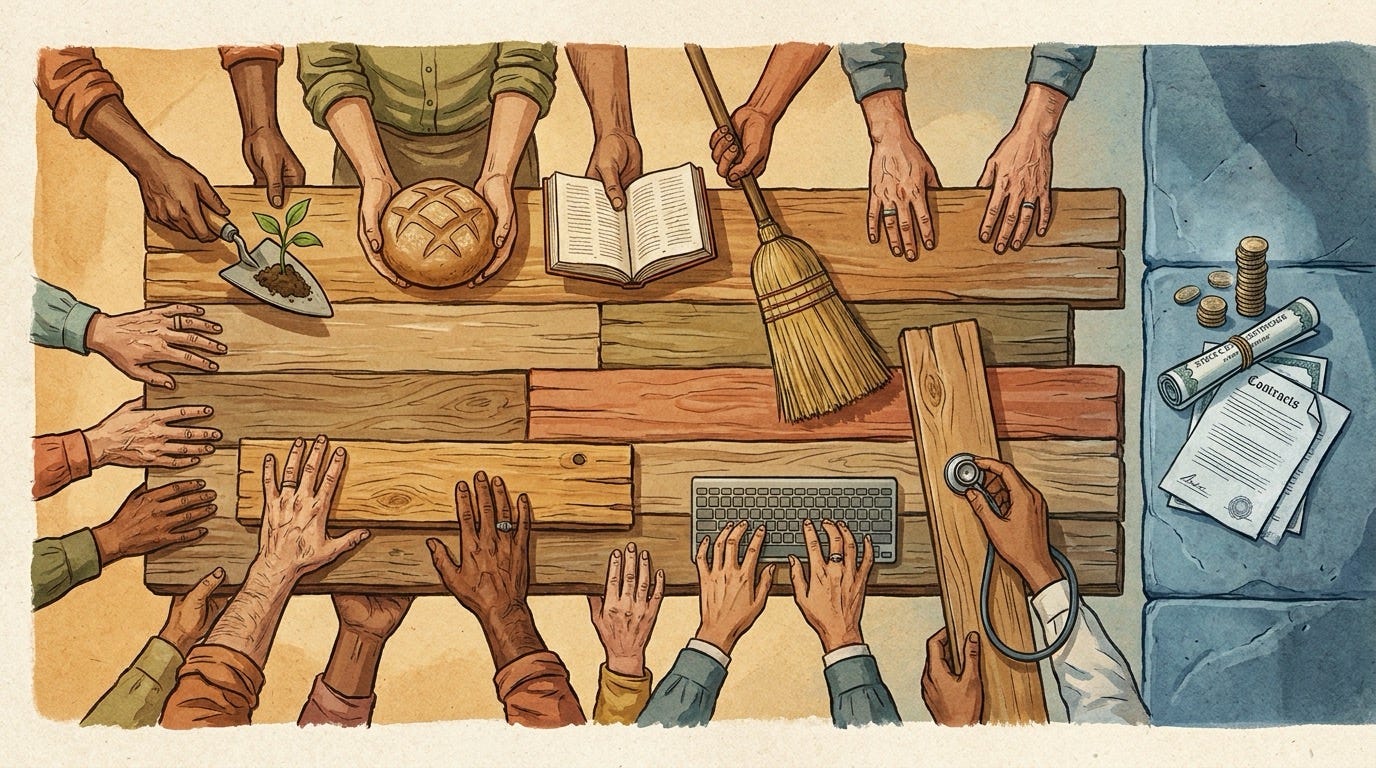
A society that wants to stay human must honor what people bring to the table. And workers do not merely bring something to the table. Workers build the table, harvest the wood, drive the truck, clean the room, prepare the food, care for the children, answer the phones, maintain the systems, assemble the machines, teach the students, tend the sick, write the code, pack the boxes, stock the shelves, and keep the whole trembling structure from collapsing.
Capital alone makes nothing. Money sitting by itself does not grow food, heal wounds, teach children, repair roads, comfort the grieving, build homes, or create beauty. Capital can organize work. Capital can purchase tools. Capital can take risk. But without labor, capital is sterile. It is seed locked in a vault, never placed in soil.
The wound is not that some people own things and some people work. The wound is that our economy has learned to treat ownership as sacred and labor as disposable.
The lie of the lonely maker
The myth of the capitalist maker depends on a kind of social amnesia. It asks us to forget the worker.
We are invited to look at a billionaire and see genius, discipline, risk, vision, and reward.
We are rarely invited to look at the warehouse worker, the delivery driver, the farmworker, the teacher, the janitor, the nurse, the line cook, the caregiver, the receptionist, the mechanic, the coder, the miner, the sanitation worker, or the person working two jobs and still falling behind, and say, “There is the maker.”
Sure we called them essential workers during Covid, but that only spoke to their production. The workers themselves were still treated as disposable.
This is not an accident. If we can be trained to see wealth as proof of contribution, then we can be trained to see poverty as proof of failure. If we can be trained to see ownership as creation, then we can be trained to see labor as replaceable. If we can be trained to see profit as virtue, then we can be trained to see exploitation as the natural order of things.
But the world is not made by capital. The world is made by people.
That does not mean every owner is evil, every investor is useless, or every business is exploitative. Staying human requires more honesty than slogan. Risk is real. Entrepreneurship can be creative. Organizing resources can be meaningful. Building something from nothing often requires courage, imagination, and sacrifice.
But there is a difference between honoring initiative and worshiping ownership.
There is a difference between receiving a fair return for organizing resources and claiming moral superiority over the people whose labor makes that return possible.
There is a difference between risk and extraction.
The question is not whether capital matters. The question is why capital is allowed to claim the whole harvest when labor planted, watered, tended, picked, packed, cooked, served, and cleaned up the meal.
The wisdom Marx saw, and the soul must still name
Marxist theory gives us a language for something many workers already know in their bodies: under capitalism, labor creates value, but capital captures much of that value.
A worker produces more value than they receive in wages. That difference, what Marx called surplus value, becomes profit. The owner says, “I made this.” But the worker knows, somewhere beneath the exhaustion, “My life was spent making that possible.”
This is why productivity can rise while wages stagnate. It is why companies can report record profits while workers cannot afford rent. It is why executives can receive bonuses after layoffs. It is why the people who make the goods, deliver the services, care for the bodies, clean the buildings, and keep the systems alive are told there is no money for healthcare, no money for childcare, no money for paid leave, no money for a living wage, no money for rest.
There is money. It has simply been taken upstream.
This is the moral core of the makers and takers reversal. Labor is not taking from capital when it asks to share in the abundance it created. Labor is asking for the theft to stop.
And theft is not too strong a word when people’s productivity grows, the fruits of that growth are captured by owners and shareholders, and then the workers are told to be grateful for scraps. Theft is not too strong a word when a society depends on essential workers while treating them as expendable. Theft is not too strong a word when working people are told they must bear insecurity so capital can enjoy certainty.
This is not only an economic problem. It is a spiritual deformation.
When a person’s time is extracted without dignity, their humanity is being drained. When a body is used up for profit, something sacred is being profaned. When a worker is told their worth is measured by output, something in the image of God is being reduced to machine logic.
A society that keeps us human does not ask, “How much can we get out of people while giving them as little as possible?” It asks, “What would make work worthy of the human beings who do it?”
But capital takes the risk
The common defense is that capital deserves its outsized reward because capital takes the risk.
There is some truth here. Starting a business can be risky. Investing money can involve loss. Owners can fail. Entrepreneurs can lose savings, reputation, time, and opportunity. We should not pretend risk is imaginary.
But we should ask a more human question: whose risk counts?
When a business fails, investors may lose money. Workers may lose rent, healthcare, stability, identity, community, and the ability to feed their children. When executives make bad decisions, workers often pay first. When shareholders demand higher returns, workers are laid off, schedules are cut, benefits shrink, workloads increase, bodies break, and families absorb the shock.
Capital risks capital. Labor risks life.
Hear that again: Capital risks capital. Labor risks life.
Capital risks money, and money matters. But labor risks hours that cannot be returned, joints that do not heal easily, nervous systems that carry chronic stress, marriages strained by exhaustion, children growing up around absence, communities hollowed by closures, and bodies treated as replaceable until they finally refuse to keep going.
If risk justifies reward, then workers deserve far more than they are given.
And there is another problem. In our current system, capital is often protected from the very risk it uses to justify domination. Corporations receive bailouts. Investors diversify portfolios. Owners use bankruptcy law. Executives leave with golden parachutes. Shareholders demand public infrastructure, educated workers, legal protections, roads, subsidies, tax advantages, and state violence to protect property, then call their profits purely private achievement.
Meanwhile, workers are told the market is simply the market.
So yes, capital may take risk. But capital also builds elaborate structures to limit, outsource, and socialize that risk, while privatizing the gains. Labor is asked to absorb the human cost.
A staying human response does not deny risk. It democratizes our concern for it. It asks why the risks of ownership are treated as sacred, while the risks of working class life are treated as ordinary.
The table was never built by one person
The deeper wisdom is that creation is always communal.
No one makes alone. Every entrepreneur relies on roads they did not build, language they did not invent, workers they did not birth, teachers they did not pay, ecosystems they did not create, public systems they did not personally sustain, and generations of accumulated knowledge they did not produce from nothing.
This is why the myth of the self-made man is so spiritually dangerous. It cuts the visible person away from the invisible web that held them. It turns dependence into shame for the poor and invisibility for the rich.
But every life is received before it is achieved.
Every maker is first made.
A human economy would remember this. It would understand that work is not merely a private transaction between employer and employee. Work is participation in the common life. It is the ongoing creation of a world. When work is degraded, the world is degraded. When workers are dishonored, the table of communion is cracked.
This is where the language of staying human matters. We are not simply arguing for a different wage policy, though we need that. We are arguing for a different anthropology.
Human beings are not units of labor cost. Human beings are beloved dust, finite and holy, carrying gifts the world needs. Work should be one way those gifts become visible, not the machine that grinds them down.
The goal of an economy cannot be maximum extraction. The goal must be shared aliveness.
What would a human economy honor?
A society that honors the real makers would begin with a few moral commitments.
It would honor labor as creative participation, not merely expense. The person cleaning a school is not a line item. They are helping make learning possible. The person stocking groceries is not low-skill background noise. They are helping feed a community. The person caring for an elder is not economically marginal. They are holding the fragile edge of human life with tenderness.
It would ensure that productivity gains bless the people who produce them. If workers create more value, workers should share in that value through higher wages, shorter hours, stronger benefits, safer conditions, and more democratic say in the workplace.
It would treat rest as part of human dignity, not a reward for those who can afford it. Machines can be run until they break. Humans must not be.
It would protect the forms of work capitalism often refuses to value, especially care work, domestic work, ecological repair, community building, grief work, teaching, healing, and art. These are not secondary to the economy. They are the conditions that make any economy worth having.
It would stop pretending that the people with the most money necessarily made the greatest contribution. Sometimes wealth is the fruit of creativity. Sometimes it is the fruit of proximity, inheritance, monopoly, exploitation, speculation, coercion, or the ability to own what others need.
And it would ask of every system, every business, every budget, every policy, every investment: does this help people become more human, or does it require their diminishment?
That is the question empire hates.
Because empire can count profits. It can count productivity. It can count market share. It can count shareholder value. But it does not know how to count the soul cost of a parent too exhausted to play, a worker too anxious to sleep, a community too underpaid to gather, a body too used up to feel joy, a people taught to measure their worth by how much can be extracted from them.
The real takers
The real takers are not the poor.
The real takers are not the workers asking for a living wage.
The real takers are not the people who need public support after being underpaid by private employers.
The real takers are not the exhausted, the disabled, the elderly, the children, the unemployed, or the people whose lives do not fit neatly inside productivity metrics.
The real takers are systems that take time without giving life back. They take labor without honoring the laborer. They take the commons and call it private genius. They take public goods and call it self-made success. They take bodies, attention, care, land, and future, then return burnout, debt, precarity, and shame.
The real takers are not people who need help. The real takers are the arrangements that make help necessary, then blame people for needing it.
A staying human politics begins here. Not with contempt for those who have wealth, but with refusal to let wealth define worth. Not with hatred of business, but with a demand that business serve life. Not with romanticizing labor, but with telling the truth that labor is where value becomes flesh.
There is no economy without workers. There is no profit without people. There is no table without those who make, serve, repair, and clean it.
So maybe the question is not whether workers are taking too much.
Maybe the question is how long we will allow takers to dress themselves as makers while the real makers are told to be grateful for survival.
A society that keeps us human honors the hands that make the world.
And if the table is built by many, the feast should be shared by many too.
If this conversation stirs something in you, especially around work, burnout, grief, or the ache of trying to stay human inside systems that keep asking you to become less than human, this is the kind of terrain I walk with people in coaching. If you want to find out more, schedule a discovery call.
Practices for Staying Human
Whether your day only allows for a 60-second reclamation, your week a one-hour resistance ritual, or you find yourself ready for a full on rebellion against a world that assaults your humanity, behind the paywall I offer you three practices that will help you bring this post to life in your everyday.
60-second Reclamation: Honor Your Labor
Before your next work task, pause and place one hand on your chest or belly. Say quietly, “I am not a machine. My work matters, and my life matters more.” Take three slow breaths before you begin.
60-minute Ritual: Balancing Work
Make a two-column list. On one side, write “What my work gives.” On the other, write “What my work takes.” Be honest. Include money, time, body, energy, creativity, relationships, rest, dignity, stress, and meaning. Then ask: what would need to change for this exchange to become more human?
Whole-life Rebellion: Embody the Post Beyond Your World
Choose one concrete way to honor labor, your own or someone else’s. Join or support a union effort. Tip more generously where you can. Advocate for paid leave, childcare, living wages, and shorter workweeks. Refuse shame-based productivity talk. Build a business, household, church, or community rhythm that treats rest, care, and repair as sacred, not secondary.