


This is a story about my kid and me, but it is not only a parenting story. It is about the expectations we carry into every kind of relationship. It is about wanting another person to recognize our gifts, receive our love in the form we prefer to give it, and help us feel like the person we believe ourselves to be. It is about the moment care quietly becomes control, generosity becomes expectation, or our desire to help becomes an attempt to achieve our own relational ends through someone else.
Staying human in relationship requires another kind of love. It asks us to take responsibility for the history we bring, to do our repair work without assigning someone else a role in it, and to become curious about ourselves and the person before us. Sometimes that means grieving the relationship we imagined so we can begin building the one that is possible.
For me, that lesson arrived through fatherhood, my kid’s twentieth birthday, and a skydive we were supposed to take together.
Watch and Listen
The Whole Story
Ten minutes before I was supposed to check in for my first skydive, I looked at the location on my phone and realized my kid was still at home.
We were supposed to be doing this together to celebrate their twentieth birthday. We had planned to drive separately because they had somewhere to be afterward. I needed gas, so I left early. My kid regularly gets up before dawn for work, so I assumed they had their departure handled.
I sent a quick message asking if they were coming, then checked in and left my phone in the car. They were supposed to meet me at the terminal. I figured they might be running late. It would take time to get everyone organized, load the plane, and get into the air.
But there was no sign of them when we headed toward the plane.
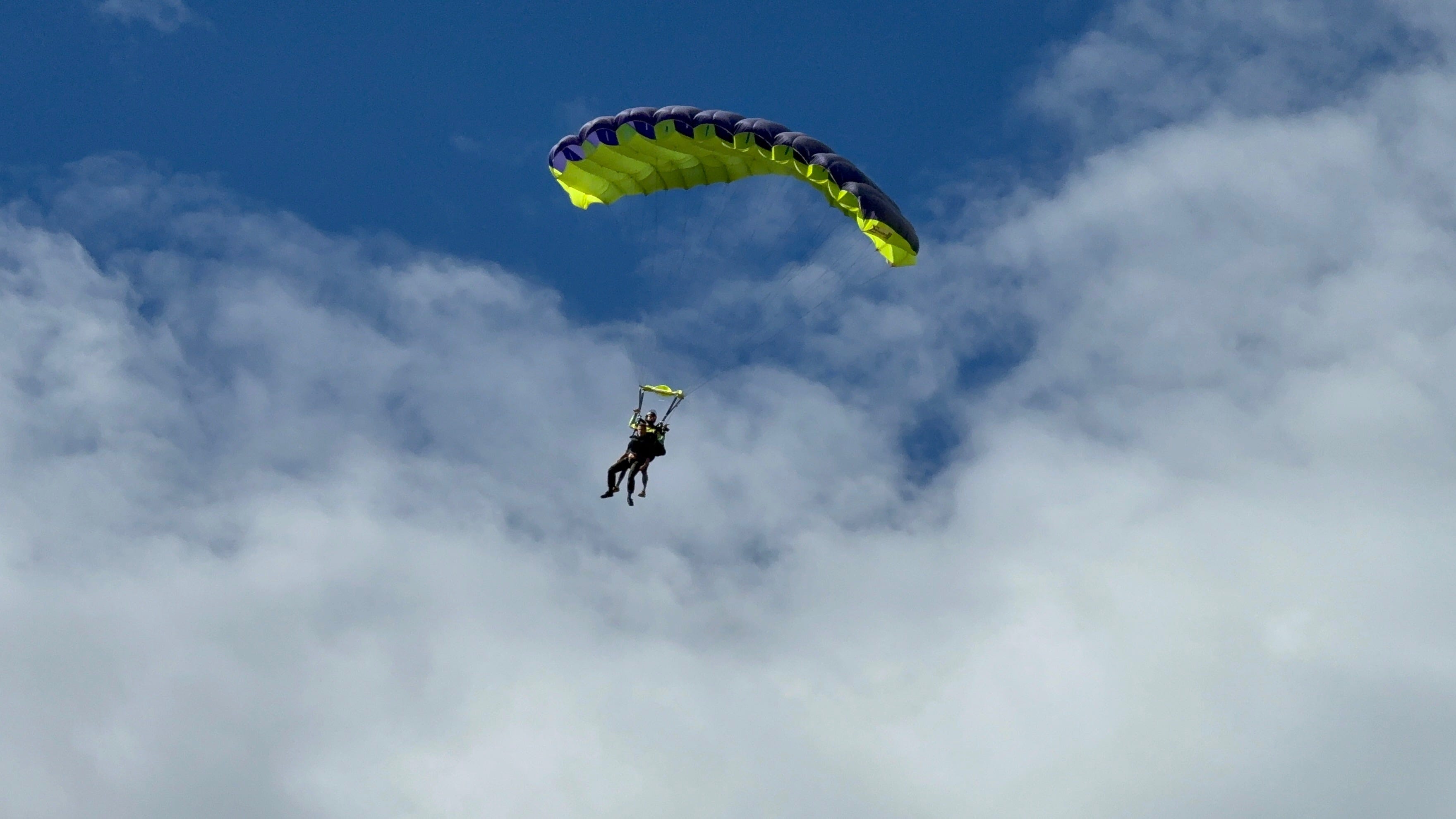
We climbed to about 8,500 feet before the pilots decided the cloud cover was too low. We came back down, landed, and waited about twenty minutes. Then we loaded up and tried again.
My kid still was not there.
There was no great wave of anger or devastation. The whole thing felt funny, quirky, and a little sad. I was about to jump out of an airplane to celebrate my kid’s birthday, and my kid was not there.
Right before I left the plane, looking down 12,500’, fear arrived. What the hell am I doing?
Then I let go.
The fear disappeared into yelling, cheering, and the astonishing joy of falling through open air. The parachute opened with a violent jerk. We spun. We floated. I could see why my kid had fallen in love with this.
The day was not what I had planned. But it was still good.
I am beginning to wonder if fatherhood is asking me to learn the same lesson.
The Father I Wanted to Become
The day before the jump, I officiated the funeral of a 49-year-old man whose 22-year-old son was struggling with the sudden terrain of grief. We spoke on the phone before the service. After the service, as everything was winding down, I saw him wander away by himself. I went and walked beside him for a while.
We talked. I listened. I asked questions. I offered a few thoughts about how he might move through what was in front of him.
At one point he looked at me and said, “Dude, you are so good at what you do.” Then he asked if we could stay in touch.
Something in me came into tune. I felt honest and integrated. I was not performing expertise or trying to manufacture a breakthrough. I was simply present, offering the kind of attention and perspective I know how to give. It felt fantastic because it felt like me.
And there was grief in it.
The Ache of Recognition
In the language of Human Design, I am a Projector. Now, I don’t use Human Design or any other tool as a determinative diagnosis or a set of rules that gets to define every relationship. I use it and other tools as a source of possibilities, some things to consider as I seek to make sense of myself and how to move through the world. That said, one of Human Design’s ideas gives language to something I recognize in myself.
Projectors are described as people whose gifts come alive through recognition and invitation. When someone sees what we carry and welcomes it, there can be a felt sense of alignment. The insight begins to flow. The guiding part of us has somewhere to go. When that recognition is absent, the same desire to guide can harden into over-giving, proving, bitterness, or trying to make ourselves useful to someone who did not ask.
Something like that happened with the young man and his family. They recognized me. They trusted my presence. They invited the part of me that listens beneath the words, notices what is happening, and helps someone see a possible path forward. I did not have to push for a role. The invitation was already there. That is part of why I felt so in tune with myself.
I do not feel that kind of recognition from my kid, at least not in the role of advisor or guide. There is real grief in admitting that. But the grief becomes dangerous if I turn it into a demand.
My child is not responsible for recognizing my gifts so I can feel aligned with myself. They do not owe me the experience of being seen as wise. A parent-child relationship cannot depend on the child affirming the parent’s preferred identity. If I need my kid to invite my guidance before I can feel connected to them, then I am asking them to achieve my relational ends for me, which is exactly what a good parent doesn’t do.
The question is not whether my kid recognizes me in the way that young man did. The question is whether I recognize my kid. Can I see the person in front of me without requiring them to become the person who makes my gifts feel most useful? Can I honor their pace, their way of connecting, and the kinds of presence they actually welcome?
Perhaps the most mature way to hold this part of myself is not to deny it, but to give it the right home. I can let my gifts be recognized in grief coaching, funeral work, and other relationships where guidance is invited. Then I can come home without requiring my child to be a client, student, or mirror. I can simply be their dad.
But that’s far easier said than done. I have spent most of my kid’s life wanting to be the trusted advisor, the steady presence, the person they come to when life becomes difficult. I have wanted to offer wisdom gathered through years of mistakes, grief, therapy, spiritual searching, and slow repair. I have wanted to help them find paths I did not find until my forties.
In other words, I wanted to become the father I needed but never had.
My father was not someone I could reliably turn to for emotional guidance or relational wisdom. Ultimately, I moved through much of my life feeling like I had no one I could go to. I needed an adult who had been there, someone who could offer perspective, help me understand what was happening inside me, and show me how to move through it without shame.
Out of what I lacked, I built a definition of fatherhood. A good father, I believed, was someone whose child trusted his wisdom. He was someone his child sought out for perspective. He was there for protection in the younger years, was there as a hand up when a kid got older and made those developmentally necessary mistakes, and the whole time serves as a fount of wisdom on how to navigate everything life throws at us.
But eight years ago, sitting together in therapy, my kid told me they did not need my advice. They had other people they could talk to and mentioned getting a variety of perspectives from kids around their age. My kid was telling me plainly that I was not the person they wanted in that role. They preferred turning to people with little life experience over someone who had been to hell and back more than once.
That conversation struck the exact wound around which I had built my definition of fatherhood. I had spent decades dealing with the consequences of feeling like I had no one to turn to. Now my kid had found people, people I viewed as vastly unqualified, and had chosen them over me.
When Love Wants to Be Useful
Here’s the thing. What I really want for my kid, is to know they are beloved. I want them to know they are good enough and worthy of all the love in the world.
And sometimes I see patterns that look painfully familiar to me, patterns they have also named in their own way. The need to be right. Defensiveness when corrected. The temptation to guard an image of rightness rather than risk being seen as wrong. The exhausting project of trying to earn the worth that already belongs to them.
I recognize those patterns because shame has done similar things in me.
I have thoughts about paths that might lead toward greater freedom. I believe some of what I have learned could help. The protective part of me wants to step in, offer perspective, and spare my kid some of the damage I experienced.
But my kid has not wanted me in that role.
That hurts. It is hard to watch someone you love struggle when you believe you have something that might help. It is especially hard when offering that help is one of the places where you feel most fully yourself.
But having something useful to offer does not mean I am entitled to be the one who offers it. Love does not give me permission to choose another person’s path, set their pace, or appoint myself their guide.
That young man’s response after the funeral affirmed something true about me. It did not prove that my kid is wrong for needing something different.
This may be one of the hardest releases in parenting an adult child. Sometimes the wisdom we carry will be received from someone else. Sometimes our children will learn later, differently, or through mistakes we wish we could prevent. Sometimes the most loving thing we can do is remain available without insisting on being useful.
Repair Is Not the Same as Construction
There’s history between my kid and me. When they were young, I was living with depression, complex trauma, compulsive behavior, and more inner chaos than I knew how to hold. I was often emotionally unavailable. I could disappear into a phone or computer when my kid wanted connection. A painful family system, one centered around divorce, widened the distance between us. There were seasons when we barely connected at all.
I have apologized. Some repair has happened. For more than three years, my kid has lived with me. We have rebuilt stability, humor, and freedom. We pass each other in the house. We trade dark and inappropriate jokes. We watch the occasional movie. We share some meals. We will spend a good part of next week up in the mountains.
Still, I have sometimes confused repairing the past with constructing the present.
Repair asks me to take responsibility for the father I was. Construction asks me to become curious about the father I can be now.
Those are not the same task.
I cannot keep asking the present relationship to prove that the past has been healed. I cannot make my kid’s growth part of my redemption story. My healing belongs to me. My relationship with my father, including the wisdom and presence I did not receive from him, is mine to grieve.
Today, as I reflect on the whole dynamic, I can see that there was love in my desire to offer something different. There was also grief. And grief can quietly turn a gift into an expectation, especially when we ask our children to carry the repair that belongs to us.
My kid cannot be assigned a role in that repair.
Healing With Is Not Being Healed By
None of this means healing happens only when we go away by ourselves and work on our wounds in isolation. We are relational creatures. Many of our deepest wounds were formed in relationship, and some of our deepest healing happens there too.
One of the ideas explored in Harville Hendrix’s Getting the Love You Want is that we are often drawn toward partners who stir the very attachment wounds we hoped love would help us escape. A marriage or dating relationship can bring together two nervous systems shaped by different histories, two sets of survival strategies, and two younger selves quietly asking, Is it safe for me to stay?
One person pursues connection while the other reaches for space. One needs reassurance while the other experiences that need as pressure. One protects against abandonment while the other protects against being consumed. Each person’s attempt to create safety can activate the other person’s fear.
That does not automatically mean the relationship is broken. In a consensual relationship between adults, this friction can become part of the shared work. We can learn to tell the truth, regulate our bodies, take responsibility for our patterns, and repair the harm we cause. We can say, “You are not responsible for fixing me, but I want to practice healing with you.”
Friendships and communities can offer this kind of healing too. Therapy, coaching, spiritual direction, and intentional groups can become places where we are witnessed, challenged, and accompanied. Healing is personal, but it does not have to be solitary. Healthy relationships can help us discover patterns we could not see alone and practice forms of trust we never learned before.
Parenting carries a different responsibility. My relationship with my kid can reveal my wounds. Loving them can soften me, challenge me, and invite me to become someone new. Our relationship may even become healing for both of us as we grow older. But my kid is not responsible for making my healing happen. They do not owe me recognition, intimacy, forgiveness, advice-seeking, or a particular kind of relationship so I can resolve what happened between my father and me.
There is a difference between healing with someone and making someone responsible for healing us. That difference is consent, reciprocity, power, and responsibility. Two adults can choose to enter a shared process of growth. A child cannot be assigned the task of repairing the adult who is supposed to help them grow.
Any healing I receive through loving my kid must remain a gift, never an assignment I place on them.
I thought breaking the cycle meant giving my child what I never received. Now I see the deeper challenge. Giving someone what I needed is not necessarily the same as giving them what they need.
I have been asking my kid to help me feel like myself. I hoped their trust would confirm that I had become the father I wanted to be. But a child, even an adult child, should not have to mirror a parent so the parent can feel whole.
My work is to mirror my kid. To pay attention. To meet them where they are. To let them become themselves without making their transformation a condition of our relationship.
Shoulder to Shoulder
The relationship my kid and I have is often not face-to-face. It is shoulder-to-shoulder.
Connection happens while watching Star Wars or what feels like the eternal wait for the final Spider-Verse movie. It happens through humor, food, and the meals they cook with real skill. It happens through a shared appetite for adventure. It may happen on a trail in the mountains, one foot in front of the other, with no demand that the conversation become profound.
These are not always the places where I feel most at home. I know how to meet someone in the depths. I know how to ask the question that opens a door. I am less practiced at trusting that a movie, a breakfast, or a hike can be enough.
Maybe that is the discomfort love is asking me to enter.
Taking the lead in a relationship with an adult child does not mean directing the relationship or deciding what it should become. It means taking responsibility for my side of it. I can notice what they enjoy. I can make low-pressure invitations. I can enter some of their interests. I can ask whether they want listening, advice, or practical help before offering any of them. I can hear no without turning it into rejection.
I can continue being myself while releasing the demand that my kid receive every part of me.
Perhaps a good hike next week becomes another hike next month. Perhaps skydiving becomes a point of commonality now that I understand its wild joy from inside the experience. Perhaps cooking, movies, and playful conversation are not lesser forms of intimacy. Perhaps they are the actual language of this relationship.
I kept waiting for connection to look like my plan. And I missed some of the connection already happening.
A Different Legacy
I have thought a lot about legacy since my father died. I wear a family ring that passed from my grandfather to my father and then to me. I do not want to reproduce a family pattern of fathers who are absent, emotionally unavailable, or untrusted.
But a different legacy is not a script I hand to my kid. It is not a mold into which they must fit. It is a way of living that gives them greater freedom to become themselves.
Maybe the legacy is not that my kid comes to me for answers. Maybe it is that they know they are free to ask, and also free not to.
Maybe it is the experience of a father who can apologize, keep growing, provide a home, celebrate their work ethic, notice their passions, and enter their world without needing to become its center.
Maybe it is a father who believes they are beloved even when they are defensive, confused, wrong, or still figuring out how to believe in their own worth.
Maybe it is a father who does not need to be chosen as the guide in order to remain present as the parent.
The job is not to make my child mirror the love I wanted. The job is to learn the shape in which this child can receive love.
That is a different kind of protection. I cannot protect my kid from every mistake, every wound, or every lie shame tells them. I can protect the freedom of the relationship. I can refuse to make love contingent on their receptivity to my advice. I can keep the door open without dragging them through it.
I can remain available for their journey without making them part of my healing.
If you are carrying grief about the relationship you had with a parent, or the relationship you hoped to have with your child, this is part of the work I hold through Life After Loss coaching. We can grieve what was missing, tell the truth about what happened, and create enough room to love the people in front of us more freely. If you would like to explore working together, you can schedule a discovery call at joeburnham.com.
Letting Go
When I stepped out of that airplane, my kid was not beside me. The day had already departed from the plan. We had driven separately. They had overslept. The clouds had forced us to land and wait. Nothing had followed the clean line I imagined.
Then the door opened.
For one breath, I was afraid. Then I let go and discovered joy.
When my feet returned to the earth, I understood something my kid loves. We had not shared the jump, but I had entered a corner of their world. That gives us another possible place to meet.
The day did not become meaningless because it did not happen the way I expected. The relationship has not either.
I am still my kid’s parent. I still have a responsibility to take the lead in tending what exists between us. But taking the lead does not mean choosing the destination. It means becoming willing to step outside my normal ways of connecting. It means showing up for the movie, the meal, the hike, or the next jump. It means staying curious about what we might build rather than demanding the relationship I once imagined.
It means letting go of the plan without letting go of the person, and that’s one way to stay human.
Three Practices for Loving Without Making Someone Part of Your Healing
Whether your day only allows for a 60-second reclamation, your week a one-hour resistance ritual, or you find yourself ready for a full on rebellion against a world that assaults your humanity, behind the paywall I offer you three practices that will help you bring this post to life in your everyday.
60-second Reclamation: Name the Plan
Bring to mind one relationship that does not look the way you hoped it would.
Ask yourself: What did I expect this person to give me, prove to me, or help me feel about myself?
Take one slow breath. Then say: I can let go of the plan without letting go of the person.
Do not use the sentence to tolerate harm or abandon your needs. Use it to distinguish the actual person from the role you assigned them.
60-minute Ritual: Repair or Construction?
Identify a difficult relationship that you want to keep going.
Divide a page into two columns. Label one “Repair” and the other “Construction.”
Under Repair, write what belongs to the past. Name harms that need acknowledgment, apologies that need to be made, boundaries that need to be honored, and grief that belongs to you. Be specific about your responsibility without turning it into a verdict about your worth.
Under Construction, write what could be built now. List the ways this person appears to receive connection. Include ordinary things: shared meals, humor, errands, movies, music, walks, texts, or practical help. Then choose one low-pressure invitation you can make.
Whole-life Rebellion: Learn Their Language of Connection
Release the idea that meaningful relationships must feel natural to you all the time. Love sometimes asks us to leave our preferred terrain and enter another person’s world.
Pay attention over time. When does this person relax? What do they initiate? What interests bring them alive? Do they connect face-to-face or shoulder-to-shoulder? What forms of attention feel welcome, and which ones feel like pressure?
Keep being honest about who you are. Do not erase your desires or pretend you have no needs. But stop requiring this person to receive you in the way that makes you feel most valuable.
Notice. Invite. Listen. Adjust. Repeat.
The goal is not to become indispensable. The goal is to become trustworthy enough that love remains free.