


Some days don’t just feel bad. They feel apocalyptic. Not because you have done the math and concluded the world is ending, but because your body gets there first. Your chest tightens. Your mind starts sprinting. Your nervous system braces like it is trying to survive a threat you cannot quite name.
This piece is about that kind of day, and about what threat-rhetoric, outrage cycles, and constant catastrophe forecasting can do to our humanity over time. Not only in what we believe, but in what we become.
I am not trying to offer a hot take. I am trying to name a formation and offer a counter-formation. A slower, more grounded spirituality that can hold collapse without becoming collapse. A way of staying human that looks less like certainty and more like presence, grief, tenderness, and the ordinary work of repair.
Lately, for me, that way has looked like compost. Building a container where what is dying can become soil.
Watch or Listen
The Whole Story
This past Tuesday had that end of the world feeling.
Not in the poetic way. In the nervous system way.
The kind of day where you can feel your chest tighten before you even know what headline you are about to read. Where the air in the room changes. Where your mind starts sprinting ahead into catastrophe math, violent images you did not consent to, and the dull throb of powerlessness.
And then a sentence hits the feed like a match.
Trump saying, “a whole civilization will die tonight.”
What apocalyptic rhetoric does to us
I do not want to argue the logistics of that line here. I want to name its effect. Rhetoric like that does something to us. It turns the world into a hostage situation. It trains our bodies to live in a constant state of bracing. It pulls the future closer to the edge. And it dares us to keep loving anyway.
So what do we do when it feels like the world could end tomorrow?
Plant the tree (even if the quote is misattributed)
There is an old line that floats around, often attributed to the reformation theologian Martin Luther, and while it’s almost certainly not something Luther said, it holds a certain wisdom: “If I knew the world would end tomorrow, I would plant a tree today.”
Because the question is not only, “Is the world ending?”
The deeper question is, “What kind of human am I becoming while I watch it burn?”
That question is the one I keep returning to, because the assault on our humanity is not only happening through policy and propaganda. It is happening through formation. The constant drip of threat, outrage, and spectacle is shaping our nervous systems, shaping our imaginations, shaping what we think is normal.
And it is working. We are becoming a people who confuse being activated with being alive. We are becoming a people who confuse being informed with being wise. We are becoming a people who can name a thousand villains and still do not know how to compost our own grief.
Core convictions I’m returning to
In moments like this, I want to return to a few of my core convictions.
God is love, fully and always. Grace is the operating system. The goal is becoming human. Scripture is a sacred meta story, not a weapon. Salvation is not evacuation. It is embodiment.
If love is the fabric of reality, then the work in apocalyptic times is not to become more certain. The work is to become more human. More present. More honest. More capable of grief, which is simply love in motion.
Compost: a slow, unglamorous spirituality
I keep thinking about compost this week. Not as an aesthetic. Not as a metaphor I had to invent. Literal compost.
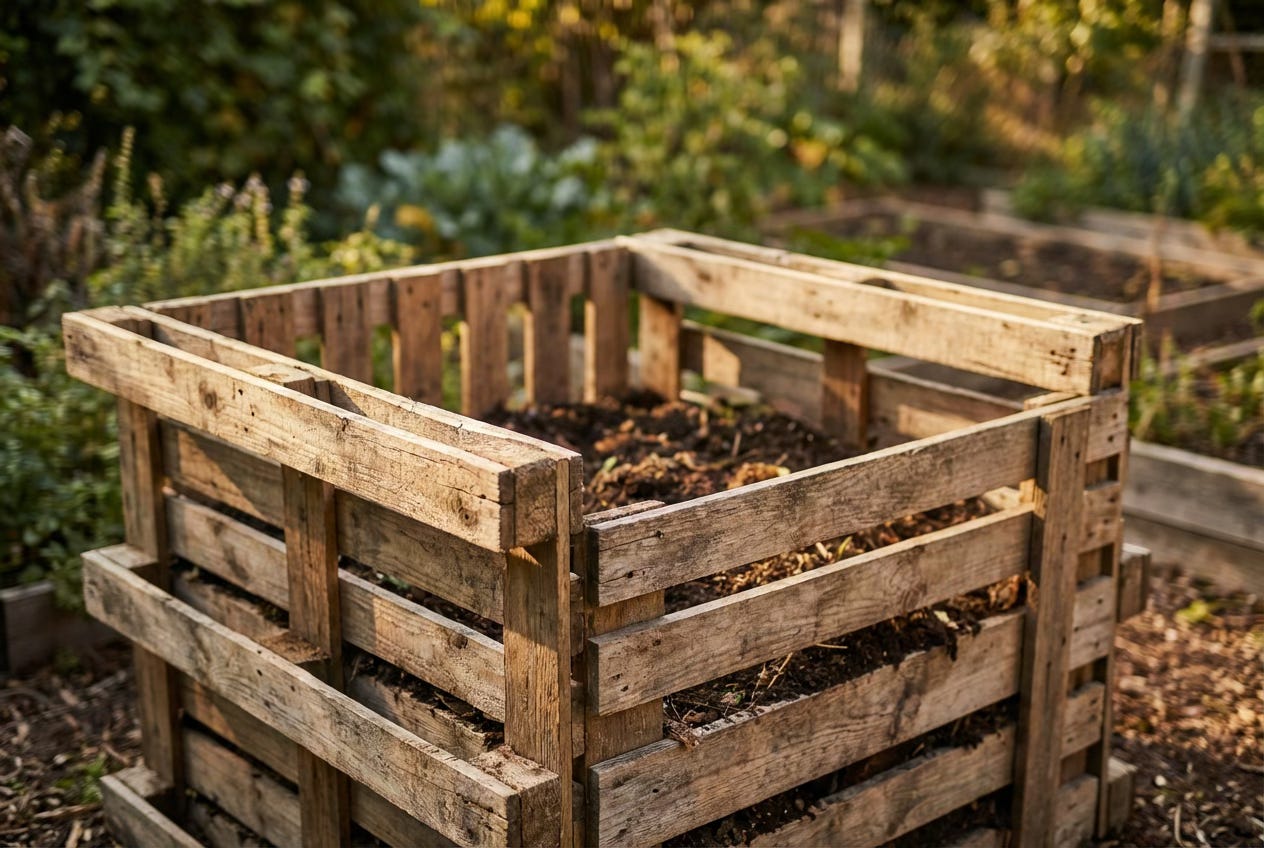
I am building compost bins. I am recycling old shipping pallets. Binding them together to form a container. Creating a place where scraps can become soil. It is small and ordinary and a little messy. It is also strangely grounding.
Because while some part of the world is shouting about ending civilizations, I am standing in my yard holding a pile of wood and thinking, “This will take time.”
What compost teaches us
Compost is slow. Compost is unglamorous. Compost can smell. Compost does not reward urgency. Compost is what happens when you stop pretending that what is dying is useless, and you create conditions for transformation.
And I wonder if this is one of the spiritual invitations of our moment. Not to deny how dangerous things are. Not to numb out. Not to pretend that a sentence like “a civilization will end tonight” is just another headline.
But to remember that renewal, real renewal, takes time. That the old does not become the new by decree. That the death we are witnessing, whether it is the death of norms, the death of innocence, the death of stability, or the death of empire stories, has to be metabolized. It has to be broken down. It has to be grieved. It has to be composted.
The stories that are collapsing
We are living inside the collapse of many stories. The story that the market will save us. The story that violence will keep us safe. The story that strongmen are strong. The story that speed equals progress. The story that being right is the same thing as being good. The story that we can consume our way into wholeness. The story that domination is destiny.
Some of these stories have been rotting for a long time. What we are seeing now is not just new chaos. It is an acceleration of decay.
If your God is control, decay feels like failure
And here is the honest truth. Decay is terrifying when you do not have a theology big enough to hold it.
If your God is control, decay feels like failure. If your God is certainty, decay feels like betrayal. If your God is empire, decay feels like the end.
But if God is love, then decay can also be the doorway. Not the doorway into naive optimism. The doorway into something truer.
Compost is not magic. It is not instant redemption. It is a process where what is old breaks down into something that can nourish new life.
That is what grief does too. Grief is not a detour from love. Grief is the price of love. And grief is also a kind of soil.
Refusing grief makes us manipulable
When we refuse grief, we do not stay clean. We stay brittle. We stay reactive. We stay easy to manipulate. When we refuse grief, fear becomes our leader. When we refuse grief, we look for someone to blame. When we refuse grief, we become the kind of people who can cheer for cruelty as long as it feels like control.
So if you felt undone this week, I want to say this gently. Something in you is responding to real danger. Something in you is responding to a fractured world. Something in you is responding to the possibility of loss. That is not weakness. That is love.
The question is not whether you will feel it. The question is what you will do with it.
Presence over dissociation
There is a kind of spirituality that treats fear like a personal failure. Try harder. Pray more. Have better thoughts. Declare victory. But that spirituality often just teaches people to dissociate.
The work of staying human begins with a different posture. It begins with presence. It begins with honesty. It begins with naming what is true without becoming possessed by it.
Power versus love
In the We Can Stay Human framework, I come back to this tension again and again: Power versus love.
There is a way of being in the world that I would call the taking form. It moves through control, scarcity, domination, fear, and the need to win.
And there is a way of being in the world that I would call the forgiving form. It moves through vulnerability, surrender, communion, creativity, and the stubborn refusal to dehumanize.
Apocalyptic talk is almost always an attempt to recruit us into the taking form. It says, “Brace.” It says, “Pick a side.” It says, “Become a weapon.” It says, “Make your heart hard, because soft hearts do not survive.”
But the way of Jesus, the Human One, is not to harden. It is to become embodied love in a violent world. Not in a sentimental way. In a costly way. In a grounded way. In a way that learns how to face fear without becoming fear.
What we can do when it feels like the world might end tomorrow
That is why I keep circling back to what we can do when it feels like the world might end tomorrow.
We can plant trees. We can build compost bins. We can make dinners. We can hold our kids and tell them the truth without handing them our panic. We can call our friends and ask how their bodies are holding the day. We can donate to efforts that reduce suffering. We can show up locally. We can refuse to let the algorithm become our priest. We can remember that our sphere of control is smaller than our sphere of concern, and that it is still holy.
Compost doesn’t reward urgency
The late capitalist machine wants you either paralyzed or activated. Paralyzed so you keep consuming. Activated so you keep clicking.
But compost asks for something else. Compost asks for patience. Compost asks for attention. Compost asks for containment. Compost asks you to do what you can, where you can, as you can.
That phrase has been sitting with me lately. Do what you can.
Not what you wish you could. Not what you think you should. Not what makes you look righteous.
What you can. Where you can. In your actual life. With your actual limitations.
As you can. In the body you have today. In the energy you have today. In the constraints you did not choose.
This is not a call to smallness. It is a call to reality. Because one of the ways dehumanization works is by ripping us out of the present. It puts us in constant mental time travel.
If the worst happens. If the next headline drops. If the next election goes sideways. If the next war escalates. If the next disaster hits. If, if, if.
And meanwhile your actual life is waiting. Your neighbor is waiting. Your body is waiting. Your grief is waiting. The sacred is waiting in the only place it has ever been waiting.
Here. Now.
In the compost pile. In the kitchen. In the phone call. In the quiet decision to not dehumanize the person in front of you. In the long exhale. In the small act of repair.
Faithfulness is devotion to love
The alternative to apocalyptic paralysis is not denial. It is faithfulness. Faithfulness is not certainty about outcomes. Faithfulness is devotion to love. And love, real love, is not abstract. It takes form.
It looks like food. It looks like shelter. It looks like listening. It looks like boundaries. It looks like tears. It looks like art. It looks like organizing. It looks like compost.
What we’re really grieving
I want to say something else that might be hard. We are grieving more than events. We are grieving the loss of stories that once made the world feel coherent. And when coherence collapses, we reach for something.
Some people reach for conspiracy because it feels like a story. Some people reach for a strongman because it feels like a father. Some people reach for contempt because it feels like power. Some people reach for religion because it feels like certainty. But none of those are the same as becoming human.
Becoming human is slower. Becoming human requires that we tolerate ambiguity. Becoming human requires that we let our nervous systems learn something other than bracing. Becoming human requires that we stop confusing outrage with moral formation. Becoming human requires that we learn the discipline of grief. Because grief is the place where we tell the truth without giving up on love.
Grief is the place where we say, “This is broken,” and we do not turn that truth into a weapon. Grief is the place where we say, “This matters,” and we refuse to become cynical. Grief is the place where we let the old die without pretending that death is the end of the story.
Resurrection as the pattern
This is where my theology matters. Resurrection is the pattern, not the exception.
I do not mean that in a triumphalist way. I mean that the divine life keeps working through death. Not by bypassing it. By entering it. By composting it.
The Christian story, at its best, is not a story about God saving us from the world. It is a story about God loving the world into new creation.
It is not a story about escape. It is a story about reweaving. And that reweaving is slow.
It is nervous system work. It is community work. It is ecological work. It is the kind of work that happens when people choose love in the small, unphotographed corners of their lives.
Going outside instead of becoming what I hate
So yes, when someone says “a civilization will end tonight,” part of me wants to scream. Part of me wants to scroll. Part of me wants to argue. Part of me wants to fantasize about control.
But another part of me wants to go outside. Another part of me wants to put my hands in the dirt. Another part of me wants to build a container for transformation. Another part of me wants to remember that I do not have to become what I hate.
This is where the We Can Stay Human project keeps landing for me.
Staying human is not being nice. Staying human is not being neutral. Staying human is not pretending that the world is fine. Staying human is refusing dehumanization as a spiritual practice.
It is refusing to let fear make you cruel. It is refusing to let outrage make you numb. It is refusing to let spectacle steal your attention from the sacred work of repair. It is remembering that the goal is not to be right. The goal is to be whole.
Integrity as wholeness
Integrity, in the deepest sense, is wholeness. It is being one thing all the way through. It is refusing to split your soul into a public self that performs and a private self that collapses. It is refusing to build your identity on reaction. It is refusing to become an instrument of the taking form.
And here is the paradox. The more the world escalates, the more radical it becomes to stay grounded. The more the world dehumanizes, the more revolutionary it becomes to practice tenderness. The more the world threatens, the more holy it becomes to plant trees.
This is not sentimental. This is resistance. It is the kind of resistance that does not only fight the system “out there,” but also refuses to let the system reproduce itself inside our bodies.
Because that is one of the great tricks of violent power. It wants you to mirror it. It wants you to become the kind of person who can only feel alive through domination. It wants you to become a person who cannot tolerate slow work. It wants you to become a person who cannot bear grief, so you outsource your pain into blame.
The invitation: a slower way
If staying human means anything, it means we refuse that formation. We become people who can hold fear and still choose love. We become people who can tell the truth and still keep our hearts open. We become people who can act without needing to perform. We become people who can do what we can, where we can, as we can.
And we become people who can think big picture without abandoning the present. Because compost is big picture. Compost is a long obedience. Compost is a bet on the future. Compost is an ecological yes spoken in the face of decay. It says, “Even this can become soil.”
That does not mean everything will be redeemed in the way we want. It does not mean harm is not harm. It does not mean we should tolerate oppression or excuse cruelty.
It means we refuse the lie that death has the last word. It means we refuse the lie that chaos can only produce more chaos. It means we believe in the slow work of reweaving.
And that belief is not theoretical. It shows up in what we do today. It shows up in whether we let ourselves grieve. It shows up in whether we regulate our nervous systems or live in constant activation. It shows up in whether we keep showing up for our relationships. It shows up in whether we keep making art. It shows up in whether we keep feeding each other. It shows up in whether we keep telling the truth. It shows up in whether we keep planting trees.
So here is my invitation for today. If this week sent you into doom, you are not alone. If this week sent you into rage, you are not alone. If this week sent you into numbness, you are not alone. But you do not have to live there.
There is another way. A slower way. A truer way.
The way of compost. The way of grace. The way of becoming human.
We will need our activism, yes. We will need our analysis, yes. We will need courage, yes.
We will also need a spirituality that can hold the collapse without becoming collapse. A spirituality that can face death without worshiping it. A spirituality that can see the rot without surrendering to cynicism. A spirituality that can name what is being lost and still plant something.
Because even if the world ends tomorrow, there is still something sacred about how we live today. And if the world does not end tomorrow, we will still need soil. We will still need community. We will still need nervous systems that know how to rest. We will still need men and women and nonbinary folks who know how to grieve. We will still need people who can love without becoming naive. We will still need people who can tell the truth without becoming cruel. We will still need the slow work.
So I am building compost bins this week. I am doing what I can, where I can, as I can. Not because compost will save the world. Because compost is one way I am refusing despair. Because compost is one way I am practicing faithfulness. Because compost is one way I am staying human.
And maybe that is the invitation for you too. Not necessarily compost bins, unless you want them. But some small, stubborn act of life. Some container for transformation. Some practice that says, “I will not let threat become my theology.” Some gesture that says, “I belong to love, even here.” Some choice that says, “The old can become soil.”
We do not know what tomorrow holds. We do not get to control the headlines. But we do get to choose how we show up. We do get to choose whether fear makes us smaller. We do get to choose whether outrage becomes our identity. We do get to choose whether we will mirror the taking form or practice the forgiving form. We do get to choose whether we will keep planting trees.
And if tomorrow comes, may it come to a world that has decided to stay human.
Before you go, a quick note. If you are feeling overwhelmed, stuck, or spiritually exhausted in this season, I offer 1:1 coaching and grief support built for exactly this kind of moment. If you want to explore working together, you can find more here.
Three Embodiment Practices To Help You Stay Rooted
Whether your day only allows for a 60-second reclamation, your week a one-hour resistance ritual, or you find yourself ready for a full on rebellion against a world that assaults your humanity, behind the paywall I offer you three practices that will help you bring this post to life in your everyday.