


A couple of Saturdays ago I woke up to see that someone in marketing at a barefoot shoe company had taken a job with a maximal cushion shoe brand. Two companies with fundamentally opposite convictions about the human foot, treated as interchangeable. And it got me thinking about values in two senses of the word: the convictions underneath our work, and the price the market puts on it.
In this piece I talk about my years fitting shoes at REI, why I could never tell a customer that a barefoot shoe and a cushioned shoe were both “good shoes,” and what Andrew Yang got right in 2020 when he said we need new metrics for success. What gets measured gets done. So what would change if we measured human thriving instead of the bottom line?
Watch or Listen
The Whole Story
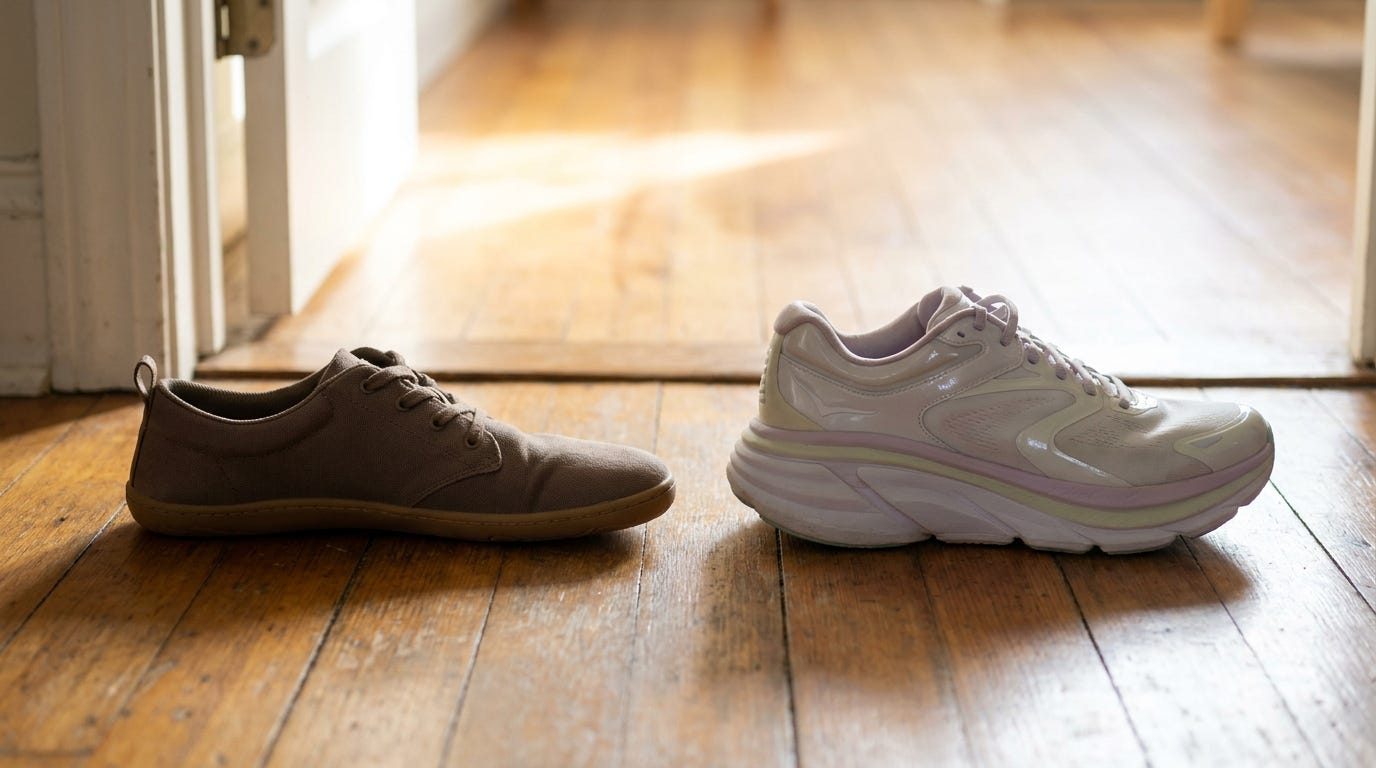
A couple of Saturdays ago I woke up, started my morning scroll, and saw that someone who worked in marketing for a barefoot shoe company was announcing a new job. She was leaving to join one of those maximal cushion shoe brands, the kind with the towering foam soles and the aggressive ad campaigns. If you know anything about footwear philosophy, you know these two kinds of companies are not just competitors. They are opposites. One exists because it believes the human foot is brilliantly designed and should be set free to do what it was made to do. The other exists because it believes the foot needs to be propped up, padded, and managed. She was moving directly from one story to the other, as if the stories were interchangeable.
I want to be honest about my reaction, and I also want to be fair. I do not know her story. She had a paycheck at the first company, so unless she was being pushed out, this was a choice, but choices have contexts I cannot see. Maybe she never grabbed onto the education offered on biomechanics. Maybe she never believed in the product she was marketing in the first place, which is its own quiet indictment, that a company hired someone to tell a story she did not carry in her body. And maybe, like so many of us, she simply took the work that was in front of her, because we live in a society where survival often requires saying yes to things we do not believe in. I hold compassion for her. I really do. But compassion for the origins of a choice does not erase what the choice reveals, and what it reveals is a wound much bigger than one person’s career move.
The Wound: We Have Confused Profit for Value
Here is the wound I want to name. We now live in a society where the dominant question asked of any product, any company, any piece of work is not “is it good for people?” but “will it sell?” We create items that move because they meet a craving or a marketing-induced need, and we call that value. But meeting a demand is not the same thing as providing value. Selling is not the same as serving. Somewhere along the way we collapsed two different words into one. Values, the convictions about what makes the world better, and value, the economic measure of what the market will bear, got fused together, and the dollar sign won.
You can see the fusion in a single job change. When someone can move from a company built on one conviction about human bodies to a company built on the exact opposite conviction, and the move reads as ordinary, even savvy, that tells you the only value actually in play is the paycheck. The convictions were decorative.
Why I Could Not Do It
Years ago I worked at REI, in the footwear department. And I can tell you plainly: I could not stand in front of a customer holding a barefoot shoe in one hand and a maximally cushioned shoe in the other and tell them both were good shoes. I could not do it, because those two shoes carry fundamentally opposite stories about what a good shoe even is.
My conviction, and I will own it as a conviction, is that the cushioned shoe is bad for the human body. It weakens your feet. It reduces your balance. It throws your body out of alignment. It does not deliver the benefits it claims to deliver. Even for a runner, the math does not work. Your foot gets heavier. There is a protrusion under your heel that invites a heel strike, and that heel strike sends more force rattling up through your legs with every step. Everything about that shoe, I believe, works against the design of the human foot and is bad for the human body.
And even when they abate symptoms like plantar fasciitis, they’re really just providing a temporary cover, like pounding antacids after a meal that gives you indigestion. The research makes it clear that the resolution is not found in support, but strength, as in strengthening the muscles in your feet. But support invites atrophy, so it might temporarily make you feel better, but it ultimately exacerbates the issue.
Now, you do not have to share my biomechanics convictions to feel the weight of this. The point is not the shoe. The point is that I had a value underneath my work, a belief about what actually helps human bodies thrive, and that belief governed what I was willing to say to a customer.
I used to directly ask customers, “Are you training for something?” If they were, my goal was to get them through the event, but I always invited them to come back after the event so we could work on a solution. If they weren’t in training, I’d ask if they wanted a bandaid or a solution and fit them accordingly.
Work without that kind of value underneath it is just the pursuit of a paycheck, or the moving of an audience, and we have built an entire economy on that hollowness.
The Wisdom: Value Is What Supports Human Thriving
So here is the reframe I want to offer, the wisdom beneath the wound. Value is what supports human thriving. That is the definition. Not what sells, not what scales, not what returns a dividend. What supports human thriving.
When we value only profit, we ignore everything else for the sake of the bottom line, or at best we deprioritize everything else. But when we value human thriving, the metric of success itself changes. And this is not a small tweak. It might mean some businesses can no longer function. It might mean some products need to go away. It might mean a genuine reorganization of how we approach things as a society. That is how deep the shift goes.
When Andrew Yang ran for president in 2020, he made a point I have carried ever since, built on the old management truth that what gets measured gets done. He argued that we need a new set of measurements. The stock market is a bad metric of national success. A company’s bottom line, shareholder dividends, stock buybacks, these are bad metrics. Instead, he suggested, we should measure things like how many people are living paycheck to paycheck. How many people are actually in a position to thrive in their daily lives. How healthy are we. What is our obesity rate. In other words, measure the thriving, and let the thriving tell you whether the economy is working.
I want to push that one step further, down into the body. In my theological tradition, the body is the sacred interface. It is how we encounter the world, each other, and God. A shoe that honors the design of the foot treats the body as kin, something to be respected and strengthened. A shoe that weakens the foot while promising comfort treats the body as a resource to be managed and monetized. And here is the tender part of the critique: people buy the cushioned shoe because they ache. The ache is real. The desire for relief is holy. What is not holy is an industry that monetizes the ache without healing it, that sells the feeling of care while quietly weakening the very body it claims to serve.
That is what profit-without-value always does. It finds a genuine human longing, and instead of serving it, it farms it.
What Thriving Would Ask of Us
Imagine, for a moment, a marketplace where the first question asked of every product was the thriving question. Does this strengthen people or weaken them? Does this honor the bodies, minds, and communities it touches, or extract from them? Some beloved products would not survive that question. Some entire industries would not. That is not a bug in the vision. That is the vision working.
And before this becomes only about shoes or economics, let it land closer to home. Most of us, at some point, have taken the job, made the sale, or stayed quiet in the meeting, not because we believed in it, but because we needed to survive. That is not hypocrisy. That is what it costs to live inside a system that measures the wrong things. But grief is allowed here. We are allowed to grieve the compromises we have made, and to grieve the society that demanded them, and to let that grief become fuel for choosing differently where we can.
The woman changing jobs is not the villain of this story. She is a mirror. The question her move puts to all of us is simple and uncomfortable: what is the value underneath your work? Not what does it pay. What does it grow. Because value is what supports human thriving, and everything else is just revenue wearing the word.
A Closing Image
The human foot is a small cathedral of arches, tendons, and twenty-six bones, engineered across millennia to carry a body through the world. You can pad it until it forgets how to hold you, or you can let it do the work it was made for and watch it grow strong. Economies are like that too. We can keep cushioning ourselves with the metrics of profit and calling the numbness comfort. Or we can let the system feel the ground again, the actual lives, the actual thriving, and build its strength on what is real.
What gets measured gets done. May we learn to measure what makes us more human.
If this piece stirred something in you, don’t brush past it. There is a real grief that comes with realizing you have been participating in a system that does harm, or that you never felt you had a choice but to participate, and that grief deserves company, not a shrug. I offer one-on-one grief coaching for exactly this kind of reckoning. You can find out more about my coaching here.
Practices for Staying Human
Whether your day only allows for a 60-second reclamation, your week a one-hour resistance ritual, or you find yourself ready for a full on rebellion against a world that assaults your humanity, behind the paywall I offer you three practices that will help you bring this post to life in your everyday.
60-second Reclamation: The Thriving Question
Think of one thing you bought this week, or one thing your work sells. Ask it the thriving question: does this strengthen the people it touches, or does it merely extract from them? No shame, no fixing. Just one honest look at one ordinary thing. Awareness is the whole practice.
60-minute Ritual: A Values Audit
Set a timer and make two lists. On the first, write down the main ways money flows through your life: how you earn it, and the five or six places you most consistently spend it. On the second, write down your actual values, the convictions you hold about what makes the world better and helps people thrive. Now hold the lists side by side. Where do they align? Where have you been telling one story with your beliefs and another with your dollars or your labor? Circle one place of misalignment, not to fix it today, but simply to see it clearly.
Whole-life Rebellion: Grieve, Then Rebuild
Find some space to name, specifically, one place where you have sold out, where you took the paycheck or moved the product or stayed silent, not because you believed in it but because you needed to survive. Do not rush past this. Grieve it honestly, with the same compassion you would offer a friend, because the system demanded it and survival is not a sin. Then widen the grief: grieve the society we live in, the one that fused values and value until the dollar sign won. Let that grief do what grief is for. Let it clarify what matters. And then choose one concrete reorganization: a purchase you will stop making, a conversation at work you will stop avoiding, a metric in your own life you will replace, trading “did it pay?” for “did it help someone thrive?” Small is fine. Small is how economies of the heart change, one honest measurement at a time.