


For years, my cholesterol stayed stubbornly high no matter what I changed. Diet, exercise, fiber, discipline, all the usual advice, and still the number would not drop below 200. Statins were the next obvious answer, but something in me resisted simply forcing the number down without asking why it was high in the first place.
This piece begins with cholesterol, but it is really about a much larger pattern: the way we keep trying to silence symptoms instead of listening for causes. In our bodies, our grief, our despair, and even our politics, the symptom is not always the whole story. Sometimes it is the signal pointing us toward what most needs attention, repair, and truth.
Watch or Listen
The Whole Story
I’ve been fighting my cholesterol for years.
I adjusted my diet. I cut out eggs. I reduced red meat. I added oats, chia seeds, hemp seeds, all the small rituals of responsible fiber. I exercised. I did the things that usually get recommended when cholesterol numbers are high.
And still, the number stayed high.
For five years, my total cholesterol hovered in the 230-ish range. In March of last year, it was 227. In December it was 231. Again and again, the same quiet frustration: I was doing the things that were supposed to help, but the number would not get below 200.
Statins were presented as the next obvious option. That is how the system tends to work: the cholesterol number is high, so prescribe something that forces the number down.
But that never sat right with me.
I had heard enough about statins to feel resistance in my body. Muscle pain. Weakness. Possible liver issues. Blood sugar concerns. The rare but serious muscle breakdown warnings. And there were murkier questions too, especially around the brain. I had watched my dad go through Parkinson’s, and knowing he had been on statins was enough to make the question feel personal, even if the research is not simple or settled.
I am not pretending to be a medical doctor here, and I am not telling anyone else what to do with their medication. I am saying that, for me, the offer felt like symptom management dressed up as a solution. Because the question still remained: why was my cholesterol high in the first place?
Lowering the number might reduce the visible marker, but it would not necessarily tell me what was happening underneath. And if there was a deeper metabolic issue, if something in my body was not processing or converting or clearing properly, then simply attacking the cholesterol number felt like turning down the volume on the alarm while the fire kept burning somewhere behind the wall.
I did not want to silence the symptom. I wanted to understand the cause.
In January, I was visiting my friend Dr. Cherene in LA. She is a chiropractor by trade, but she also studies a wide range of functional health approaches and works with professional athletes who need to constantly optimize their bodies. We were talking through some medical things before an adjustment, and my cholesterol came up.
She started naming symptoms connected to MTHFR-related dysfunction. MTHFR stands for methylenetetrahydrofolate reductase, an enzyme involved in the methylation cycle, which helps the body regulate things like detoxification, DNA repair, neurotransmitter production, hormone metabolism, immune function, and cardiovascular health. In simple terms, methylation is part of how the body processes, converts, clears, and repairs.
She said, in essence, “You show signs of this. And one consequence can be high cholesterol, because your body may not be processing things well.”
That sentence shifted something for me.
What if the cholesterol was not the root issue? What if it was a signal pointing toward a deeper metabolic cause?
The protocol she suggested focused on supporting methylation and detox pathways: methylated B vitamins, especially B12 and B9, zinc, SAMe, and magnesium. For me, the change was real.
Two and a half months later, my total cholesterol had dropped to 203. This week, it was 182.
Almost 50 points down after years of trying to manage the symptom without knowing the cause.
The number mattered. Of course it mattered. But the number was not the whole story. It was pointing to something underneath.
And this is where the cholesterol story becomes something larger than cholesterol.
Because we live in a culture obsessed with symptom management.
We ask, “How do I make this stop?” before we ask, “What is this trying to reveal?” We ask, “How do I become functional again?” before we ask, “Functional for what, and for whom?” We ask, “How do I quiet the pain?” before we ask whether the pain might be telling the truth about a life, a relationship, a body, a culture, or a system that has become unlivable.
This is the wound: we have been trained to treat signals as enemies.
We do this with the body. We do this with grief. We do this with depression and despair. We do this with rage. We do this with politics. We do this with whole communities of people whose pain is inconvenient to the machinery that profits from their silence.
If the body hurts, we want the hurt gone. If grief interrupts us, we want the mourner to “move on.” If despair rises, we medicate, distract, numb, optimize, or spiritualize it before we ask what kind of world keeps producing despair. If rage erupts from the margins, we condemn the tone before we listen to the wound. If politics feels broken, we argue about personalities, parties, decorum, slogans, and spectacle while refusing to face the deeper corruption of money, extraction, and empire beneath the performance.
A culture addicted to symptom management will always call truth-telling dysfunction.
It will call grief weakness. It will call exhaustion laziness. It will call rage divisive. It will call despair pathology. It will call protest disorder. It will call holy maladjustment extremism. It will teach us to distrust the very signals that might lead us back to life.
But staying human requires a different kind of listening.
The wisdom is this: a symptom is not always the enemy. Sometimes it is the body, the soul, or the community refusing to let the deeper wound stay hidden.
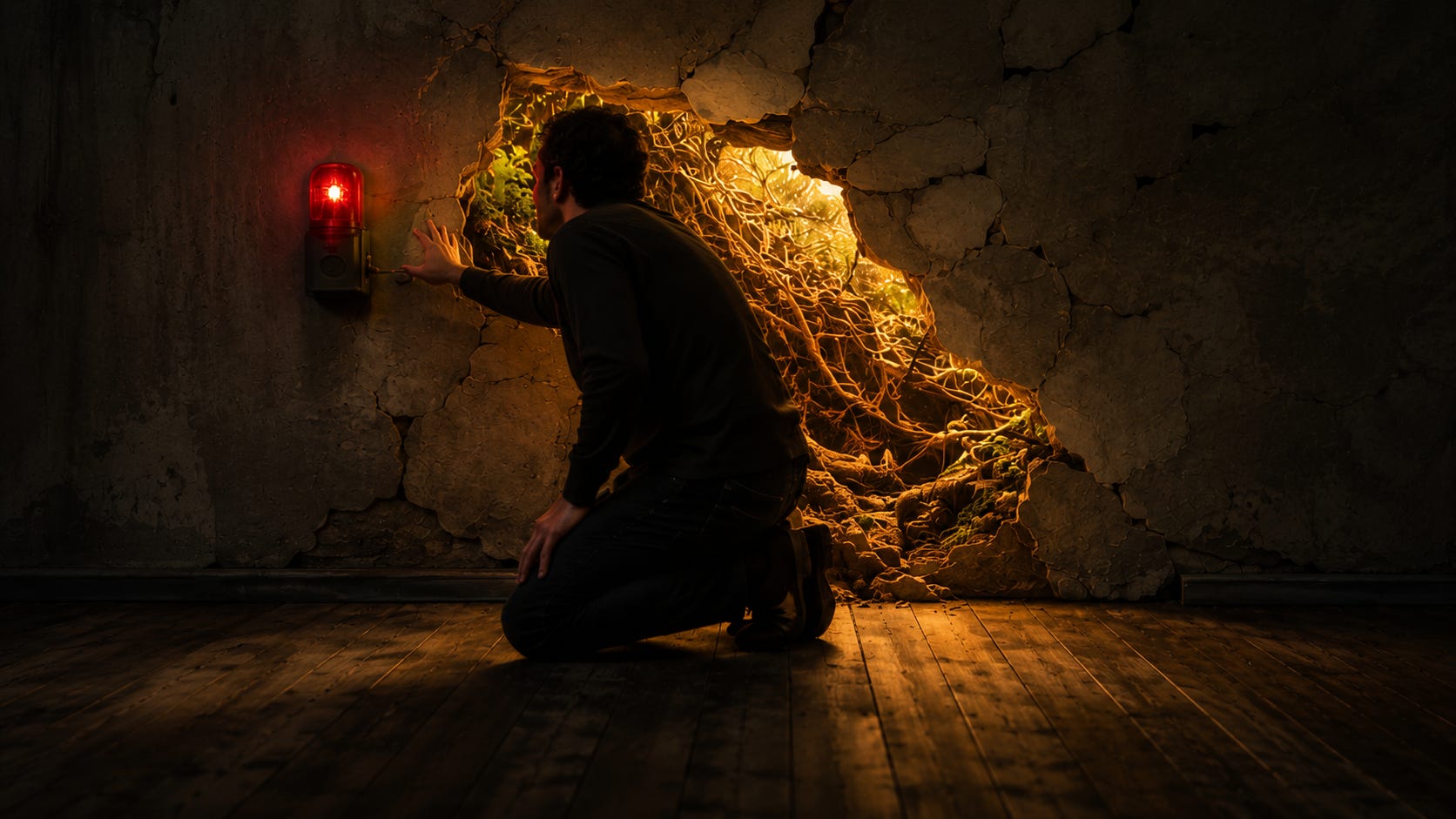
This does not mean every symptom is secretly wise in some simplistic way. Pain is not holy because it hurts. Suffering is not automatically redemptive. Bodies need care. Depression may need treatment. Anxiety may need support. Cholesterol may need medication. Grief may need companionship. Rage may need boundaries. Despair may need clinical care. None of this is an argument against help.
It is an argument against reduction.
It is an argument against treating human beings like malfunctioning machines whose warning lights simply need to be turned off.
You are not a machine. You are beloved dust. You are body and breath and memory and longing. You are nervous system and story. You are biology and attachment and culture and Spirit. You are not merely a set of numbers to optimize or symptoms to suppress. You are a living ecosystem trying, in all the ways living things try, to move toward repair.
When my cholesterol would not move, the issue was not simply willpower, diet, or effort. It was revealing that something upstream needed attention.
What if we gave our grief the same dignity?
What if grief is not proof that we are broken, but evidence that love has left an imprint deep enough to ache? What if despair is not always a personal failure, but sometimes an honest response to inhabiting a world that asks us to become less human in order to survive? What if rage is not merely a problem to manage, but sometimes the part of us that still knows a boundary has been violated? What if numbness is not laziness, but a survival strategy that once kept us from being overwhelmed?
Much of what looks like dysfunction began as protection.
Freeze, fawn, control, withdrawal, over-functioning, pleasing, shutting down, staying busy, staying numb, staying useful, these are not character flaws first. They are often ancient machinery doing what ancient machinery does. They helped us survive before we knew how to be free.
Grace does not shame the survival system. Grace creates enough safety for truth.
And truth is where healing begins.
Not the kind of truth that humiliates. Not the kind that says, “Here is what is wrong with you.” The kind that asks, “What love is still pulsing beneath the wreckage?” The kind that listens long enough to notice where the signal is coming from. The kind that sees the symptom and says, “Thank you for trying to get my attention. Now show me what needs care.”
This is also why our political imagination is so thin right now.
We keep staring at the symptoms of a sick society. Polarization. Corruption. Performative outrage. The collapse of trust. The feeling that everyone is shouting and no one is listening. The sense that every crisis becomes content, every wound becomes a brand opportunity, every public good becomes another market to exploit.
But if we only treat the symptoms, the system keeps producing them.
We can rage about politicians while refusing to confront the money that buys access, shapes policy, and turns public service into theater for private gain. We can lament loneliness while maintaining an economy that isolates, exhausts, and commodifies people. We can condemn despair while protecting the systems that generate it. We can call people unhealthy while ignoring the soil their bodies and souls are forced to grow in.

Empire loves symptom management.
It lets the machinery stay intact while individuals blame themselves for breaking down inside it.
Love asks deeper questions.
Love asks what kind of world makes so many bodies inflamed, so many souls numb, so many families exhausted, so many communities suspicious, so many young people hopeless, so many elders isolated, so many workers disposable, so many mourners rushed, so many truth-tellers punished.
Love refuses to silence the alarm and call it peace.
Jesus, at least as I understand him, was never merely interested in helping people manage symptoms so they could return quietly to the systems that were killing them. He healed bodies, yes. He restored people to community. He touched the untouchable. He fed the hungry. He named hypocrisy. He confronted domination. He exposed religious respectability when it became a mask for harm. He listened to cries that polite society wanted silenced.
The Human One did not treat pain as an inconvenience to the powerful. He treated it as revelation.
Where does it hurt?
Who told you to hide it?
Who benefits if you stay quiet?
What would repair require?
That is not just medicine. That is theology. That is politics. That is spiritual formation. That is what it means to stay human in a world that keeps asking us to become efficient, numb, agreeable, and easy to manage.
The practice, then, is not to worship our symptoms or ignore the help we need. The practice is to listen beneath them.
The next time something in you refuses to “get over it,” pause before you declare war on yourself. The next time grief interrupts your productivity, ask what love it is honoring. The next time exhaustion makes you angry, ask what limits have been violated. The next time despair rises, ask whether your soul is telling the truth about a life that needs more support, more beauty, more community, more rest, more justice, more room to breathe.
And yes, get help. See the doctor. Call the therapist. Talk to the coach. Take the medication if that is what care requires. Change the diet. Move your body. Do the labs. Make the appointment. Join the group. Build the practice.
But do not let anyone reduce you to the symptom.
You are not the number. You are not the diagnosis. You are not the grief wave. You are not the panic. You are not the shutdown. You are not the rage. You are not the despair.
You are the beloved life underneath, trying to be heard.
If you are carrying grief, despair, or a life transition that will not be rushed into “normal,” this is the heart of my Life After Loss work. I help people listen to what pain is revealing, honor what has been lost, and practice becoming human again without shame. If that is the kind of support you need, reply to this email or send me a message.
The number was not the whole story. The symptom was pointing toward a cause.
Maybe yours is too.
Practices for Staying Human
Whether your day only allows for a 60-second reclamation, your week a one-hour resistance ritual, or you find yourself ready for a full on rebellion against a world that assaults your humanity, behind the paywall I offer you three practices that will help you bring this post to life in your everyday.
60-second Reclamation: Listen beneath the signal
Place one hand on your chest or belly. Name one symptom, feeling, or pattern that has been asking for your attention. Say quietly, “You are not my enemy. What are you trying to show me?” Do not force an answer. Let the question be enough.
60-minute Ritual: Map the root system
Choose one recurring symptom or struggle, emotional, relational, physical, or spiritual. On paper, write it in the center of the page. Around it, map possible roots: body, sleep, food, grief, stress, money, family systems, trauma, loneliness, work, culture, politics, spiritual wounds, unmet needs. Then circle one root that deserves compassionate attention this week.
Whole-life Rebellion: Build a repair ecology
Begin shifting from symptom management to root-care. This may mean building a care team, changing your relationship to work, joining a grief group, seeing a clinician, creating rituals of rest, practicing nervous-system regulation, doing functional testing, telling the truth in a relationship, or joining movements that address systemic harm. The question is not, “How do I make the pain disappear as fast as possible?” The deeper question is, “What kind of life, community, and world would make repair possible?”
Everything is truly connected. Very insightful piece.