


There’s a gift box I keep on my bookshelf.
It’s just a box. A ridiculous, brilliant, 3D-printed puzzle box from my kid. Part prank, part project, part parable. The kind of thing that makes you laugh and groan and feel deeply seen all at once.
What starts as a story about that box (and a Christmas card that refused to stop playing Rick Astley) unfolds into something more: a meditation on the lies we’re sold about freedom, the places we think will save us, and the realization we all eventually face: You always bring yourself with you.
This piece is about play and presence, inner maps and honest healing. It’s about what it means to stay human in a world that depends on our fragmentation.
There’s a compass inside this one.
Let’s find our way together.
Watch or Listen
The Whole Story
My kid is a fantastic gift giver. Not, like, “here’s a thoughtful thing you asked for” gift giver. More like, “I studied your psyche and built a small comedic device to mess with you for an entire afternoon” gift giver.
Last year for Christmas they handed me a plastic box with a plastic bow on top. It looked innocent. It looked like the kind of thing you would set under a tree when you want the person opening it to feel a little more anticipation.
It was not innocent.
When I first picked it up it seemed unopenable. After tinkering for a moment I realize the bow was not just a decoration, it also concealed a tool. Unscrewing the plastic bow revealed a tiny key, one that would allow me to remove a collection of screws along each of the four ribbons that ran down the side of the box.
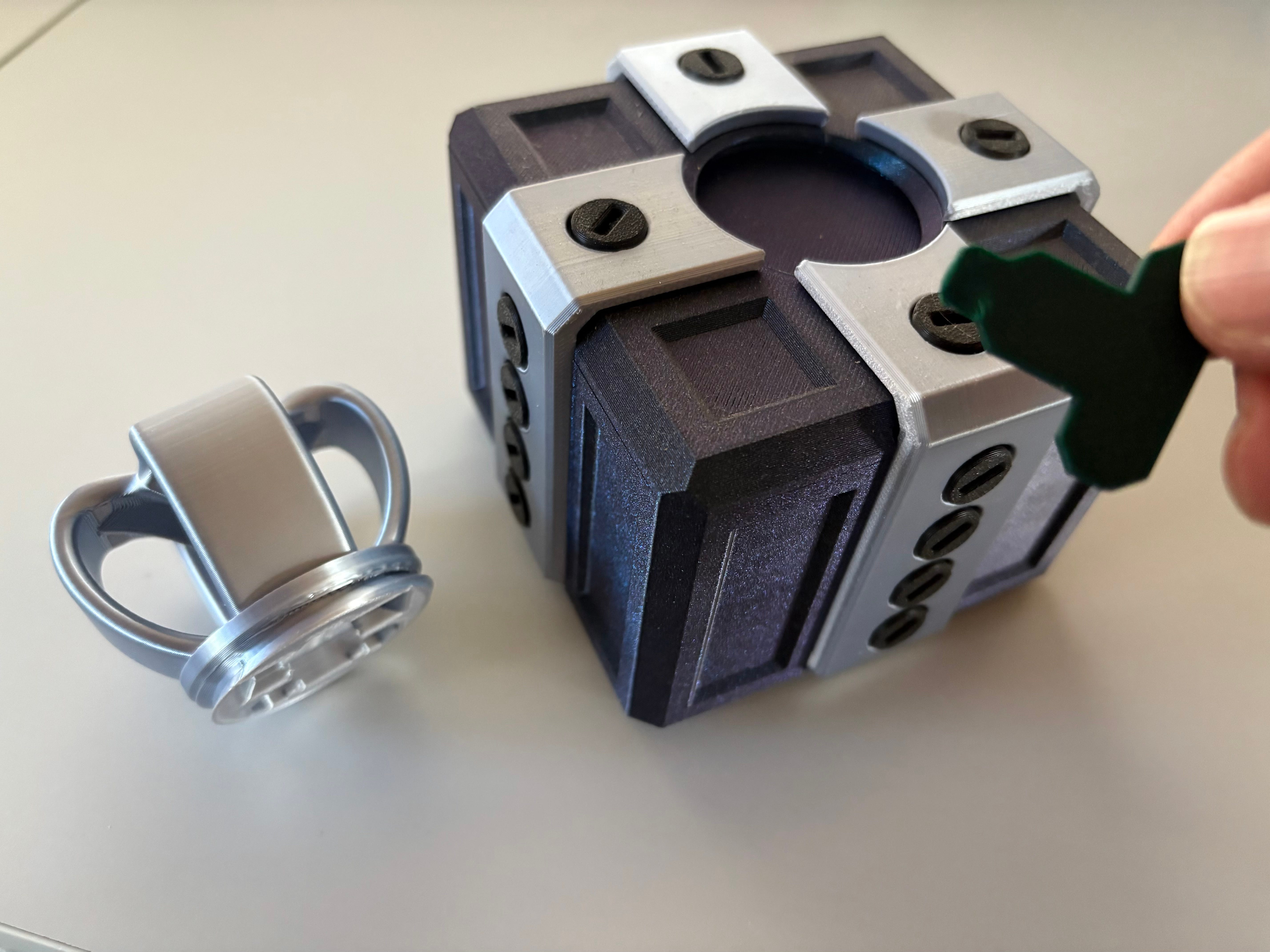
Five screws on each of the four ribbon segments. Twenty screws. Twenty. This was not gift wrapping. This was an engineering project. This was my kid looking at me and saying, “You are going to work for your joy.”
I sat there for a long time, slowly undoing screw after screw, laughing because the whole thing was so ridiculous.
I could feel the satisfaction in the room. Not in me. In them. They were watching their design do what it was designed to do.
Eventually, I got the ribbon off. Eventually, I got the box open. Inside was another little box. Small. Like an oversized ring box. On it, it said Just for you.
I opened it. A middle finger on a spring shot straight up.
I lost it. I laughed so hard. One of those deep belly laughs that makes you want to hit the floor and roll. It’s the response that prompted the original lmfao.
It was stupid. It was perfect. It was intimate in the strangest way. Because this is what good gift giving does. It says, “I see you.” It says, “I know what will make you laugh.” It says, “I know what kind of play you can carry right now.” And in a world that is increasingly allergic to play, that kind of attunement is not small.
It is holy. It is a way of staying human.
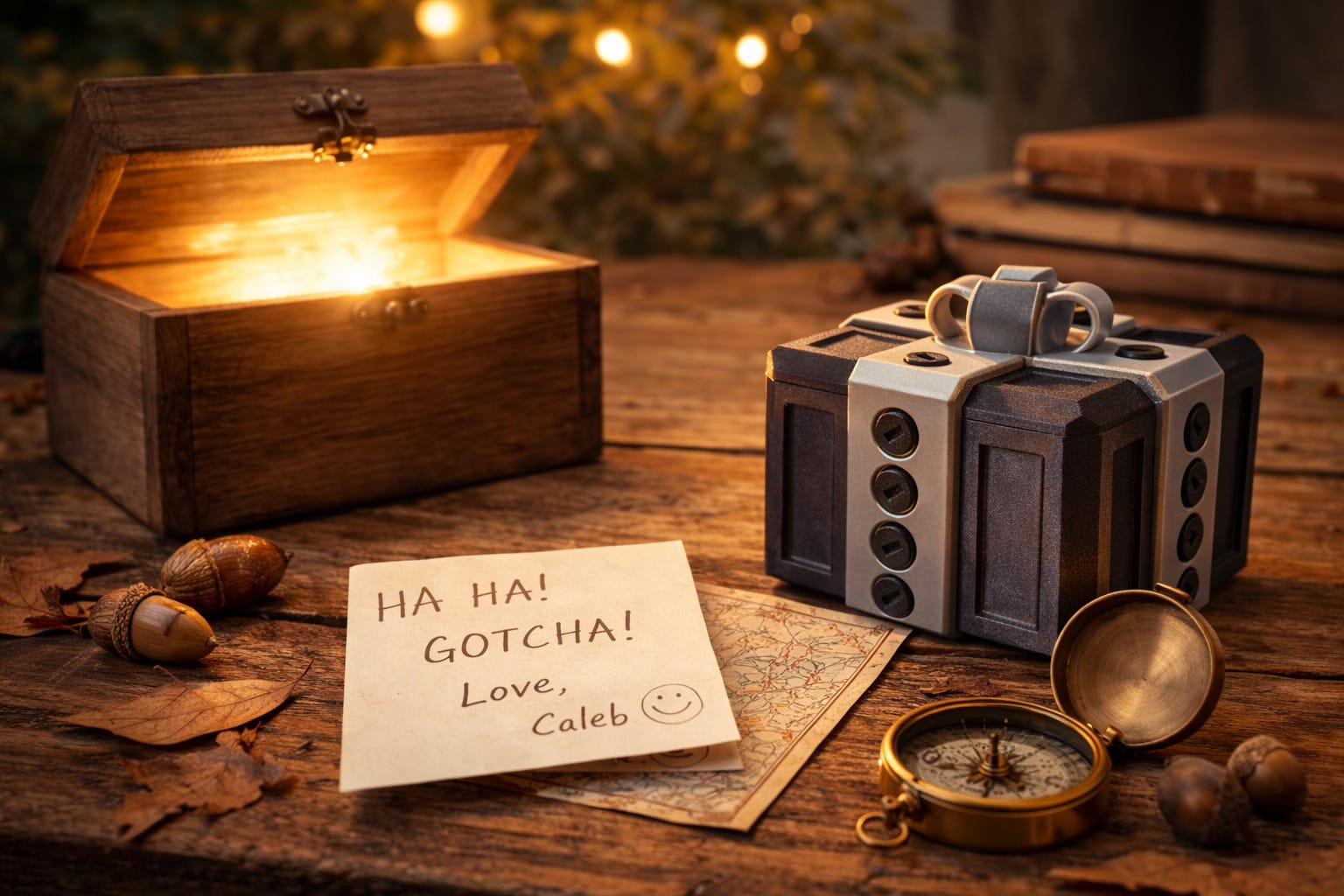
Next came the Christmas card. I opened it. It started playing Rick Astley. “Never gonna give you up, never gonna let you down.”
A classic gag. I laughed again. And then I closed the card. And the card kept playing. On repeat. Over and over and over.
I opened it again thinking maybe it was motion activated. Nope. It just wanted to live. The song kept playing. The Rick Roll to end all Rick Rolls.
I did what any reasonable adult does when faced with a tiny piece of paper that will not stop making noise. I hid it. I took it out to the garage and locked it away until it finally died.
And the whole thing was hilarious.
But also, if I am honest, it was a tiny parable. Because so much of our modern life is loud. So much of our modern life is designed to keep playing even when we close the card. We try to shut it down. We try to escape. We try to silence it. But the music keeps going.
The notifications.
The hustle.
The doom scroll.
The subtle sense that we are behind.
The belief that if we could just get to the right place, the right job, the right body, the right relationship, the right schedule, then the noise would stop.
But the noise does not stop. It just follows us. And at some point, if we are brave enough, we admit the thing that we thought would bring us liberation, far too often, brings us devastation.
Why? Because even when all the externals change, no matter where you go, you bring yourself with you. There you are. And everything you are carrying is there too. The question is not whether we carry our story. The question is whether we will keep trying to outrun it. Or whether we will finally turn toward something more human.
The lie we keep buying
There is a lie we keep being sold, and it is powerful because it contains a small grain of truth. The lie is that you can do something external that will finally change your internal reality. If you move. If you buy. If you grind. If you rebrand. If you reinvent. If you find the perfect morning routine.
If you finally become the kind of person who does cold plunges and makes sourdough and never has a messy house. If you leave your town. If you leave your people. If you leave the version of yourself that remembers too much. Then, maybe, you will become free.
Now, to be fair, sometimes external changes matter. Sometimes you do need to leave. Sometimes you do need to get out of the environment that is actively harming you. Sometimes you do need distance to breathe. Sometimes you do need therapy and medication and community and new rhythms and a new zip code.
I am not here to romanticize staying stuck. I am here to name the trap.
Because there is a difference between leaving a cage and believing that the cage was the only thing in the way. There is a difference between change that supports your healing and change that replaces your healing. And our culture is very good at selling replacements.
It is good at telling you that the next purchase will finally make you feel like yourself.
It is good at telling you that the next place will finally make you feel alive.
It is good at telling you that the next relationship will finally make you feel whole.
It is good at telling you that the next achievement will finally make you feel safe.
It is good at telling you that hustle is a spiritual practice.
It is good at turning your life into a brand.
It is good at turning your pain into content.
It is good at turning your longing into a market.
And the whole system depends on you believing a very specific story. That the problem is out there. That the solution is out there. That you can outrun what hurts by moving fast enough. But sooner or later you arrive at the place you thought would save you, and you realize something.
You brought the haunt with you.
I have seen this a thousand ways:
People move to Denver.
People move to Nashville.
People move to Austin.
People move to LA.
They think the move will be the first step in their healing. They think the mountains, or the music scene, or the sunshine, or the new friend group will finally unlock something inside them.
And sometimes it does. And then, slowly, the deeper truth shows up.
I thought when I got away from my family I would no longer struggle. I thought I could finally be myself. I thought I could express myself more clearly. And then I got here and realized I did not really know who I was without them.
Or I thought when I got here and could do all these outdoor activities life would be more fun. But I am not having fun. I am distracting myself. I am staying busy. I am staying moving. I am avoiding the quiet. And when the quiet comes, there I am.
Still carrying fear.
Still carrying shame.
Still carrying grief.
Still carrying all the parts of my story that are not solved by a new skyline.
This is not a reason to despair. It is a reason to get honest. Because once you admit that you bring yourself with you, you stop wasting energy trying to perform your way into freedom. You start doing the work that actually changes you. You start turning toward something more human.
The gift I wanted to give
My kid’s gifts are playful. They are ridiculous. They are designed for laughter. They are also designed for connection.
When they give like that, it is not a distraction. It is a signal. It says, “I am paying attention.” It says, “I know you.” It says, “We are still capable of delight.”
And that kind of play is part of what I mean when I say staying human.
Not performing.
Not optimizing.
Not consuming.
Re-creating.
Reclaiming delight.
Reclaiming presence.
Reclaiming the ability to laugh at the absurdity of being alive.
So when their graduation came in May, I wanted to match that energy. I wanted to give them something that said, “I see you.” Not in the shallow way. Not in the social media way. In the real way.
I was proud. And tender. And scared. Because this is what it means to love someone who is stepping into the world.
You want their future to be bright. You want them to be free. You want them to be seen. You also know the world is not gentle. You know being human is not simple. So I gave them a big box.
On the tag I wrote, “I promise you, your future is bright.” Inside the big box was a box of light bulbs.
A dad joke, yes. But also a blessing. A way of saying, “Your life has light in it.” A way of saying, “You will not be swallowed by the dark.”
And then I wanted to give them something more substantive. Not as a lecture. Not as a sermon. Not as a “here’s how to live your life” monologue. More like a staged gift.
Wisdom that comes in phases. Because that is how real life works.
So I gave them a book. Lauren Graham’s In Conclusion, Don’t Worry About It. Inside the book cover I wrote something like this:
I think this is where I’m supposed to drop some dad wisdom bombs. But I’ve learned over the years that while sometimes valuable, they come best in stages and when invited. So I picked up four books for you. Four resources. After this one, I’ll only give you the next one when you finish the previous one and ask for the next.
This one: a great starting mantra.
And invitation to adventure and discovery.
For when you realize that no matter where you go, you bring yourself with you.
The rest of your life.
At the end of the book I left a note. Let me know when you are ready for an invitation to adventure and discovery.
A couple months later they came back. “Yeah. I’m ready.” So I handed them the next book. Dr. Seuss, Oh, the Places You’ll Go.
And again, at the end, I tagged it. Because the point was never the book. The point was the arc. Adventure. Discovery. And then the moment where you realize something no one really tells you when you are young. No matter where you go, you bring yourself with you.
We have all met that moment.
Some of us meet it at 19.
Some of us meet it at 29.
Some of us meet it at 49.
Some of us meet it after a divorce.
Some of us meet it after a promotion.
Some of us meet it after a move.
Some of us meet it after our body finally says, “I can’t do this pace anymore.”
But we meet it.
And the question becomes, “Now what?”
This is where the gift of staying human matters. Because if you believe the cultural lie, the answer is, “Do something bigger.” Move again. Buy more. Hustle harder. Start over.
But if you are willing to tell the truth, the answer is, “Go inward.” Not as narcissism. Not as self-absorption. As reclamation. As healing. As wholing.
Healing and wholing
When I say healing and wholing, I mean something simple and also not simple at all.
It means learning to recognize the parts of your story that shaped you. The parts that informed you. The parts that have been trying to guide how you move through the world. Even when they guide you in ways that are not actually helping you anymore.
Shame does this.
Fear does this.
Grief does this.
Old coping strategies do this.
They are not evil. They are not proof that you are broken beyond repair. Most of the time, they are parts of you trying to help you survive. But survival strategies are not always life strategies.
Healing and wholing is the work of going back to those parts. Listening. Blessing the original ache. Giving those parts what they needed then, and what they need now.
So you can stop being run by the loudest voice in your inner world. So you can live from your wholeness. So you can live from belovedness. So you can move toward something more human.
And yes, I think it is almost impossible to do this alone. Sometimes we have to start by simply noticing what is happening inside us. And then we realize what is happening inside us is too big for us to hold by ourselves.
We need guides.
We need therapists.
We need coaches.
We need spiritual directors.
We need friends who will not flinch when we tell the truth.
We need community.
We need people who can sit with us long enough for the nervous system to stop believing it is in danger.
Not because we are weak. Because we are human.
A nature-based map for the psyche
One of the most helpful frameworks I have found for this work comes from Bill Plotkin.
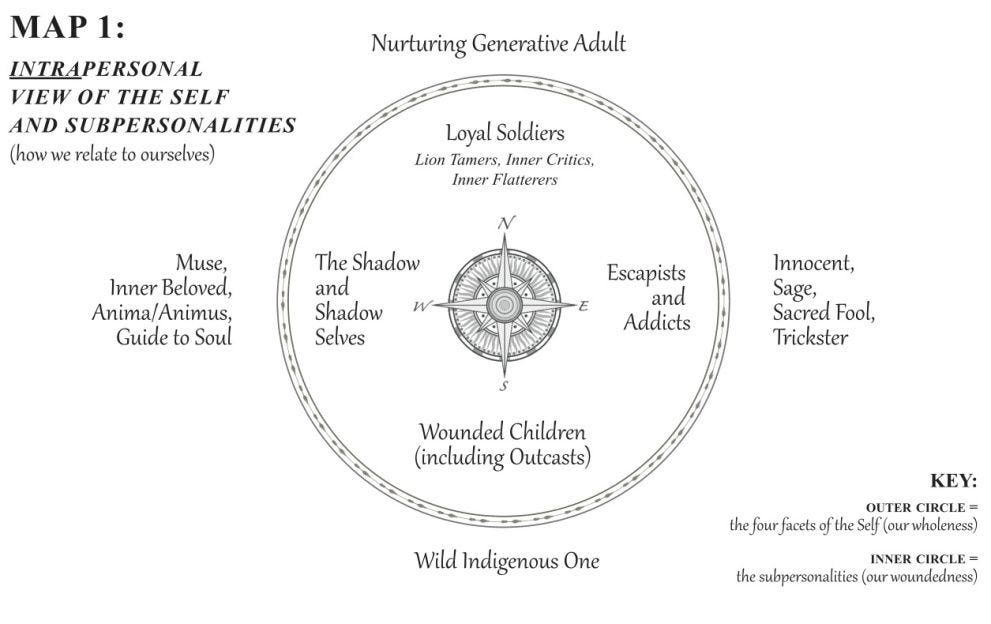
In his book Wild Mind, Plotkin offers a nature-based map of the human psyche. It is not a formula. It is not a personality test. It is not a neat little box you can put yourself in. It is a compass.
A way of noticing where you are living from. A way of naming the parts of you that keep grabbing the steering wheel. A way of understanding why you keep ending up in the same patterns, even when you change the scenery.
Plotkin uses the image of the four directions. Each direction holds an aspect of wholeness. Each direction also has its own distortions. Its own sub-personalities. Its own ways of trying to keep you safe.
And the work of staying human is learning how to integrate the whole circle. Not just your favorite quadrant. Not just the part of you that performs well. Not just the part of you that can hold it together. The whole thing. The whole human.
Plotkin’s Map
In the South, Plotkin locates our wounded children. The parts of us that learned early what it takes to belong. The parts of us that carry the insider and outsider stories. The parts of us that still flinch in rooms that resemble our childhood.
When we are trapped here, we tend to live from fear or anger. We react. We brace. We protect. We become small.
Or we become sharp. Not because we are bad. Because a part of us is trying to keep us safe.
The path toward healing in this quadrant is not to shame the wounded child. It is to meet it. To listen. To offer it what it needed. A voice from the North. A voice Plotkin calls the Nurturing Generative Adult. The part of you that can care. That part of you that can hold tenderness. That part of you that can parent your own inner world.
But even the Nurturing Generative Adult has its distortions. Plotkin names one of them the Loyal Soldier. That protective mechanism that thinks safety equals smallness. That voice that says, “Do not risk it.” That voice that says, “Do not be too much.” That voice that says, “Stay in line.”
And here is the thing. Our culture loves the Loyal Soldier. It can monetize it. It can recruit it. It can build whole economies off your fear. It can convince you that your smallness is virtue. That your silence is maturity. That your compliance is wisdom. And part of staying human is learning to thank the Loyal Soldier for its service, and then inviting it to stand down.
In the East, Plotkin locates the Magician and the Mystic. This is the part of you that can look up and see the cosmos. The part of you that can sense meaning. The part of you that can feel wonder. The part of you that can name patterns. The part of you that can access insight.
When we are integrated here, we are awake. We are curious. We are attentive. We are connected to the sacred.
But when we get trapped here, especially in a culture that is exhausted and overstimulated, the distortion often looks like escapism. Addiction. Dissociation. Numbing. The desire to get away from it all.
Some of us escape through substances. Some of us escape through scrolling. Some of us escape through work. Some of us escape through constant self-improvement. Some of us escape through spiritual experiences that never touch the body. We become people who can talk about the universe but cannot sit with our own grief. We become people who can name everyone else’s patterns but cannot tell the truth about our own.
And again, it is not because we are broken. It is because a part of us is trying to survive. The invitation here is not more shame. It is more presence. It is coming back into the body. It is learning to tolerate reality without running. It is learning to let wonder become grounded, not floaty.
In the West, Plotkin locates the Dark Muse and the Beloved. This is the realm of soul. Shadow. Depth. The underworld places where we encounter what we have buried.
This is where grief lives. This is where desire lives. This is where the parts of you that do not fit the brand live.
When we are integrated here, we are honest. We are humble. We are rooted. We are not terrified of complexity.
But when we get trapped here, the distortion can look like shadow avoidance in its sneakiest form. We tuck things away. We deny. We pretend we do not see it. We tell ourselves, “That is not me.” Even when it is.
Even when it is shaping our relationships. Even when it is shaping our choices. Even when it is making us reactive. Even when it is making us cruel.
And a culture built on performance rewards this kind of denial. Because if you never tell the truth about your shadow, you can keep curating your image. You can keep being “fine.” You can keep being “good.” You can keep being “successful.” And you can stay fragmented forever.
The invitation in the West is to let the buried things come into the light with safety and support. Not to indulge them. Not to glamorize them. To integrate them. To let the truth become metabolized. To let shame lose its grip. To let the Beloved in you remember it is beloved even with the shadow on the table.
The Gift of Plotkin’s Map
Plotkin’s map is more detailed than this. There is more nuance. There are more layers. But even this simple circle offers a gift.
It tells you that your coping mechanisms have a context. It tells you that you are not randomly broken. It tells you that your patterns are intelligible. It tells you that there is a way forward.
Not a shortcut. A path. And this matters because so many of us are living from one corner of ourselves.
We are living from the wounded child and calling it “being realistic.” We are living from the Loyal Soldier and calling it “being responsible.” We are living from escapism and calling it “self-care.” We are living from denial and calling it “being positive.” And the system cheers us on. Because the system does not want you whole.
A whole person is harder to manipulate.
A whole person is harder to sell to.
A whole person is harder to recruit.
A whole person is harder to shame.
A whole person is capable of solidarity.
A whole person is capable of saying, “No.”
A whole person is capable of re-creation.
So the system keeps offering replacements. Move. Buy. Hustle. Reinvent. Distract.
And the inner work stays undone. Until the body says, “Enough.” Until the relationship fractures. Until the anxiety becomes unbearable. Until the quiet finally catches you.
And then, if you are lucky, you get honest. You bring yourself with you. So now you have to learn how to be with yourself.
Staying human: belovedness, authenticity, solidarity, re-creation
If I had to say what staying human is in one sentence, it would be this: Staying human is learning to live from belovedness, embrace your authenticity, practice solidarity, and embody re-creation.
Belovedness says, “You do not have to earn your right to exist.”
Authenticity says, “You do not have to perform a self you cannot sustain.”
Solidarity says, “Your healing is not just personal relief, it is part of reweaving the world.”
Re-creation says, “You were not made to consume your way into meaning, you were made to create, to play, to rest, to become.”
This is why my kid’s prank gifts matter. Because play is not childish.
Play is a form of resistance.
Play is a way of remembering we are not machines.
Play is a way of remembering we belong to each other.
Play is a way of remembering the world is still enchanted, even when it hurts.
And this is why the “substantive” gifts matter too.
Because we need maps.
We need language.
We need practices.
We need companions.
We need ways to do the inner work that the outer world will never do for us.
We need ways to tend the parts of us that are still afraid. Still ashamed. Still grieving. Still bracing.
So we can stop outsourcing our healing to the next move. So we can stop outsourcing our identity to the next purchase. So we can stop outsourcing our worth to the next achievement. So we can stop outsourcing our hope to the next politician or pastor or influencer. So we can turn toward something more human.
A simple invitation
If any of this is landing in your body, here is my invitation. Pick up Bill Plotkin’s Wild Mind.
Not because it will fix you.
Not because it will give you a one-size-fits-all plan.
Not because it will replace therapy or community.
But because it might give you a map.
A way to name where you have been living from. A way to locate the sub-personalities that keep grabbing the wheel. A way to understand why the move did not save you. A way to understand why the hustle did not heal you. A way to understand why the distraction stopped working. A way to start doing the work that actually changes you.
You bring yourself with you.
So let’s stop running.
Let’s stop buying replacements.
Let’s stop treating our inner world like a problem to manage.
Let’s become curious.
Let’s listen.
Let’s take an hour and sit with the four directions.
Let’s journal what comes up.
Let’s notice what part of us is loudest.
Let’s offer it kindness, and truth.
And slowly, steadily, let’s move toward something more alive. Toward something whole. Toward a life that feels like yours. Towards something that will help us all stay human.
Embodiment Practices
Whether your day only allows for a 60-second reclamation, your week a one-hour resistance ritual, or you find yourself ready for a full on rebellion against a world that assaults your humanity. While these practices are usually behind the paywall, this week they are my gift to you.
60-Second Reclamation Reflection: “You Brought Yourself With You. That’s the Gift.”
One-Hour Resistance Ritual: The Fourfold Listening Circle
Inspired by Bill Plotkin’s Wild Mind, this is a solo ritual of sacred reorientation. You’ll need a quiet space and ideally something to mark each direction (a stone, candle, branch, etc.).
Preparation:
Mark a central space.
Set four markers around you at approximate cardinal directions: South, North, East, West.
Sit at the center. Breathe. Set your intention: to listen within, from every angle of your own becoming.
Then take time sitting in each direction, facing back toward the center. At each stop, ask:
🐾 SOUTH — Wild Indigenous One
What wildness, longing, or instinct is rising?
Where is life calling me to run barefoot again?
🧡 NORTH — Nurturing Generative Adult
What wisdom or grounding does my inner caregiver have for me?
What needs tending in my life right now?
🧠 EAST — Magician or Sage
What clarity or insight is breaking through?
What old stories am I being invited to rewrite?
💀 WEST — Dark Muse Beloved
What grief, rage, or shadow seeks to be heard?
What truth has been locked in silence?
Take 15-minutes at each location, taking time to journal about whatever stirs.
Close by returning to the center.
Place your hand on your heart. Whisper:
“All of me is welcome. All of me is here.”
Step Into A Life-Changing Rebellion: A Year With Your Wild Mind
If you’re serious about integration, about staying human in the face of fragmentation, don’t just dip a toe in. Get the book. Order Wild Mind by Bill Plotkin.
And don’t speed-read it.
Sit with it. Wrestle with it. Dialogue with it. Let it guide you through the coming months as a counter-map to every story that told you you had to be one thing, perform one way, or hide your inner world.
Make it your New Year’s soulwork.
Mark your calendar. Read one chapter per week or per two weeks. Journal what each of the four quadrants stirs in you. Step into the practices. Bring it into walks, prayer, dreams, breathwork, coaching, or conversations with those who can hold all of you.
Because the world doesn’t need more polished personas.
It needs humans who have met themselves. And stayed.