


Belovedness can be a beautiful idea and still remain far from the places where we actually live. We can believe we are loved while our bodies brace for rejection. We can speak about grace while shame keeps teaching us to hide, perform, control, or disappear.
In this second part of A Theology of Staying Human, I explore what happens when Love puts on skin. Through incarnation, the body, shame, accountability, and repair, we will ask what it means for Love to become more than something we understand. What would it mean for Love to become a way of inhabiting our bodies, relationships, wounds, and ordinary lives?
However you prefer to take it in, you can watch, listen, or read. The full written reflection continues below.
Watch and Listen
The Whole Story
Last week, I began this theology of staying human with a claim that has reordered nearly everything for me: You are beloved. You are not broken. You may be wounded, unwell, disconnected, or living from patterns shaped by survival. You may need healing, accountability, and repair. But none of that makes you a broken human being.
The Christian story, as I had often received it, began with a problem. Humanity was sinful. God was holy. A great distance stood between us. The rest of the story explained how that distance might be crossed and how we might become acceptable to God.
I suggested we begin somewhere else. Before there is failure in Genesis, there is blessing. Before there is sin, there is belovedness. Before the humans hide, they are naked and not ashamed, fully seen without having to manage what is seen. The serpent does not take away their belovedness. The serpent teaches them to mistrust it. They reach through control for what they had already received as gift, then see themselves through shame and hide.
That story matters to me because I know what it is like to organize a life around being acceptable.
For years, I knew how to be useful. I knew how to step into a room with something to offer. I could preach, teach, solve problems, care for people, explain theology, and find language for grace. Usefulness became one of the ways I knew who I was. If I could help, perform, or make meaning, I could feel secure in my place.
Maybe your version looks different. Maybe you learned to be easy to love, productive enough to matter, competent enough not to need anyone, agreeable enough to avoid conflict, spiritual enough to silence doubt, or strong enough that nobody would notice how frightened you were. Most of us develop some version of a self that knows how to survive the room.
The trouble is that a survival strategy can work so well that we mistake it for wholeness.
I could believe in grace while still experiencing failure as a threat to my identity. I could preach forgiveness while remaining unprepared for what happened inside me when another person’s pain implicated me. I could speak about human failure and woundedness in the abstract, yet still struggle to remain present when the truth became particular, when it had a face, a history, and consequences I could not explain away.
My theology told me I was forgiven. My body still heard accusation as annihilation.
That gap is part of what belovedness began to expose. If Love is the ground beneath us, then belovedness is not merely a comforting idea to repeat when we feel bad. It must become something our bodies can trust. It must change how we respond when we are afraid, ashamed, grieving, confronted, or unable to control another person’s perception of us.
Otherwise, theology can become a hiding place.
We can learn the right words for grace without becoming gracious. We can defend the incarnation while remaining disconnected from our bodies. We can affirm resurrection while refusing to grieve. We can preach forgiveness in ways that protect people who caused harm from ever having to face what that harm did to someone else.
Those theological ideas were not meaningless to most people, But ideas alone do not make people whole. Understanding is a doorway, not a dwelling place.
So the second movement follows directly from the first. If we come from Love, then Love cannot remain an abstraction. It must enter breath, muscle, memory, relationship, grief, consequence, and repair. It must become more than something we affirm. It must become a way of inhabiting our humanity.
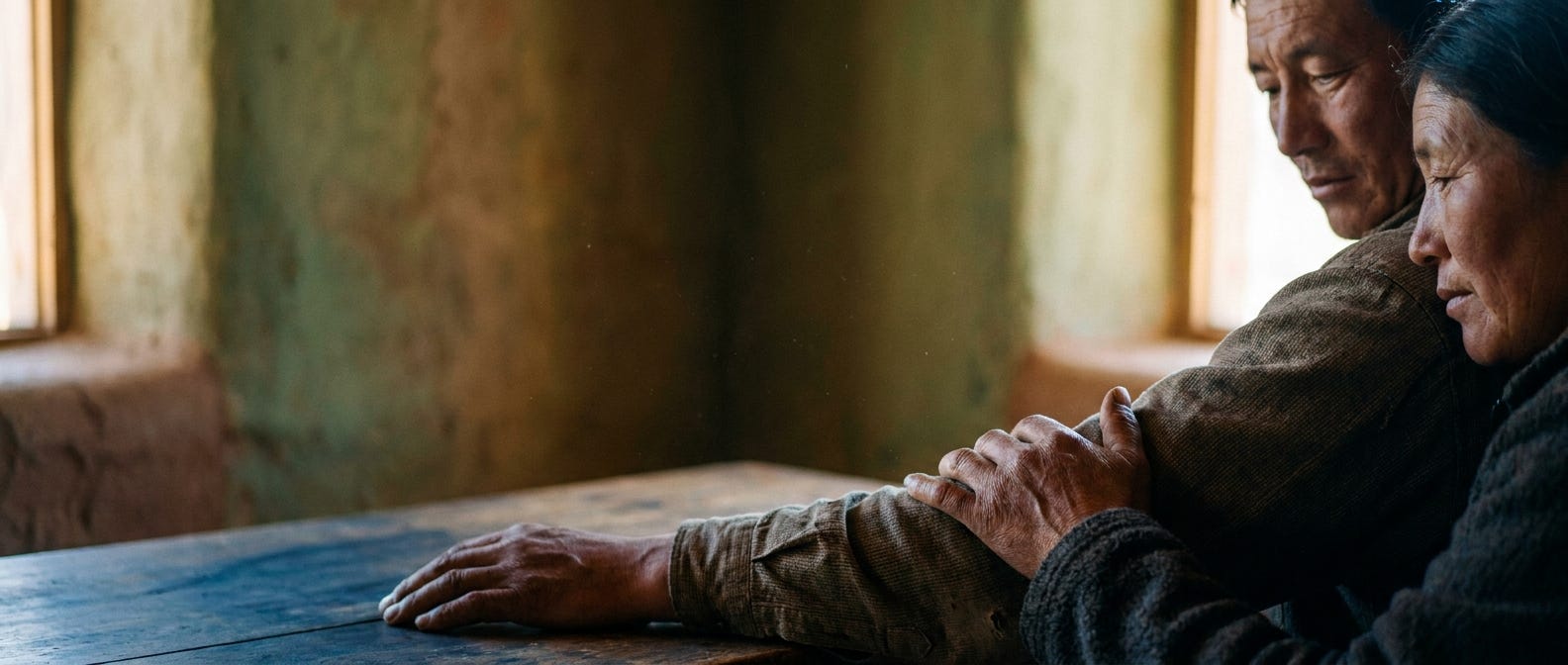
The second claim in my theology of staying human is this: Love becomes real when it puts on skin.
The Human One
At the center of Christianity is an astonishing claim: in Jesus, God becomes flesh.
That word matters. Flesh means a body that gets tired and hungry. A body that can touch and be touched. A body that grieves, sweats, bleeds, eats, sleeps, and needs companionship. Jesus enters a particular place, language, people, political reality, and history. Divine love does not remain distant from ordinary human life. It becomes visible within it.
This is part of what draws me to Jesus. Jesus reveals what God is like, but also what it can look like to become fully human. His life shows love taking shape through presence, touch, grief, courage, relationship, and solidarity. I do not follow Jesus because I am trying to escape my humanity. I follow because his life keeps calling me more deeply into it.
This is what I mean when I call Jesus the Human One. In him, divine love has dirt beneath its feet.
We often turn Jesus into a divine loophole. He becomes the mechanism that solves a cosmic legal problem so our souls can go somewhere else when our bodies die. But the Gospels keep returning us to the body and the world.
Jesus touches bodies declared unclean. He eats with people denied respectable belonging. He notices bodies ignored by crowds. He feeds hungry people. He weeps at a grave. He becomes angry at exploitation carried out in God’s name. He tells stories about soil, seeds, bread, birds, wounds, vineyards, wages, and tables.
This is not salvation from the human condition. It is divine solidarity within it.
Salvation is embodiment, not evacuation
Many of us inherited a spiritual imagination that treated the physical world as a waiting room.
Earth was temporary. Heaven was home. The body was unreliable, desire was suspicious, and salvation meant getting the important part of us safely out of the material world.
But incarnation says matter can carry divine presence.
The body is not an obstacle to spiritual life. It is the sacred interface through which we encounter God, one another, grief, delight, danger, memory, and transformation. We do not love without bodies. We do not repair without bodies. We do not experience harm as an abstract concept. Harm enters muscles, breath, sleep, appetite, attention, and the nervous system.
Trauma lives in the body, but so does the possibility of repair.
This means a belief has not yet become formation simply because I can explain it. It must touch breath, behavior, relationship, and practice.
I may believe I am loved while my body continues to brace for rejection. I may believe in grace while becoming defensive whenever someone names my impact. I may believe in community while disappearing when relationship becomes uncomfortable. I may believe in justice while arranging my life so I never have to feel the cost of another person’s suffering.
The question is not only, “What do I believe?”
The question is, “What has my body learned to expect?”
Shame and the hiding body
In the first part of this series, I wrote about Genesis and the movement from belovedness into shame. The humans’ bodies do not change after they eat. Their gaze changes. They experience vulnerability as danger, cover themselves, hide, and begin blaming.
Shame tells the body that exposure is annihilation.
So we adapt. We perform. We please. We control. We withdraw. We numb. We intellectualize. We make ourselves useful. We curate a version of ourselves that seems safe to love.
These patterns can cause real harm, but many of them began as protection.
The false self is not simply a fraud to be destroyed. It is often a survival costume assembled by a younger version of us who was trying to remain attached, safe, valued, or unseen. Healing begins when we can thank that strategy for how it protected us while also telling the truth about what it costs now.
Grace does not shame the survival system. Grace grows capacity.
Freedom is not total control over every reaction. Freedom is the growing ability to notice, pause, receive love, tell the truth, practice repair, and make a different choice in a small embodied moment.
Sometimes that is enough agency to begin.
What the cross reveals
If we misunderstand the cross, we can turn the healing of shame into its ultimate source.
Many of us were taught a story that sounded something like this: God is holy. Humanity is sinful. God cannot be near sin. Justice requires punishment. Jesus receives the punishment. Now God can forgive and love us.
But if Jesus reveals what God has always been like, then Jesus is not changing God’s posture from wrath to mercy.
The cross is not Jesus persuading God to become loving. The cross is Love entering the machinery of human shame, religion, empire, scapegoating, and violence.
The cross shows us what domination does. It accuses. It mocks. It strips. It tortures. It makes a spectacle of vulnerability. It kills a human body and calls the killing necessary for peace.
Jesus enters that system and refuses to surrender his humanity to it.
He does not become contempt. He does not build his identity around the enemy’s gaze. He does not answer dehumanization by becoming less human.
The cross is God entering the place of ultimate shame and saying, “Even here, you are loved.”
This does not make violence good. It reveals violence. It exposes the stories human beings tell to make domination look righteous. It shows us divine solidarity with every body crushed by those stories.
Resurrection is not God approving the cross. It is God refusing to let violence have the final word.
Staying human in the presence of harm
To stay human does not mean remaining innocent, agreeable, or untouched.
It means staying present enough to tell the truth.
It means refusing to reduce another person to an enemy, even when boundaries or consequences are necessary. It means refusing to reduce ourselves to our worst action, even when responsibility is unavoidable. It means grieving rather than numbing, listening rather than controlling, and repairing rather than performing remorse.
This is where belovedness becomes accountability.
Before belovedness, accountability can feel like annihilation. If I have built my identity around being good, helpful, enlightened, faithful, or harmless, then another person’s pain threatens the entire structure. I may rush to explain my intent. I may demand recognition for how much I have changed. I may apologize in a way that quietly asks the harmed person to soothe me.
Belovedness allows something else.
I can be good and still have caused harm. I can be beloved and still need to face consequences. I can remain human without making myself the center of the repair.
A faithful apology does not perform self-hatred. It names what happened. It assumes responsibility. It listens to impact. It asks what repair might require. It accepts that repair may include restitution, changed behavior, boundaries, distance, or the end of a relationship.
Grace does not guarantee reconciliation. Grace makes truth possible.
The body knows the difference
Our bodies often know the difference between shame and truth before our minds can explain it.
Shame constricts. It says, “Disappear. Defend. Attack. Become smaller. Make them stop.”
Truth can be painful, but it opens a path. Truth says, “Stay here. Breathe. Listen. Something needs to be named. Something may need to change.”
This does not mean every uncomfortable feeling is divine guidance. Sometimes discomfort comes from an old wound. Sometimes an accusation is inaccurate. Sometimes another person is trying to control us. Discernment still matters.
But a spirituality that never reaches the nervous system leaves ancient machinery in charge.
We need practices that teach the body what the mind may already believe. Breath. Grounding. Consent. Lament. Honest conversation. Ritual. Community. Boundaries. Rest. Repetition. Repair.
Not because these practices earn Love, but because they create room for Love to become embodied.
Incarnation now
The incarnation is not only something we affirm about Jesus. It is a pattern we are invited to inhabit.
Love keeps taking flesh.
It takes flesh when someone remains at a hospital bedside without trying to explain the suffering away. It takes flesh when a person listens to impact without demanding that intention settle the matter. It takes flesh when a community feeds people without asking them to prove worthiness. It takes flesh when grief is given time, when a boundary is honored, when restitution is made, when a frightened body is met with patience rather than contempt.
Incarnation means becoming water for the dust we are actually standing on.
Not escaping into the perfect position. Not posting the correct identity. Not waiting until we have solved ourselves. Becoming present here, in this body, in this relationship, in this neighborhood, in this wound, in this moment where Love needs somewhere to live.
That is what Jesus shows us.
God is not saving us from being human. God is meeting us inside humanity and calling us more deeply into it.
Next week, I want to ask what happens when embodied Love becomes communal and political. If belovedness remains private, empire can easily absorb it. If healing ends with my inner peace, the systems producing harm remain untouched.
Spirit does not merely comfort isolated individuals. Spirit breathes between us, forming a people capable of truth, repair, liberation, and the reweaving of the world.
For now, ask yourself:
What does my mind claim to believe about Love that my body still does not trust?
Where do I hide, perform, control, blame, or disappear?
What is one small embodied act that would let Love put on skin through me?
If this piece has helped you notice a distance between what your mind believes and what your body can trust, you are not failing. Many of us learned to treat the body as a problem to control, ignore, improve, or escape. Finding yourself in your body again can be slow work, especially when shame, grief, trauma, or years of survival have made presence feel unsafe.
Life After Loss coaching offers a steady, non-shaming place to explore what your body is carrying, listen to the wisdom beneath your protective patterns, and practice becoming more present without forcing yourself toward someone else’s version of healing.
Schedule a discovery call to explore whether coaching could help you feel more at home in your body and your life.
Embodiment Practices
Whether your day only allows for a 60-second reclamation, your week a one-hour resistance ritual, or you find yourself ready for a full on rebellion against a world that assaults your humanity, behind the paywall I offer you three practices that will help you bring this post to life in your everyday.
60-second Reclamation
Feel both feet on the floor. Exhale slightly longer than you inhale. Ask, “What is my body trying to protect right now?” Do not argue with the answer. Offer the protective part gratitude, then ask, “What is one percent more presence?”
60-minute Ritual
Choose one belief you value, such as “I am beloved,” “grief is allowed,” “my needs matter,” or “accountability does not erase my humanity.” Write about how your body and relationships would behave if that belief became embodied. Identify one practice you can repeat this week.
Whole-life Rebellion
Move from insight collection to embodied formation. Build relationships and rhythms that can hold truth. Practice apologies that do not ask for reassurance. Let grief reach the body. Create boundaries that protect dignity. Measure spiritual growth less by what you can explain and more by your increasing capacity for presence, courage, tenderness, and repair.