


Inner healing matters. Learning to feel beloved, inhabit our bodies, tell the truth, and loosen the grip of shame can change a life. But eventually another question arrives: What is all this transformation for?
In this final part of A Theology of Staying Human, the movement widens from the personal to the communal and political. We will explore what happens when private healing becomes shared responsibility, when judgment becomes Love refusing to look away, and when charity grows into mutuality and repair. We come from Love. Love takes flesh. Love reweaves the world.
However you prefer to take it in, you can watch, listen, or read. The full written reflection continues below.
Watch and Listen
The Whole Story
Over the past two weeks, I have been building a theology of staying human through a simple movement: We come from Love. Love takes flesh. Love reweaves the world.
In the first part, I suggested that you are beloved, not broken. We can be wounded, unwell, disconnected, and capable of causing real harm without becoming broken human beings. The Christian story does not begin with depravity, distance, or a God waiting to be persuaded to love us. It begins with blessing, goodness, and human beings made in the image of God. Shame teaches us to mistrust that belonging, but it does not erase it.
Last week, I moved from belovedness to embodiment. If Love is the ground of reality, it cannot remain a comforting idea. In Jesus, Love puts on skin. It enters hunger, grief, touch, conflict, vulnerability, and the political realities of an occupied people. And if that Love is going to transform us, it has to reach our bodies too. It has to change what we do when we are frightened, confronted, ashamed, or tempted to hide.
But there is still a question waiting for us: What is all this transformation for?
That question matters because healing can quietly become another project of self-improvement. We can become more regulated, self-aware, boundaried, and spiritually grounded while remaining largely untouched by the suffering around us. We can learn to feel beloved without asking who our comfort excludes. We can become calmer without becoming more courageous. We can use spiritual practice to feel at peace inside arrangements that deny peace to other people.
I know the appeal of making the work private. Private healing feels manageable. I can read, reflect, grieve, examine my patterns, and make changes in my own life. Those practices matter. Much of my life has depended on them. But private work also lets me remain in control of the questions. It does not necessarily ask what my healing changes for anyone else.
Maybe you know that tension too. You have worked hard to understand yourself. You have learned language for trauma, attachment, boundaries, grief, or faith. You have become better at noticing what is happening inside you. But eventually another question emerges: Does this inner work make me more available to other people? Does it help me tell the truth, repair harm, share power, protect someone vulnerable, or participate in building something more humane?
That is where this series has been heading.
Belovedness matters because shame cannot produce honest transformation. Embodiment matters because ideas do not change us until they enter breath, behavior, and relationship. But neither belovedness nor embodiment reaches its full meaning if the result is simply a more peaceful private life.
A theology of love can become another private possession.
I can believe I am beloved. I can cultivate an inner life. I can heal old wounds, regulate my nervous system, set boundaries, and become more peaceful. All of that matters. None of it is insignificant.
But if my healing ends with me, something essential is missing.
If belovedness helps me feel better while other people remain disposable, it has not yet become liberation. If embodiment helps me become calm but not courageous, it has not yet become solidarity. If spirituality brings private comfort without changing how power, resources, risk, and belonging are shared, it can become one more way of adapting to a dehumanizing world.
Love must become more than a feeling, belief, or personal practice.
Love must become a world.
This is the third movement in my theology of staying human. We come from Love. Love takes flesh. Then Love draws us into the repair and reweaving of everything our fear has fractured.
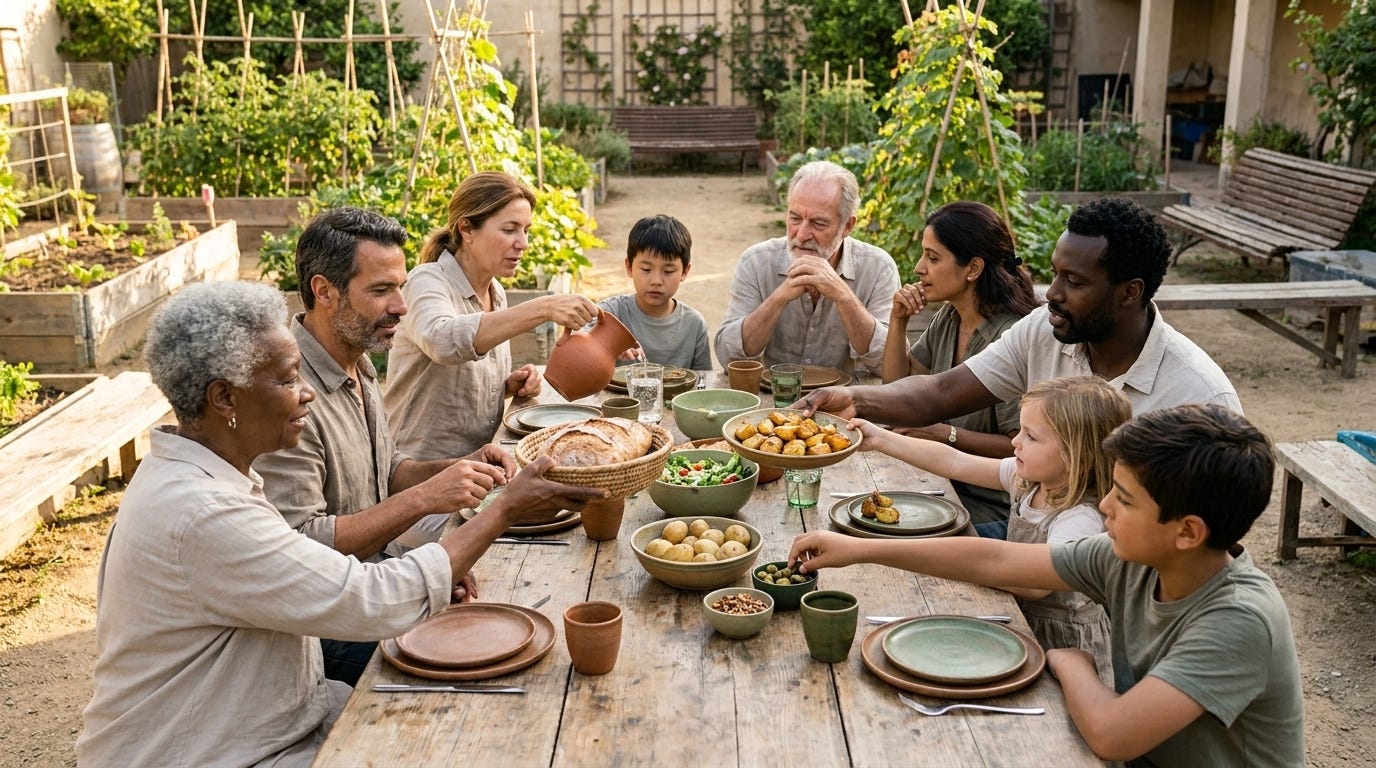
The Spirit between us
Christian theology often calls this movement Spirit.
Spirit is breath, fire, whisper, presence, and the animating current of Love moving within and among all things. Spirit is not divine control imposed from above. Spirit is communion emerging within and between us.
The biblical language itself is bodily. Breath enters lungs. Wind moves through a room. Fire warms, illuminates, and burns away what cannot survive its honesty. Spirit awakens bodies and gathers people who had been isolated by fear.
This is why I understand Trinity less as a puzzle about divine mathematics and more as a sacred dance of mutuality. God is not lonely domination. God is relationship, self-giving, receiving, delight, and communion.
If humanity bears that image, then spiritual maturity cannot be measured only by private morality or individual enlightenment. We become human together.
My life is bound to yours. My freedom cannot be purchased with your captivity. My safety cannot depend on making your body disposable. My comfort cannot be the final measure of what is good.
Salvation is not evacuation from the world. It is the healing of fragmentation within ourselves, between people, throughout communities, with the earth, and in our relationship with God.
Liberation is not a metaphor. It is the shape Love takes when it shows up in history.
From belovedness to truth
The movement begins with belovedness, but it cannot stop there.
Belovedness creates enough safety to become aware. Awareness helps us notice the patterns, defenses, stories, and systems shaping us. Embodiment brings that awareness into breath, behavior, and relationship. Truth-telling names grief, harm, desire, fear, and complicity. Release loosens the strategies that once protected us but now keep us hidden. Repair moves toward apology, restitution, boundaries, changed behavior, and renewed trust where trust is possible.
Then Love becomes fruitful.
The fruit is not looking healed. It is greater aliveness, courage, tenderness, justice, freedom, and participation in the reweaving of the world.
This is a different vision of spiritual formation from the one many of us inherited.
Formation is not learning to appear correct, pure, composed, productive, or impressive. It is becoming the kind of person who can remain present to reality without requiring reality to protect an identity.
It is becoming able to hear another person’s pain without making the conversation a trial about our worth. It is becoming able to recognize a system that benefits us without collapsing into self-hatred or rushing toward innocence. It is becoming able to grieve what cannot be repaired, repair what can be repaired, and resist what continues to cause harm.
Spirit does not perfect our image. Spirit increases our capacity for Love.
But truth-telling cannot stop with the patterns inside one person. Once we become able to face what fear and shame do in us, we also become able to see what those same forces do between us. Personal patterns gather power. They become family roles, institutional habits, economic arrangements, religious teachings, and political systems. The movement from belovedness to truth eventually widens the circle.
When personal patterns become public systems
In the world we know shame begins personally, but it does not remain personal.
Fear becomes hierarchy. Scarcity becomes hoarding. The need for control becomes patriarchy, white supremacy, nationalism, militarism, extraction, and empire. Human beings build systems that enact at scale what frightened nervous systems do in relationships.
We classify. We dominate. We exclude. We decide whose pain counts, whose testimony is credible, whose body deserves protection, whose labor can be exploited, and whose death can be treated as an unfortunate necessity.
Then we create stories that make the arrangement look righteous.
Religion blesses hierarchy. Markets call exploitation efficiency. Nations call violence security. Political movements call cruelty order. Respectability hides the bodies carrying the cost.
This is why staying human requires more than personal kindness. Kind people can participate in cruel systems. Well-intentioned people can preserve arrangements that make neighbors disposable. We can sincerely mean good and still avoid asking who bears the cost of the world that keeps us comfortable.
Truth therefore has to examine more than intention. It has to examine fruit.
Who benefits?
Who pays?
Who is believed?
Who is blamed?
Who is being asked to absorb the violence required to preserve someone else’s comfort?
Where has goodness become a story we tell about ourselves rather than something our neighbors can actually experience?
Judgment is Love refusing to look away
Once truth widens from personal patterns to public systems, we arrive at judgment.
That word can sound like condemnation, especially for those of us formed by images of an angry God searching for reasons to punish. But judgment, as I understand it, is not Love disappearing so punishment can take over. Judgment is what Love does when Love tells the truth about what is happening.
Without judgment, love becomes sentimentality. It comforts but does not protect. It forgives without listening to the harmed. It rushes toward reconciliation without truth. It calls peace what is really silence imposed by the powerful.
Divine judgment is Love’s refusal to ignore harm.
Love exposes what has been hidden. Love names the wound. Love interrupts violence. Love protects the vulnerable, sets boundaries, and asks what must be restored.
This is why restorative judgment differs from revenge. Revenge needs someone to suffer so the moral order feels balanced. Restorative justice asks what truth, accountability, protection, restitution, transformation, and healing require.
Not every relationship can be restored. Not every person who causes harm is currently willing to change. Sometimes love requires distance. Sometimes protection requires removing access to power. Sometimes the most faithful form of repair is accepting consequences without demanding a path back to the relationship.
Grace is the final word, but grace is not permission to continue harm. Grace keeps humanity visible while judgment tells the truth.
That can sound abstract until judgment turns its attention toward something we already consider good.
When goodness preserves distance
Consider charity.
Churches and communities are often comfortable with charity because charity feels like an obvious expression of goodness. And it can be. If someone is hungry, feed them. If someone needs shelter tonight, help provide shelter tonight. We should not withhold immediate mercy until we have solved every structural problem.
Judgment does not ask us to call that generosity evil. It asks us to tell the whole truth about it.
Charity can relieve suffering while preserving the distance that made the suffering easy to ignore. It can imagine one person as the capable giver and another as the needy recipient. It can address a crisis without asking why the same crisis keeps happening. It can let me feel like a good person without requiring me to question an arrangement that continues to benefit me.
This is one way something meant for good can stop short of repair.
Mutuality takes the next step. It begins with the claim that our lives belong to one another.
Charity asks, “What can I give you?”
Mutual aid asks, “What can we build together because your survival and flourishing are part of our shared responsibility?”
The movement from charity to mutuality is not a rejection of generosity. It is generosity becoming relationship, and relationship becoming solidarity. It is judgment telling the truth about where our goodness preserves distance, then Love inviting us closer.
Feed the person who is hungry today. Then make room at the table where we ask together why people are hungry, who profits from hunger, and what kind of community would make hunger less likely.
Stop the bleeding. Then tend the wound. Then ask what keeps causing the injury.
This is how inner transformation begins to become a different kind of shared life. Love responds to immediate suffering, tells the truth about what produces it, and participates in structural repair.
New creation starts here
Christian hope is often described as confidence about what happens after death. I believe death is real and not the final word. But resurrection is larger than an afterlife guarantee.
Resurrection is a pattern.
Life emerges where endings seemed final. A seed disappears beneath the soil and becomes something it could not have become without surrendering its previous form. A forest metabolizes decay into new growth. A wounded community tells the truth about what happened and begins building relationships that no longer depend on silence. A person who once hid behind shame becomes able to apologize without disappearing.
This does not mean every loss is secretly good. Pain is not holy simply because it hurts. Resurrection does not restore every relationship or return what death has taken.
It means destruction does not exhaust the futures available to Love.
New creation is already unfolding in bodies, streets, soil, kitchens, mutual aid networks, friendships, protests, rituals, grief circles, and communities that refuse to make people disposable.
Heaven is not elsewhere. It is the slow, sacred work of making earth more like home for everyone.
A political theology of staying human
This understanding of Love is political, but it cannot be contained by partisanship.
Politics asks how we organize our common life. Who has power? How are resources shared? What happens when interests conflict? Whose safety matters? What do we owe one another?
A theology of staying human cannot avoid those questions.
It also cannot hand its soul to a candidate, party, nation, or state. Every political arrangement is shaped by coercion, borders, wealth, competing interests, and institutions invested in preserving their own power. No administration is the kingdom of God. No candidate is a savior.
But that does not make every political choice equal.
Political decisions enter human bodies. They determine whether people can obtain food, housing, medical care, legal protection, education, clean air, bodily autonomy, and meaningful participation in public life. Some choices intensify suffering. Others restrain it. Some normalize cruelty. Others create more room for communities to breathe, organize, resist, repair, and flourish.
Love does not offer a formula that removes ambiguity. It gives us questions.
Which choice protects people with the least power to protect themselves?
Who will carry costs I may never feel?
Does this option merely manage the wound, or does it create room for repair?
What kind of people are we becoming through the practices surrounding our politics?
Are we becoming more truthful or more willing to spread anything that helps our side? More courageous or more fearful? More capable of solidarity or more dependent on powerful figures to save us?
These questions will lead directly into next week’s piece, The Ballot on the Table, a sermon I’m preaching as I release this.
A ballot is a consequential tool. It is not a sacrament. We can vote without worshiping. We can use political power to restrain harm without imagining that Caesar’s machinery has become the kingdom of God.
The deeper work remains.
Feed people who are hungry. Protect neighbors who are being targeted. Tell the truth about harm. Redistribute resources. Build relationships stronger than the algorithms dividing us. Grieve together. Practice forgiveness without avoiding accountability. Create communities in which fewer people are disposable.
The world we reweave
To stay human is to participate in this reweaving.
Not because we are certain we will win. Not because history automatically bends toward justice. Not because every wound will close or every relationship will be restored.
We participate because Love is our origin, incarnation is our pattern, and communion is our future.
We refuse shame because shame makes truth unbearable.
We refuse dehumanization because every person bears divine image.
We refuse escape because God keeps meeting us in bodies and soil.
We refuse domination because divine power looks like self-giving Love, not control.
We practice repair because grace is not a declaration of innocence. It is the power to tell the truth and return to relationship where relationship is possible.
We resist empire because no human being is expendable.
We hope because resurrection means violence does not determine every future Love can bring to life.
We come from Love.
Love takes flesh.
Love reweaves the world.
And the world will not be rewoven through one heroic act. It will be rewoven through ordinary people practicing another way at kitchen tables, hospital bedsides, ballot boxes, neighborhood meetings, funerals, gardens, classrooms, protests, and shared meals.
This is the spiritual life. Not escape, certainty, moral purity, religious branding, or performance.
The work of becoming fully human through grace, embodiment, repair, liberation, communion, and courageous participation in the reweaving of the world.
Sometimes inner healing leaves us with a new question: What do I do with the life I am recovering? When an old identity, faith, relationship, or way of moving through the world falls away, it can be difficult to know where you belong or what meaningful participation looks like now.
Life After Loss coaching can help you discern your place in the world without turning purpose into another performance. Together, we can explore what is yours to carry, what is yours to release, where your life wants to become more connected, and how your values might take shape through relationships, work, community, creativity, repair, and the next faithful step.
Schedule a discovery call to explore what it might mean to stop trying to escape your life and begin participating in it more fully.
Practices to Reweave the World
Whether your day only allows for a 60-second reclamation, your week a one-hour resistance ritual, or you find yourself ready for a full on rebellion against a world that assaults your humanity, behind the paywall I offer you three practices that will help you bring this post to life in your everyday.
60-second Reclamation
Name one person or group whose humanity your preferred political or cultural story makes easy to ignore. Take one breath and say, “Your life is not disposable.” Let that recognition complicate you.
60-minute Ritual
Draw three columns labeled “Immediate harm,” “Unrepaired wound,” and “World being built.” Choose one issue affecting your community. In the first column, name what protection is needed now. In the second, name the history or structural damage requiring repair. In the third, describe the conditions in which the injury would become less likely. Identify one action within your actual capacity.
Whole-life Rebellion
Move from charity alone toward mutuality. Join or help build a community where resources, risk, care, and responsibility are shared. Let your politics include but extend beyond voting. Practice solidarity in ways that cost something, remain accountable to the people most affected, and make fewer people disposable.