


Before I started writing We Can Stay Human, I spent years as a pastor. I no longer serve in that role, but faith remains deeply important to me. It continues to shape how I understand power, love, community, and what it means to remain human in a world constantly trying to form us into something else.
That has probably been especially clear over the past three weeks, as We Can Stay Human has explored a three-part theology of staying human.
Every so often, The Sanctuary in Denver asks me to preach. This time, the invitation happened to fall nine days before Election Day, with ballots already sitting on kitchen tables across Colorado. We are even closer to the election now, so I thought I would share what I put together for last Sunday.
The sermon grows directly out of this recent series. It asks how the stories, habits, and media ecosystems surrounding us shape what we fear, whom we blame, and where we look for salvation. It takes the ballot seriously, but refuses to treat it as a sacrament. And it asks what Jesus might mean when he tells us to give Caesar what belongs to Caesar and give God what belongs to God.
Even if you do not share all the faith commitments behind it, I hope its questions about power, love, and the humanity of our neighbors still offer something worth considering.
Watch
The Full Story
Unless you’re really on top of things, odds are, this morning, as you walked out of the house, you left behind, a ballot.
For those of you watching online who do not live here, in Colorado our election ballots come through the mail. My now 20-year-old was in a stroller the last time I remember going to a polling place.
Instead, our ballots come through the mail, mixed in with grocery ads, credit card offers, bills, election flyers, and whatever else the postal service delivered that day.
If we sign up for BallotTrax, we get an email telling us our ballot is on the way. After we’ve returned it we get another email telling us our ballot was received and then another when it is counted. If the signature we put on our ballot doesn’t match the one on file, we might get a different kind of follow up, one seeking to confirm that we were the ones who actually voted.
And while the ballots come weeks before election day, most of us don’t drop it in a ballot collection box until the last possible moment. So this morning, nine days before America votes, a lot of those Colorado ballots are still sitting there.
Maybe yours is on the counter beside the coffee maker. Maybe it is under a stack of mail on the kitchen table. It’s arrived. Maybe you opened it. Or perhaps you’re stalling on doing even that because there’s a certain level of existential dread that rises up whenever you think about it.
Perhaps there’s a voters guide next to it. A pack of paper designed to help you trudge your way through various ballot measures, and finding time to educate yourself feels impossible in the craziness of daily life.
Some of you with a more conservative ilk might have issues with a ballot that arrives by mail, and every time you look at it you fear there are people out there who aren’t eligible to vote who also have a ballot on their table.
If you’re a mainstream liberal, well, odds are you’ve already voted in hopes that a new Congress will come with some oversight and accountability.
If you’re a leftist, depending on where you live, you might be, for the first time in your life, feeling like you actually get to vote for someone, but also holding your breath because hope and change always seems to be followed by disappointment.
Whatever your political ideology, it sits there carrying far more than ink and paper. It carries our fears about the future. It carries our hopes for our neighbors and our country. It carries questions about safety, freedom, money, schools, healthcare, immigration, war, the environment, and who we are becoming together.
And it is not sitting at an empty table.
It landed there after months of headlines, advertisements, notifications, arguments, fundraising messages, yard signs, podcasts, panels, and predictions. By the time we finally sit down with a pen, we have already been shown a thousand images of what will supposedly happen if the wrong people win.
But who the “wrong people” are depends on who you listen to.
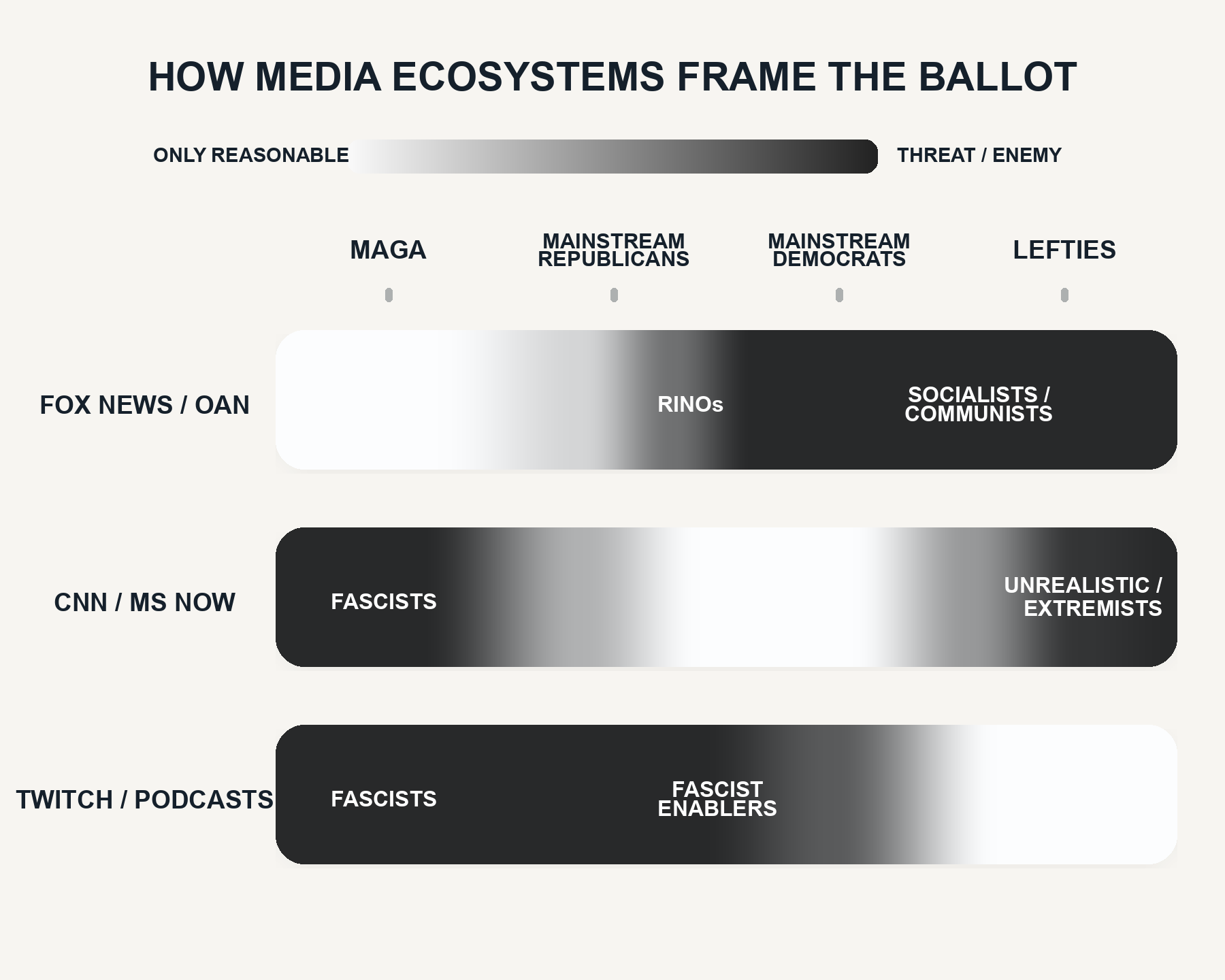
If you watch Fox News or OAN, you’re told the ballot includes the only reasonable choice, a RINO or two, and a collection of socialists or communists. Change the channel to CNN or MSNOW and you’re told there are reasonable choices, fascists, and some folks who land somewhere between unrealistic and extremist. Move into another media ecosystem, be it a twitch stream or a podcast, and you may be told the options are fascists, the people who enable fascism, and the only morally defensible alternatives.
The descriptions change, but the liturgy surrounding them is remarkably similar.
Here is the enemy.
Here is what you should fear.
Here is the only person who can save you.
So how should we understand everything that’s been coming at us before we ever open the ballot envelope?
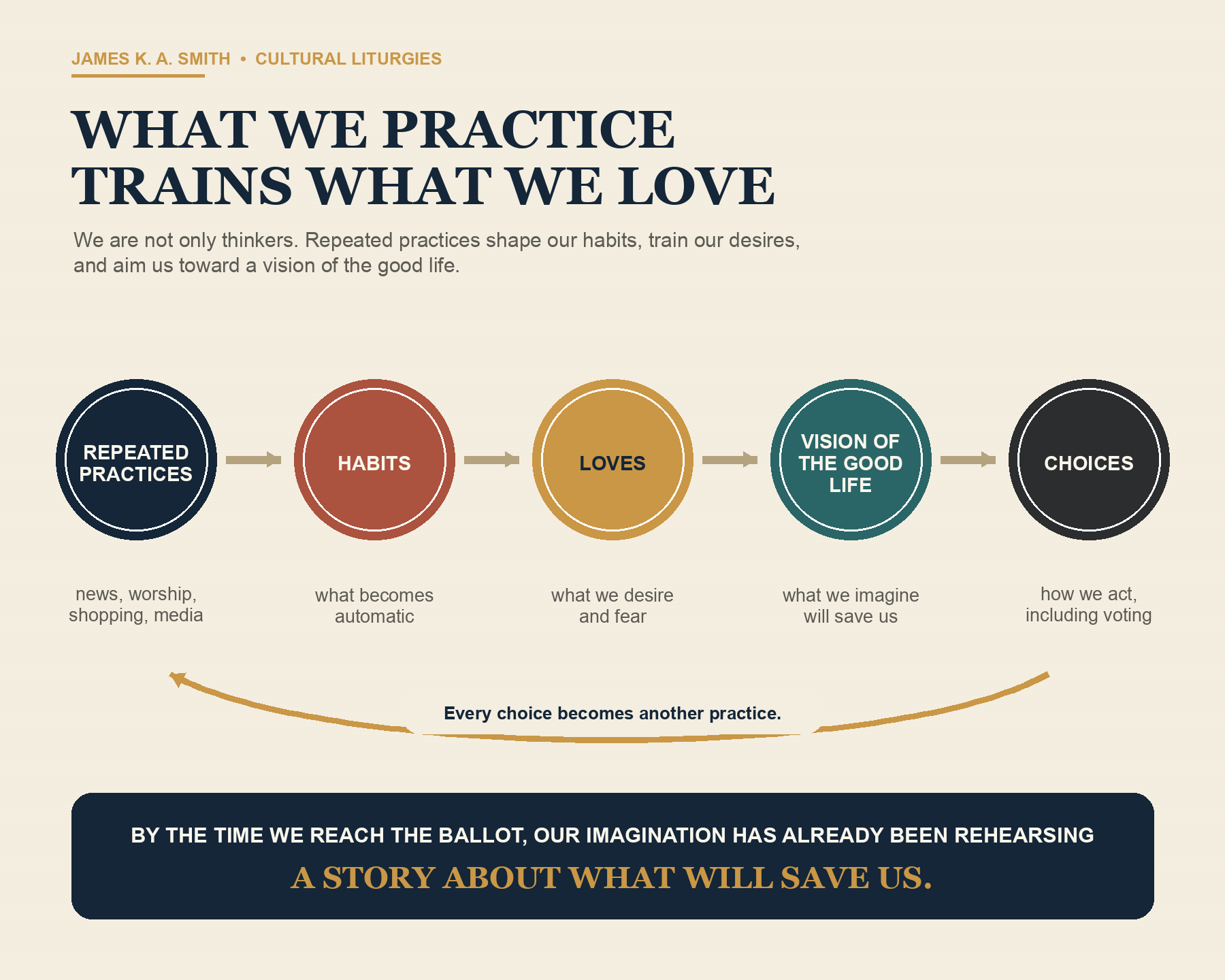
Christian philosopher James Smith writes about the power of cultural liturgies. These are the repeated rituals that form our desires before we ever stop to evaluate their arguments. We are not simply thinking creatures who collect information, compare it objectively, and then make rational choices. We are creatures of habit and desire. Our loves are trained by what we repeatedly do and then we use our thinking brains to rationalize a belief that is more primal.
From this framework, the website refresh trains vigilance. The notification trains urgency. The TV panel argument trains contempt. The social media algorithm trains confirmation.
Then on top of all that, the advertisement-funded news cycle has a financial interest in keeping us watching, and the things most likely to keep us watching are confirming what we already believe and keeping us angry. So they are not incentivized to tell the whole truth, they’re incentivized to tell some stories, manipulate others, and avoid some altogether.
These are the worship-like rituals that are out to form our hearts and souls.
Moreover, they do not merely tell us what to think about the ballot. They train us whom to fear, whom to blame, whom to distrust, and where to look for salvation.
And if that wasn’t enough, what we believe about politics doesn’t stay political. These practices follow us into every relationship we have. How many of us have lost a friendship over politics, endured an ugly conversation at the dinner table, struggled to talk with our children, or felt the distance widening between us and our parents? What we repeatedly hear about whom to fear, blame, and distrust eventually shapes how we see the people around us, be it the person across the table at home, the next table over in the restaurant, or perhaps even the guy standing just a few feet from the communion table.
So in this tense environment, perhaps we need to step back, and rather than ask what we are going to mark on the ballot, we should begin by asking, “What has been marking us?”
Before we ask who deserves our vote, perhaps we need to ask who has captured our imagination.
Which brings us to our primary text for today, Mark 12:13-17:
And they sent to him some of the Pharisees and some of the Herodians, to trap him in his talk. And they came and said to him, “Teacher, we know that you are true and do not care about anyone’s opinion. For you are not swayed by appearances, but truly teach the way of God. Is it lawful to pay taxes to Caesar, or not? Should we pay them, or should we not?” But, knowing their hypocrisy, he said to them, “Why put me to the test? Bring me a denarius and let me look at it.” And they brought one. And he said to them, “Whose likeness and inscription is this?”
They said to him, “Caesar’s.” Jesus said to them, “Render to Caesar the things that are Caesar’s, and to God the things that are God’s.” And they marveled at him.
Mark tells us that during the final week of Jesus’ life, some Pharisees and Herodians came to trap him with a question.
That pairing itself should make us suspicious. The Pharisees were invested in religious faithfulness and Jewish identity. The Herodians were connected to the political establishment that survived through cooperation with Rome. They did not naturally belong together. But threatened systems often discover that they have more in common than they imagined.
They begin with flattery.
Then comes the question. Not an abstract question about responsible citizenship. Judea is occupied territory. The tax is tribute paid to the empire that rules them. Paying it acknowledges Caesar’s authority. Refusing it can be treated as rebellion.
But at the beginning of the week, Jesus entered Jerusalem in a procession that mocked the pageantry of imperial power. While Rome maintained peace through horses, weapons, soldiers, and the threat of crucifixion, Jesus came riding on a borrowed donkey. Then he entered the Temple and disrupted an economic system exploiting people in the name of God.
So if Jesus says, “Yes, pay the tax.” he discredits everything he has just enacted. Say no, and Jesus’ opponents have what they need to hand him over to Rome as an insurrectionist.
It is a perfect trap because both available answers remain inside Caesar’s imagination.
Collaborate or revolt.
Submit to power or seize power.
Accept the world as it is or defeat your enemies and impose a better world.
Caesar understands both options because both still assume that history is ultimately changed through power over others.
But Jesus, who rejects Caesar’s approach of power over, asks for a denarius.
The coin likely bears the image of Tiberius Caesar and an inscription identifying him as the son of the divine Augustus. The other side identifies Caesar with Rome’s highest religious authority. This is not merely money. It is imperial theology carried in a pocket: Caesar’s face, Caesar’s titles, Caesar’s story about the world.
Jesus looks at it and asks, “Whose image is this? Whose inscription?”
They answer, “Caesar’s.”
Jesus says, “Give back to Caesar the things that are Caesar’s, and to God the things that are God’s.”
We often hear this passage interpreted as if Jesus were drawing a clean line through reality.
This part belongs to Caesar: government, taxes, elections, economics, public life.
This part belongs to God: prayer, worship, private morality, whatever happens inside a church building.
Be a responsible citizen in Caesar’s territory and a faithful Christian in God’s territory. Keep the two compartments separate.
But the text itself tells us that it’s a problematic interpretation. It treats Jesus like a politician refusing to really answer the question. He essentially tells them to pay the tax, but does it in a way he can later argue he meant something else.
Moreover, Mark tells us that they marveled at him. His response left them astonished. Saying some things are God’s and some things are Caesar’s is not a reply that prompts amazement. So clearly, that’s not what they heard him say.
Moreover, Caesar is not a neutral administrator in the New Testament, someone God can safely trust with the public half of life. Caesar is the head of the empire occupying Judea. His taxes sustain military rule. His peace is secured by soldiers, prisons, and crosses. Before the week is over, Caesar’s governor will sentence Jesus, and Caesar’s soldiers will torture and execute him.
The pattern continues across the New Testament. In Acts, proclaiming Jesus as king is treated as a challenge to Caesar. Paul is beaten, imprisoned, and eventually, according to Christian tradition, killed by the empire whose order he is sometimes accused of blessing. Yes, Paul tell Christians how to live wisely under governing authorities, but he never images those authorities are trustworthy. Revelation pulls back Rome’s pageantry and portrays imperial power as beastly.
So Caesar is not presented as the responsible manager of a legitimate second realm. Caesar claims what does not belong to him. He claims bodies for empire, wealth for expansion, obedience for rulers, and sometimes worship for himself. The biblical question is not whether a government can ever perform a useful function. The question is whether Christians will mistake power for goodness and legality for holiness.
So when Jesus says, “Give back to Caesar the things that are Caesar’s,” he is not placing government inside a protected compartment where its claims become sacred. He is holding Caesar’s coin in a land Caesar occupies, surrounded by people Caesar taxes, days before Caesar’s machinery will nail him to a cross.
Give Caesar back his metal if he wants it.
But do not give him your conscience.
Do not give him your worship.
And do not give him the right to decide that violence becomes good simply because the state authorizes it.
Furthermore, it is an interpretation that leaves the most important question unanswered: What belongs to God? And it is that question where we begin to understand what Jesus meant.
The people listening to Jesus know the opening story of Scripture. In Genesis, God says, “Let us make humankind in our image, according to our likeness.”
Caesar’s image is stamped on the coin.
God’s image is stamped on you.
God’s image is stamped on your neighbor.
God’s image is stamped on the immigrant and the citizen, the housed and the unhoused, the person whose politics comfort you and the person whose politics frighten you. God’s image is stamped on the Christian, the Jew, the Muslim, and the atheist. God’s image is stamped on people whose bodies, identities, families, and futures are discussed as political issues by people who will never have to live with the consequences of the choices we make.
Whatever the issue, Caesar stamps his image on money to announce what belongs to him. God stamps God’s image on people to announce who must never be reduced to property, instrument, enemy, collateral damage, or expendable population.
So Jesus is not dividing the world into God’s things and Caesar’s things as if Caesar owns one portion of reality and God owns the rest.
What could possibly exist that does not already belong to God?
And when we forget that, we all too easily abandon Jesus’ way of love for Caesar’s way of power.
Caesar’s way tells us that other people can be sacrificed for our security. Jesus’ way tells us that every person bears the image of God.
Caesar’s way tells us that peace comes when our enemies are defeated and our side controls the machinery. Jesus’ way tells us that peace grows through truth, justice, repair, service, solidarity, and a love that refuses to treat anyone as disposable.
Caesar’s way tells us that the right people can use domination for good ends. Jesus’ way asks what happens to our souls when we become what we claim to oppose.
The contrast is not between involvement and withdrawal. It is not between caring about politics and floating above it in spiritual detachment. The contrast is between two ways of being in the world: the way of power over others and the way of love poured out for others.
So what I want to do for the rest of this message is unpack what it might look like for us to have our approach to political life shaped by the way of Jesus.
This doesn’t mean I’m going to tell you who to vote for or what policies to embrace. And that’s not because I don’t have opinions, if you follow me on social media you know I have quite a few. Rather I’m going to explore what it might mean to honor the image of God stamped on other people, and embrace the way of love poured out, in a world that wants us to act in the image of Caesar.
And maybe the best place to start, to convince you that I’m not preaching a specific political agenda, is to start with one specific tension filled policy issue: immigration.
Saying that God’s image is stamped on the immigrant is not the same as saying we need open borders or that immigration policy should be careless. Recognizing the image of God can take several forms.
Here at home, we can create clear legal pathways rather than a jumbled system where there’s often no clear line to stand in. We can also take on the reality that many of our businesses have learned to depend on cheap immigrant labor, something that juices profits, but drives down wages and keeps workers, both native and foreign born, vulnerable. We can also give communities the resources they need when they receive new neighbors.
At the border, we can staff asylum offices and immigration courts so people fleeing persecution have their claims heard fairly and quickly. We can create a process that is orderly without treating truly vulnerable people as threats.
Then, beyond our border, we can change foreign policies that help create the conditions people are fleeing in the first place. Over the last 70-years the United States repeatedly participated in shaping the political conditions of Central and South America. In several cases, it supported governments, militaries, coups, counterinsurgencies, or proxy forces that contributed to prolonged violence and repression. Those conflicts displaced millions of people. A significant portion of those displaced people eventually migrated north, including to the United States.
People can disagree in good faith about enforcement, limits, and the exact combination of policies. But if every person bears God’s image, our approach must protect human dignity here at home, at the border, and in the countries our power touches. It must tell the truth about our own complicity and create order without using cruelty as its tool.
But it’s not just the immigrant we should treat kindly. Our fellow citizen neighbor, be it the one across the table, across the street, or across town is worthy of the same treatment.
And part of honoring the image of God stamped on our neighbor is seeking to understand them before we judge them, be it about the lives they lead or the politics they embrace.
Martin Luther said that the commandment against bearing false witness asks more of us than simply refusing to tell lies. It calls us to defend our neighbors, speak well of them, and interpret their actions in the kindest plausible way.
That does not mean pretending dangerous beliefs are harmless. It does not mean refusing to confront lies, racism, domination, or policies that harm people. Giving someone a fair hearing does not require giving the harm they cause permission to continue.
But it does mean learning what people actually believe instead of settling for the caricature our side has handed us.
If I can describe my neighbor’s position only in language my neighbor would reject, I do not understand my neighbor.
If I know what my opponents believe only because my allies told me, I may be participating in false witness.
If I share a story because it confirms what I already think, without caring whether it is true, Caesar’s liturgy is forming me.
This is where our graphic from earlier comes in handy. If you can lock yourself in on that chart and say with any level of confidence and comfort, “That’s me.” then your politics has been stamped by Caesar and, in some way, you are denying the divine image stamped on your neighbor. And I say that as someone who has to fight every day against the impulse to blindly categorize people into some of those boxes.
So how do we counter that pull?
As a starting point, you might take time to discover the underlying values in your neighbor’s political opinions.
Over most of my lifetime, the culture war has been placed front and center in American politics. Part of that is because in the mid-1970’s, Republican operatives knew they needed to expand their base, and they found that, in part, by highlighting moral issues, they could rally mainstream and evangelical Christians to their side. That fueled the birth of the Moral Majority and the Religious Right. Other moral and cultural issues from both sides have taken center stage over the decades, but that isn’t the only way to approach the ballot.
Some people instead focus on foreign policy. You have people who see a need for American military bases around the world to keep the peace and others who think that our military presence actually makes us less safe. The politics of this second group might center on anti-interventionism or even isolationism. This means your neighbor might be a Black, gay, and pro-choice Trump voter, simply because there was such a strong emphasis on no more wars in each of Trump’s campaigns.
I know people who, based on identity, you would assume voted for Kamala, but voted for Trump because they were part of the Kennedy, “Make America Healthy Again” faction.
Other people focus on economics. Here some embrace the trickle-down model, a variant of capitalism popularized by Reagan. A good faith argument here says that you organize society based on what’s good for those with capital and trust that they will spend money in such a way that it flows to everybody.
Others don’t believe this works, and a good faith argument has them organizing society and economic policy around what’s good for people, be it through universal services like Medicare For All, anti-trust policy that keeps the market competitive, or empowering labor, something Professor Richard Wolff calls, “Democracy at work.” Whichever path they promote, you can often still make money, even a lot of money, but not at the expense of your workers, your customers, and the planet.
While it could be argued that Trump won the 2016 election because of this kind of populist focus, today people aching for change are often drawn to candidates like those endorsed by Bernie Sanders, whether they claim the label of Democratic Socialist or not. This means that you could have a straight, white, male Michigan union factory worker who drinks Budweiser while watching football all weekend, that’s ready to put a mark next to Abdul El-Sayed’s name.
And I think this economic issue requires an extra dose of humility on our part because our perspective may be shaped by a world that no longer exists.
Some of us look at a young person, one openly supporting one of those “crazy leftists,” and miss that they are struggling to buy a home, afford healthcare, pay for education, or imagine a future that is more than a scramble to survive. Then we think, “I figured it out. Why can’t they?”
But they are not navigating the same economy we did. The map we carry may accurately describe the world we knew while failing to describe the world our neighbors inhabit now.
Imagine two people stepping into adulthood, one in 1985 and one today.
The person entering adulthood in 1985 did not enter an easy world. Ronald Reagan had just begun his second term. The economy had emerged from a punishing recession. Unemployment remained significant. A thirty-year mortgage averaged about 12.4 percent. People worked hard and many struggled. This is not nostalgia for a past when everything was simple.
But 1985 is useful because many people in this room formed their understanding of what hard work could buy in that economy. They learned the map by living inside it.
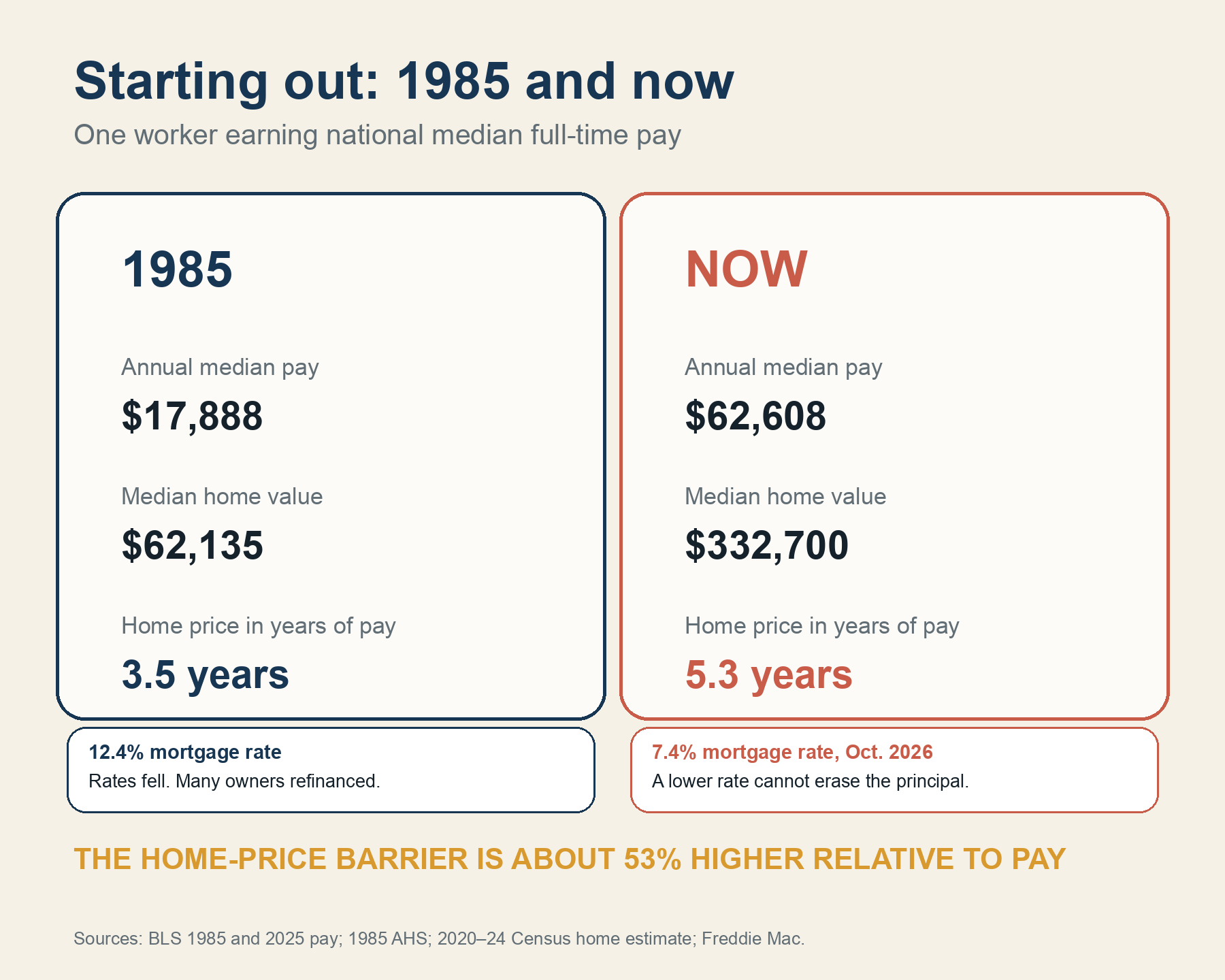
In 1985, median full-time pay was just under $18,000 a year. The median owner-occupied home was valued at just over $62,000. For one worker earning median pay, that home represented about 3.5 years of gross earnings.
Today, median full-time pay is over $62,000 a year. The most recent Census estimate puts the median owner-occupied home value at over $332,000. For one median worker, that home represents about 5.3 years of gross earnings.
Now, the mortgage rate matters. At 12.4 percent, financing that 1985 home was punishing. A mortgage on the full value would have consumed roughly the same share of one median worker’s gross pay as a mortgage on today’s home at current rates. So when someone remembers that buying a home was hard, they are telling the truth.
But the interest rate was not the principal. A 20 percent down payment, what you needed to get into a home in the first place, represented about 36 weeks of median pay in 1985. Today it represents about 55 weeks.
By 1993, the average mortgage rate fell to about 7.3 percent, and while not every homeowner qualified, and not everyone refinanced, many people who had managed to buy a home replaced that expensive mortgage with a cheaper one. They kept the lower purchase price, cut the interest rate, reduced the payment, and then watched the value of the home rise.
That escape route does not work the same way today.
An interest rate can be refinanced. A purchase price cannot. A future rate cut might reduce the monthly payment on a $332,000 mortgage, but it cannot turn the principal back into $62,000. And when housing is scarce and wealth is concentrated, lower rates can also give buyers more money to bid against one another, pushing prices higher again. And that’s before we talk about what private equity is doing to today’s housing market.
Ultimately, if you bought a home in the mid-80’s, falling rates and rising values could build wealth. But if you are trying to enter the market now, that rising value is an enormous wall standing in front of you.
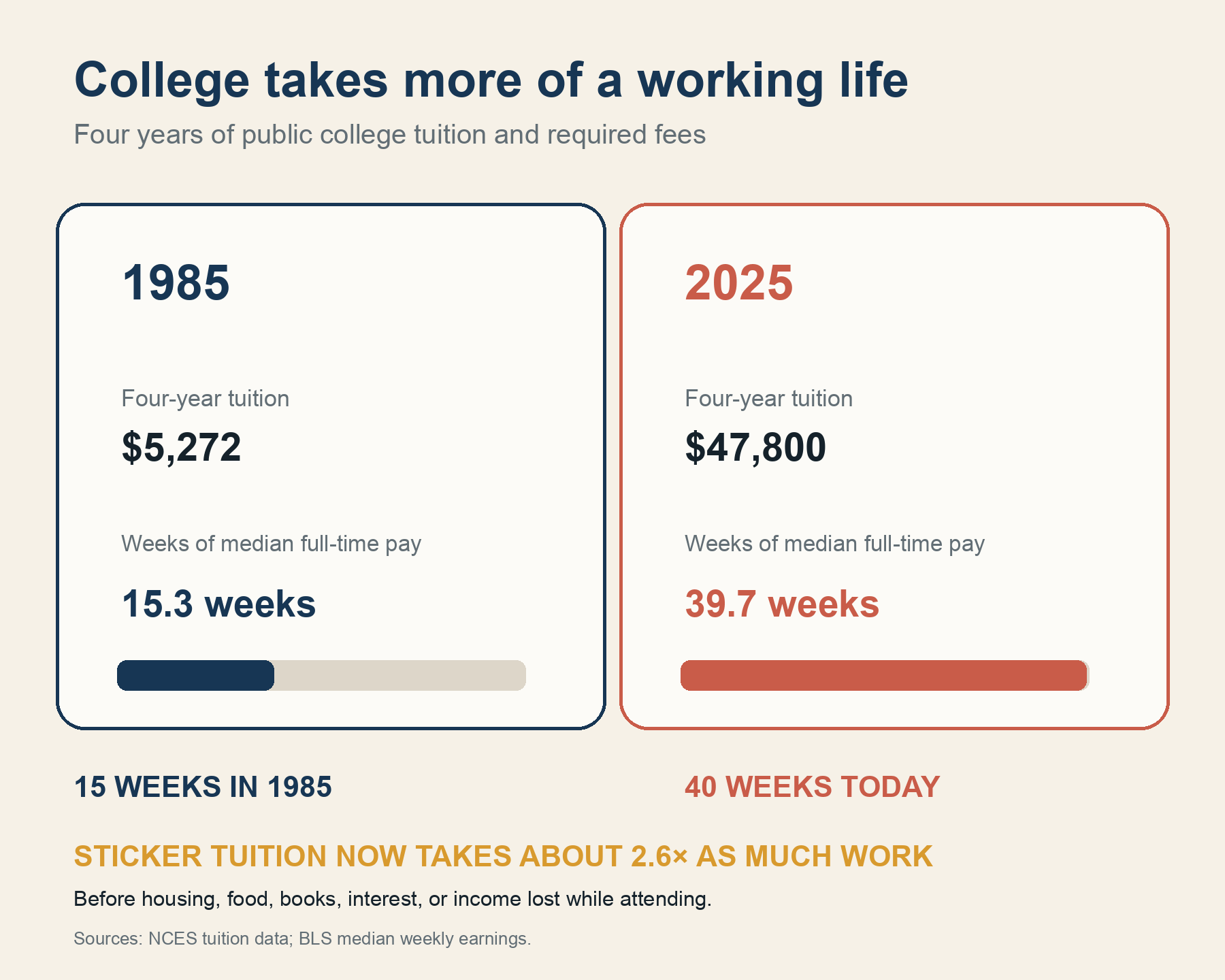
And that’s before we get to college. Four years of in-state tuition and required fees at a public college cost around $5,300 in 1985, roughly 15 weeks of median full-time pay. By 2025, the same four years of published tuition cost almost $48,000, roughly 40 weeks of median pay.
And because a summer job barely covers the cost of books and doesn’t even touch tuition, for many young adults, the cost does not disappear at graduation. It follows them into the years when they are also trying to find stable housing, get medical care, and build a life.
And notice, I haven’t even touched on the rise of health care costs, something I’m sure everyone in this room feels.
All this means that an older adult may truthfully remember how hard they worked. And a young adult may be working just as hard inside a different cost structure and getting significantly less. Today some of the largest gateways to stability have moved farther out of reach. So they look to candidates who argue that our economy isn’t working, just like union workers and those in towns where factories and mines shut down turned to Trump in 2016.
All of this means that love asks us to become curious.
What has this person experienced that I have not?
What do they fear losing?
What pain or longing sits beneath the political language?
Where might my own vision be distorted?
Until you understand your neighbor’s world, you cannot understand what is stirring your neighbor’s politics.
And in the process, we might just learn the appeal of candidates we find ourselves trained to fear, even if we don’t ultimately embrace them.
So we listen past the caricatures. We listen until we can hear what people across the political spectrum are actually saying, not merely what our preferred media tells us they are saying. We listen for their fears, their hopes, the wounds they are carrying, the future they are trying to protect, and the future they are trying to create.
Armed with a far broader political imagination, we can start thinking about our ballots, but now we’re invited to ask a different question: Which choice moves us most toward the way of love?
Now, it would be convenient if this gave us a formula that told every faithful Christian exactly how to vote. Unfortunately, it does not.
The best political arrangement available to us will still be administered through institutions shaped by coercion, violence, wealth, borders, competing interests, and the desire to preserve their own power.
But saying that every option is a variation of Caesar does not mean every variation is equal.
Political choices have consequences in human bodies. The ballot cannot bring the kingdom of God, but it can intensify suffering or restrain it. It can make vulnerable people more vulnerable, or give communities more room to breathe, organize, resist, repair, and flourish.
So perhaps the Christian question is not, “Which option leaves my hands perfectly clean?” Rather, the question is, “What does love require of me under imperfect conditions?”
When you look at your ballot, do not begin only by asking which candidate represents you most completely. Ask what each choice will mean for the people Caesar’s systems most easily sacrifice, because the answer to Cain’s question in Genesis 4, is yes, you are your neighbor’s keeper.
So who benefits?
Who pays?
Who is being blamed?
Who is being rendered invisible?
Who is being asked to absorb the violence required to maintain someone else’s comfort or security?
Which choice most protects those who have the least power to protect themselves?
Which choice asks me to call cruelty necessary?
Which choice gives the least among us more room to live?
Not every option is equal because not every option will treat the image of God in our neighbors equally.
Even then, discernment is complicated.
Love asks about immediate impact. Who might be protected or harmed tomorrow? Who might lose healthcare, food, housing, legal protection, safety, or belonging? Some people can afford for an election to be primarily symbolic. Others will experience the results in their bodies and families.
The immediate matters because people are hurting now.
If someone is bleeding, the first thing you do is stop the bleeding. That matters. It may save their life. But nobody looks at a person lying wounded on the ground and says, “Good news. The bleeding stopped, so our work here is done.”
The wound still has to be cleaned. Whatever is lodged inside it has to be removed. The wound may need to be closed. Infection has to be prevented. The damaged body needs time, care, and rehabilitation. Eventually, we have to ask what caused the injury and what must change so it does not keep happening.
Triage keeps someone alive. Repair helps make them whole.
There is a danger when we only look at harm reduction. Yes, we might stop inflicting new wounds, or at least slow the bleeding, but leave people living inside the damage that has already been done. We feel good about not making things worse while asking wounded people to accept their current suffering as the new status quo. That is not repair.
If people still cannot afford a home, see a doctor, feed their children, get an education, or imagine a future in which their lives become more than a scramble to survive, they remain desperate. It is not enough to tell them that the people in charge are no longer actively making the wound deeper. They are still living with the wound.
Over time, people may forget who caused the original injury. What they know is that the people standing in front of them now are telling them this is as good as it gets. The people who promise stability begin to look like the people preserving their suffering. And desperate people do not always reach for cautious options. They reach for anyone who seems willing to name their pain and break with the status quo. Sometimes that is an authoritarian figure who offers scapegoats, promises vengeance, and says the answer is enough power in the right hands. Sometimes it is a movement calling for structural change, redistribution, and repair.
Those are not morally equivalent simply because both stand outside the political center. A promise to repair harm is not the same as a promise to redirect that harm toward someone else. But both can gain energy from the same failure: respectable institutions managed people’s suffering without healing it, then seemed surprised when those people went looking for something less respectable.
So Christian discernment cannot stop with asking who might slow the bleeding. We also have to ask who is willing to tend the wound, tell the truth about how it happened, restore what was taken, and move us toward conditions in which the injury is less likely to happen again.
There will not always be a clean answer. A vote may reduce immediate harm while reinforcing a system that continues to produce harm. Another choice may express a longing for deeper change while leaving people exposed in the present.
Christian faith does not remove that tension. It asks us to enter it with humility, truthfulness, and particular attention to the people who will carry costs we ourselves may never feel.
Love asks about the harm that could happen tomorrow, the wounds that still need repair, the world being built for the next generation, and the kind of people we are becoming along the way.
So what do we do with the envelope on the table? First, we actually open it.
Then study the issues. Listen beyond the media ecosystem that already agrees with you. What do the candidates say? What have they done in the past? Who is paying for their campaign and what do they want from the candidate? Pay attention to actual consequences, especially consequences borne by people with less power than you. Fill out the ballot as an act of imperfect love.
Then know that while your vote can help determine who controls Caesar’s machinery, it cannot transform Caesar’s machinery into the kingdom of God. And know if our political participation ends when we seal the envelope, Caesar has already succeeded in shrinking our imagination.
Caesar wants us to believe that power belongs primarily to candidates, officials, donors, courts, armies, corporations, and institutions. Caesar wants us to believe that our role is to choose which powerful people will act on our behalf and then wait for the next election.
Jesus forms a people who embody another kind of power.
They share food.
They care for children and elders.
They accompany people who are afraid.
They protect neighbors who are being targeted.
They tell the truth about harm.
They practice forgiveness without avoiding accountability.
They redistribute resources.
They create sanctuary.
They grieve together.
They build communities in which fewer people are disposable.
The way of Jesus is not merely selecting a better ruler. It is becoming a people who organize our common life around love rather than domination, belonging rather than exclusion, abundance rather than hoarding, and mutual responsibility rather than abandonment.
This is political, but it is deeper than partisanship.
This is what happens when we remember that God’s image is stamped on everyone.
Communion
This sermon began with a ballot sitting on a kitchen table.
But Christians gather around another table.
At Caesar’s table, people are classified by usefulness, citizenship, wealth, productivity, race, purity, and power.
At Jesus’ table, the hungry are fed. Outsiders become family. Abundance is shared. Power takes the form of service. Broken bodies are not discarded. Nobody earns a place by proving that they are right, useful, pure, or impressive enough to belong.
At one table, we make a consequential choice among the options Caesar’s world has placed before us.
At this table, God forms us through bread and wine, through the body and blood of Jesus placed inside of us, into a people capable of imagining and embodying another world.
So take the ballot seriously. Make your choice with humility, courage, and attention to the people who will live with its consequences.
But do not give the ballot your soul.
Caesar’s image may be stamped on the coin.
Caesar’s names may be printed on the ballot.
But God’s image is stamped on you. It is also stamped on every person who will live with the consequences of your choice.
Give Caesar back the metal carrying Caesar’s image.
Give God the life carrying God’s image:
Your body.
Your courage.
Your resources.
Your grief.
Your resistance.
Your neighbor.
Your love.
And the world we might yet reweave together.
That is the world Jesus saw on the night he was betrayed and he took break and broke it, saying to them, “Take, eat, this is my body, given for you.” And when he took the cup, blessed it, and gave it to them saying, “Take, drink, this is my blood, given for you.”
The dark cup is wine, the light cup is juice. It is all the gift of God, to form the people of God.
Blessing After the Final Song
I grew up in a home where we joked that my dad was far enough Right to make Rush Limbaugh look Left. Following in his footsteps there was a time I could easily place myself on that first graphic. In fact, I was Alt Right before they ever called it Alt Right.
Things have changed over the years. And it usually started with meeting someone who saw things differently. The dad of a college girlfriend. Kids showing up solo to a church in the hood of East St. Louis. The Jesus who jumped from the page when I started reading the Bible not as a book that dropped from heaven but as one written in historical time and place.
Those encounters prompted questions that led to answers and still more questions, some of which I brought up rather quickly this morning. Answers and questions that deserve more time than a sermon allows.
So to feed some of your own questions, I’ve started pulling together a resource page at joeburnham.com/ballot. It touches on various topics I brought up this morning and links to some resources that have fueled my journey. It’s not a voter’s guide, a fact check, or a summary of what I believe. But it’s some of what’s challenged my thinking over the years.
But more important than any of that, I want to go back to what Jesus’ said in our text, and the easily overlooked line that his answer that amazed them. Why did they marvel?
I don’t think it was just that he avoided the trap they set for him. It was that in just a few words, he undermined their entire worldview. He invited them to believe the Gospel.
To believe that they bore the image of God. And as a divine image bearer, you are called to give back to Caesar the things that are Caesars. Not the literal coins, but a world shaped by power over, the grasping for control, the need to dominate, and the fear that tells us someone else must lose for us to be safe.
To believe that instead, you can live love poured out, to yourself and your neighbor. All of your neighbors. All of your fellow image bearers.
So as you go, may you give up power over and embrace love for. May you have the courage to resist domination, the humility to listen, the strength to repair what has been harmed, and the grace to recognize the image of God in every person you meet.
Go in peace. Walk in love. You and your neighbor belong to God.