


America is turning 250, which means we are about to be invited into a lot of nostalgia. There will be fireworks and flag graphics, speeches about freedom, sentimental appeals to unity, and probably a great deal of pressure to celebrate the country as if celebration and honesty are opposites.
But I keep thinking about the Preamble. Not as a sacred object behind museum glass, and not as proof that America has ever fully lived up to its own language. I keep thinking about it because, right there at the beginning, the Constitution admits something we often forget: the union was never finished.
The phrase is not “a perfect Union.” It is “a more perfect Union.” More honest. More whole. More just. More capable of holding the people it once excluded, exploited, erased, and abandoned. And in the same breath, the Preamble tells us part of what that repair is for: to “promote the general Welfare.”
That phrase feels almost startling now. The general welfare. Not corporate welfare. Not shareholder welfare. Not market stability abstracted from human suffering. The general welfare. The conditions that allow actual people, in actual bodies, to live with dignity, receive care, raise children, grieve their dead, rest without shame, work without being consumed, breathe clean air, and belong to one another without being sacrificed to profit.
So as America approaches 250, I do not find myself asking how we can best preserve the country we inherited. I find myself asking whether we are willing to repair it toward the promise it has so often betrayed. Because if a more perfect union means anything, it has to mean more than nostalgia. It has to mean a country where the measure of our common life is not whether corporations are thriving, but whether people can actually live.
Watch or Listen
The Whole Story
America is turning 250, and I keep thinking about the word “more.” Specifically the use of the word “more” in the opening line of the Constitution. The Founding Father’s didn’t talk about making something perfect. But more perfect. Even in its founding imagination, even beneath all the compromise and contradiction and violence, there was an admission hidden in plain sight: this thing was unfinished.
A more perfect union is not something you preserve in amber. It is something you keep repairing. And right there, in the same breath, the Constitution tells us part of what that repair is for: to promote the general welfare. Not the welfare of corporations. Not the welfare of shareholders. Not the welfare of markets abstracted from bodies. The general welfare. The shared conditions that allow people to live, rest, heal, eat, work with dignity, raise children, grieve their dead, breathe clean air, receive care, and belong to one another without being crushed by the machinery of profit.
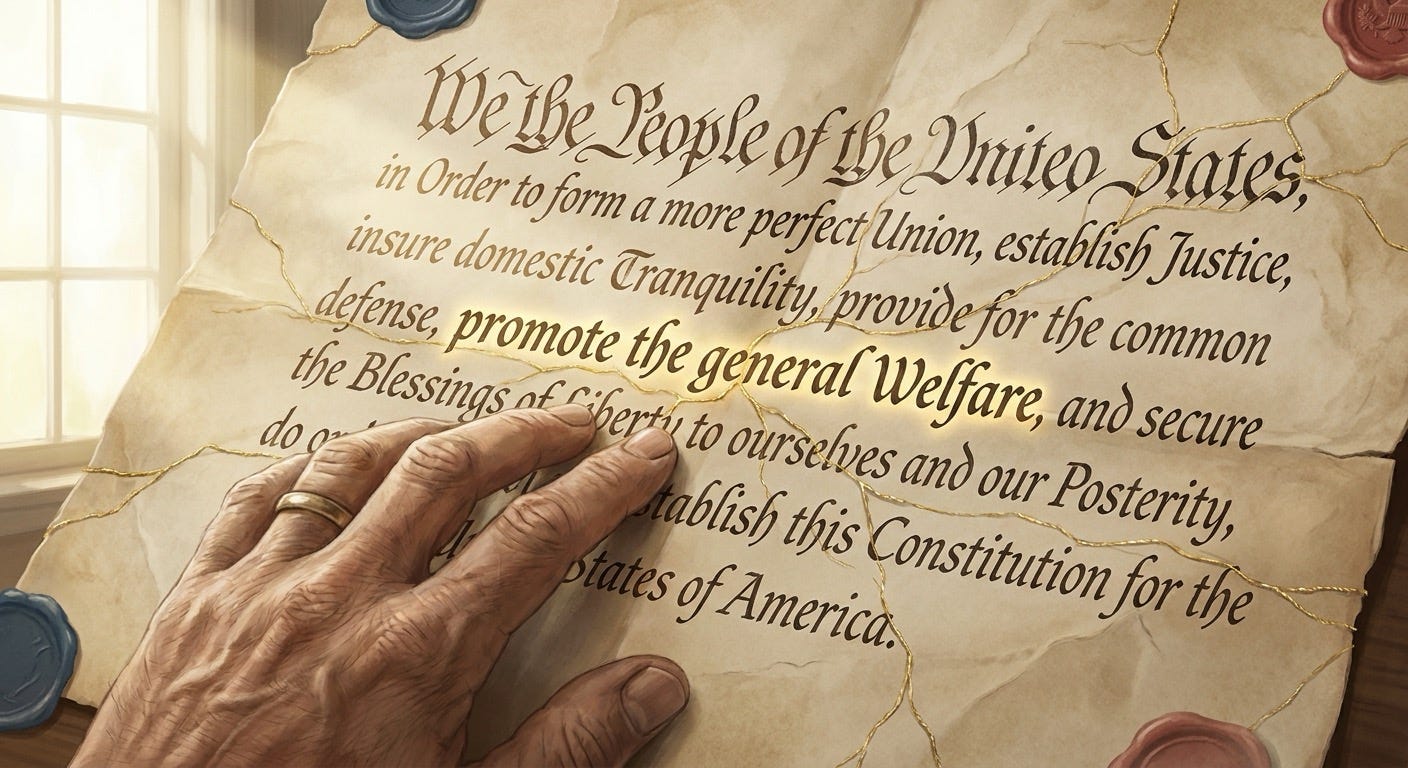
We keep quoting “We the People” while building a country for corporations. That is the wound. And it is everywhere. It is in a healthcare system that can bankrupt a family for getting sick. It is in housing treated less like shelter and more like an asset class. It is in wages that do not rise with the cost of being alive. It is in parents trying to raise children inside an economy that treats care as a private burden instead of a public good. It is in workers told to be grateful for jobs that drain their bodies, consume their hours, and still do not pay enough to build a life. It is in the quiet exhaustion so many of us carry, the kind that does not come from laziness or fragility, but from living in a society designed to extract more than human beings can sustainably give.
And then, when people ask whether another way is possible, we are told to be realistic. Realistic, apparently, means accepting that corporations can receive subsidies, bailouts, tax breaks, legal protections, and endless political deference, while ordinary people are asked to crowdfund insulin, ration groceries, delay dental care, and treat rest as a luxury. Realistic means the market gets a safety net and the people get a lecture about personal responsibility. Realistic means we can imagine infinite money for war, policing, prisons, and corporate rescue, but healthcare, housing, childcare, climate repair, and student debt relief are treated as dangerous fantasies. A country organized around profit will always call care unrealistic.
But America 250 gives us a chance to ask a better question. Not, “How do we celebrate the country we inherited?” But, “What kind of country are we still willing to become?” Because the phrase “more perfect Union” is not a permission slip for patriotic denial. It is a confession of incompletion. It means the founding was not the finish line. It means democracy is not a relic we worship, but a living relationship we repair.
More perfect means unfinished. More perfect means the excluded must be brought in. More perfect means the harmed must be heard. More perfect means the promises have to become material, not just rhetorical. More perfect means liberty cannot belong only to those who can afford it. More perfect means the general welfare cannot be reduced to the quarterly earnings of companies that would replace every worker with a machine if the machine were cheaper. If a policy works for the market but breaks the body, it is not promoting the general welfare.
This is where the recent surge of democratic socialist candidates feels significant to me. Not because any label will save us. Not because a party platform can become a substitute for moral imagination. Not because politicians, even the good ones, can carry work that belongs to all of us. But because something in the public imagination is shifting. More people are asking whether the economy is supposed to serve human beings, rather than human beings serving the economy. More people are tired of being told that corporate growth is the same thing as collective flourishing. More people are beginning to notice that the language of “freedom” has been hollowed out when it means the freedom of the powerful to exploit and the freedom of everyone else to endure.
Maybe democratic socialism is surging because people are tired of being told that corporate health is the same thing as human flourishing. Maybe it is not a rejection of America’s promise. Maybe it is a demand that we finally take the promise seriously. Promote the general welfare. Feed people. House people. Care for people. Let people rest. Let people get sick without being destroyed. Let people grieve without losing their job. Let children learn without entering debt servitude. Let the earth breathe. Let workers have power. Let communities shape the conditions of their own lives. Let democracy mean more than choosing which representatives will spend the next term listening more closely to donors than to the people who elected them.
This should not sound radical. It should sound constitutional. It should sound spiritual. It should sound like the bare minimum of any society that claims to believe human beings carry dignity. In my theological language, salvation is not evacuation. It is embodiment. It is not getting out of the world, but getting free inside it. Liberation is the undoing of the forces that fracture relationship, within us, between us, around us, and through the systems we inherit and build.
So when I hear “general welfare,” I do not hear a dry civic phrase. I hear a question of embodiment. Can bodies live here? Can nervous systems soften here? Can children grow here? Can elders age here? Can workers breathe here? Can disabled people belong here? Can those who don’t fit any box flourish here? Can Black and brown communities be safe here? Can immigrants be welcomed here? Can the grieving be held here? Can the earth survive us here? If the answer is no, then we are not promoting the general welfare. We are managing the machinery of harm.
And this is also making me rethink the shape of We Can Stay Human itself. For a while, I thought these pieces needed to be long enough to build a whole world. Maybe sometimes they still do. There is a place for the cathedral, for the long walk, for the essay that takes its time and lets the argument unfold like a river. But I am starting to wonder if, in this moment, staying human requires something more portable. Something people can carry into the scroll, into the group chat, into the family argument, into the voting booth, into the body. Not less depth. Less bloat. Not less conviction. More breath.
If a different kind of politics is beginning to win, maybe we need a different kind of public speech to meet it. A kind of speech that does not simply denounce what is broken, but gives people language for what they have been feeling in their bones. A kind of speech that can name the wound, offer the wisdom, and give us one practice for becoming human again.
So here is the wound: America has confused corporate welfare with the general welfare. Here is the wisdom: a more perfect union is not behind us. It is unfinished repair. And here is the practice: measure public life by the body. Before you ask whether a policy is moderate or radical, ask what it does to bodies. Does it feed them? Does it house them? Does it heal them? Does it protect them from violence? Does it honor their limits? Does it give them time to rest, grieve, create, connect, and belong? Does it help people become more human? Or does it sacrifice them to keep the machine running?
That question will not solve everything. But it will clarify more than we think. Because once you start measuring politics by the body, some things become very hard to defend. It becomes harder to defend a system where people die because they cannot afford medicine. It becomes harder to defend wages that require multiple jobs and still do not cover rent. It becomes harder to defend a planet treated as disposable. It becomes harder to defend billionaires going to space while children go hungry. It becomes harder to defend a country that asks people to love freedom while denying them the material conditions that make freedom livable.
A more human union would not be perfect. But it would be honest about what perfection requires. Not purity. Not nostalgia. Not domination dressed up as tradition. Repair. Care. Shared power. Material dignity. The courage to say that an economy is not healthy if the people inside it are breaking. The courage to say that the general welfare belongs to the general public, not to the donor class. The courage to say that government is not the enemy when it is used to protect the vulnerable from the powerful. The enemy is any system, public or private, that forgets the human beings it exists to serve.
America is turning 250. I do not want a birthday party for a myth. I want a reckoning with a promise. I want us to stop asking how to preserve the country as it has been and start asking how to repair the country toward what it claimed it wanted to become.
A more perfect union. The general welfare. We the people. Not we the corporations. Not we the shareholders. Not we the market. We the people. Fragile, beloved, exhausted, beautiful, aching, unfinished people. Still here. Still longing. Still capable of repair. Still able, if we choose, to become more human together.
If this season has left you grieving what this country has become, or aching for a way to stay tender without going numb, that is part of the work I do through Life After Loss and Staying Human coaching. We practice how to remain present, embodied, and connected in a world that keeps asking us to shut down. If you want support in that work, check out my website or DM me.
Three Embodiment Practices To Help You Move Towards More
Whether your day only allows for a 60-second reclamation, your week a one-hour resistance ritual, or you find yourself ready for a full on rebellion against a world that assaults your humanity, behind the paywall I offer you three practices that will help you bring this post to life in your everyday.